



Page 32
Page 32

Computational Logic in Multi-Agent Systems ; 7th International Workshop, CLIMA VII, Hakodate, Japan, May 8-9, 2006, Revised Selected and Invited Papers
This book constitutes the thoroughly refereed post-proceedings of the 7th International Workshop on Computational Logic for Multi-Agent Systems. It was an associated event of AAMAS 2006, the main international conference on autonomous agents and multi-agent systems.

Computational intelligence in economics and finance ; Vol. II
Computational intelligence (CI), as an alternative to statistical and econometric approaches, has been applied to a wide range of economics and finance problems in recent years, for example to price forecasting and market efficiency. This book contains research ranging from applications in financial markets and business administration to various economics problems. Not only are empirical studies utilizing various CI algorithms presented, but so also are theoretical models based on computational methods. In addition to direct applications of computational intelligence, readers can also observe how these methods are combined with conventional analytical methods such as statistical and econometric models to yield preferred results.

Computational intelligence and security ; Vol.3802 ; International Conference, CIS 2005, Xi'an, China, December 15-19, 2005, Proceedings, Part II
The two volume set LNAI 3801 and LNAI 3802 constitute the refereed proceedings of the annual International Conference on Computational Intelligence and Security, CIS 2005, held in Xi'an, China, in December 2005. The 338 revised papers presented - 254 regular and 84 extended papers - were carefully reviewed and selected from over 1800 submissions. The second volume is subdivided in topical sections on cryptography and coding, cryptographic protocols, intrusion detection, security models and architecture, security management, watermarking and information hiding, web and network applications, image and signal processing, and applications.

Computational intelligence and bioinformatics ; International conference on intelligent computing, ICIC 2006, Kunming, China, August 16-19, 2006, Proceedings, Part III
The International Conference on Intelligent Computing (ICIC) was formed to provide an annual forum dedicated to the emerging and challenging topics in artificial intelligence, machine learning, bioinformatics, and computational biology, etc. It aims to bring together researchers and practitioners from both academia and industry to share ideas, problems and solutions related to the multifaceted aspects of intelligent computing.the theme for this conference was “Emerging Intelligent Computing Technology and Applications”. Papers related to this theme were especially solicited, including theories, methodologies, and applications in science and technology.

Computational intelligence ; Vol. 4114 ; International conference on intelligent computing, ICIC 2006, Kunming, China, August 16-19, 2006, Proceedings, Part II
The International Conference on Intelligent Computing (ICIC) was formed to provide an annual forum dedicated to the emerging and challenging topics in artificial intelligence, machine learning, bioinformatics, and computational biology, etc. It aims to bring together researchers and practitioners from both academia and industry to share ideas, problems and solutions related to the multifaceted aspects of intelligent computing.

Computational earthquake physics ; Part II
Exciting developments in earthquake science have benefited from new observations, improved computational technologies, and improved modeling capabilities. Designing realistic supercomputer simulation models for the complete earthquake generation process is a grand scientific challenge due to the complexity of phenomena and range of scales involved from microscopic to global. The present volume - Part II - incorporates computational environment and algorithms, data assimilation and understanding, model applications and iSERVO. Topics covered range from iSERVO and QuakeSim: implementing the international solid earth research virtual observatory by integrating computational grid and geographical information web services; LURR (Load-Unload Response Ratio) described in six papers involving this promising earthquake forecasting model; pattern informatics and phase dynamics and their applications, which was also a highlight in the Workshop; computational algorithms, including continuum damage models and visualization and analysis of geophysical datasets; evolution of mantle material; the state vector approach; and assimilation of data such as geodetic data, GPS data, and seismicity and laboratory experimental data.

Combinatorial Stochastic Processes : Ecole d'Eté de Probabilités de Saint-Flour XXXII - 2002
This volume contains the course “Combinatorial stochastic processes” of Professor Pitman. We cordially thank the author for his performance in Saint-Flour and for these notesThere is particular focus on the theory of random combinatorial structures such as partitions, permutations, trees, forests, and mappings, and connections between the asymptotic theory of enumeration of such structures and the theory of stochastic processes like Brownian motion and Poisson processes.

Codici correttori : Un'introduzione = Correction codes : An introduction
The objective of the theory of desire is that of studying the method to communicate in an affidable way, purely in the presence of disturbance. This is if it is an indispensable instrument for the realization of digital communication systems and, pertanto, the suo studio riveste notevole of practical interest. In this testo testo, destined to studenti dei corsi di laurea di primo (II / III anno) and secondo livello in mathematics, physics or engineering, I come to introduce the famiglie classiche di codici correttori di errore and if it shows how this possano essere concretely applicable per I will communicate; If I present inoltre anche alcune family of covetousness of più recent scoperta, currently oggetto di intense attività di ricerca.

Codici cifrati: Arne Beurling e la crittografia nella II guerra mondiale = Cipher codes : Arne Beurling and cryptography in world war II
The story of the German codebreaking is told in detail for the first time and has all the makings of a thriller, but with elements that make it an excellent introduction to the field of cryptography, as well as a vibrant and human portrait of the society of the time: a desperate wartime situation, political and espionage intrigue, the sometimes incomprehensible yet always fascinating genius of the main architect of its success — mathematician Arne Beurling—the difficulties and tricks of the trade, but also the systematic and obscure work of a crowd of codebreakers who treat their situation as if it were a normal job. The author, Bengt Beckman, was for years, after the war, head of the cryptanalysis department of the Swedish intelligence agency.

Code : The Hidden Language of Computer Hardware and Software ; 2nd ed
The classic guide to how computers work, updated with new chapters and interactive graphics Computers are everywhere --- most obviously in our laptops and smartphones, but also our cars, televisions, microwave ovens, alarm clocks, robot vacuum cleaners, and other smart appliances. Have you ever wondered what goes on inside these devices to make our lives easier but occasionally more infuriating? Explores more deeply the bit-by-bit, gate-by-gate construction of the heart of every smart device ― the central processing unit that combines the simplest of basic operations to perform the most complex of feats. Along with new chapters, Petzold created a new website, CodeHiddenLanguage.com, that uses animated interactive graphics to make computers even easier to comprehend.

Coastal Fluxes in the Anthropocene : The Land-Ocean Interactions in the Coastal Zone Project of the International Geosphere-Biosphere Programme
In global coastal zones, the major fabric of goods and services for human welfare as well as global changes are extraordinarily visible. They are shaped by natural Earth systems processes on a planetary scale, which are reflected in a continuously adapting coastal environment. Now, in the "Anthropocene", human society is a greater catalyst for change - impacting and modifying coastal processes. This book synthesizes knowledge on coastal and riverine material fluxes, biogeochemical processes and indications of change, and the human influence, before looking at future research and management needs. It is a milestone rather than a destination on the journey which continues under the new International Geosphere-Biosphere Programme (IGBP), the International Human Dimensions Programme on Global Environmental Change (IHDP) and the LOICZ II (Land-Ocean Interactions in the Coastal Zone) Project.

Coastal architectures and politics of tourism : Leisurescapes in the global sunbelt
Offers a critical and complicated picture of how leisure tourism connected the world after the World War II, transforming coastal lands, traditional societies, and national economies in new ways. Analyzes selected case studies of architectures and landscapes around the world, contextualizing them within economic geographies of national development, the geopolitics of the Cold War, the legacies of colonialism, and the international dynamics of decolonization. Postwar leisure tourism evokes a rich array of architectural spaces and altered coastal landscapes, which is explored in this collection through discussions of tourism developments in the Mediterranean littoral, such as Greece, Turkey, and southern France, as well as compelling analyses of Soviet bloc seaside resorts along the Black Sea and Baltic coasts, and in beachscapes and tourism architectures of western and eastern hemispheres, from Southern California to Sri Lanka, South Korea, and Egypt.
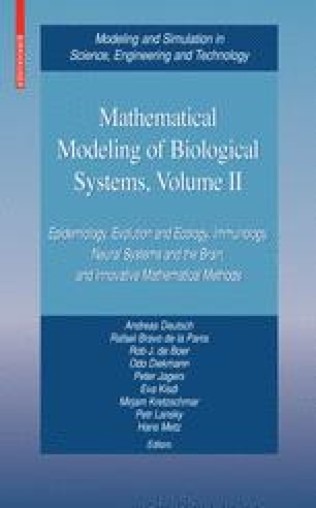
Mathematical Modeling of Biological Systems ; Vol. II : Epidemiology, Evolution and Ecology,Immunology, Neural Systems and the Brain, and Innovative Mathematical Methods
This two-volume, interdisciplinary work is a unified presentation of a broad range of state-of-the-art topics in the rapidly growing field of mathematical modeling in the biological sciences. Highlighted throughout both works are mathematical and computational approaches to examine central problems in the life sciences, ranging from the organizational principles of individual cells to the dynamics of large populations.
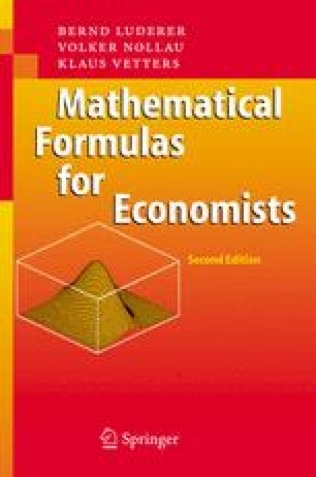
Mathematical Formulas for Economists
This collection of formulas constitutes a compendium of mathematics for eco nomics and business. It contains the most important formulas, statements and algorithms in this significant subfield of modern mathematics and addresses primarily students of economics or business at universities, colleges and trade schools. But people dealing with practical or applied problems will also find this collection to be an efiicient and easy-to-use work of reference. First the book treats mathematical symbols and constants, sets and state ments, number systems and their arithmetic as well as fundamentals of com binatorics. The chapter on sequences and series is followed by mathematics of finance, the representation of functions of one and several independent vari ables, their differential and integral calculus and by differential and difference equations. In each case special emphasis is placed on applications and models in economics. The chapter on linear algebra deals with matrices, vectors, determinants and systems of linear equations. This is followed by the representation of struc tures and algorithms of linear programming. Finally, the reader finds formu las on descriptive statistics (data analysis, ratios, inventory and time series analysis), on probability theory (events, probabilities, random variables and distributions) and on inductive statistics (point and interval estimates, tests). Some important tables complete the work.

Markov Processes, Brownian Motion, and Time Symmetry
The book consists of two parts. Part I,This part introduces strong Markov processes and their potential theory. In particular,it studies Brownian motion, and shows how it generates classical potential theory.Part II, focus on the effects of time reversal, duality, and time-symmetry on potential theory. Certain theorems in Part I are re-proved in Part II under slightly weaker hypotheses. The volume is very useful for people who wish to learn Markov processes but it seems to the reviewer that it is also of great interest to specialists in this area who could derive much stimulus from it. One can be convinced that it will receive wide circulation." (Mathematical Reviews)
Marketing communications in emerging economies ; Vol. II : Conceptual issues and empirical evidence
Aims to share fascinating perspectives on marketing communications by discussing the shift in the power of public relations, and highlighting how the small and local use communication effectively to improve performance and shares useful lessons on how to communicate hope by responding to customer emotions during uncertainties. The book contains valuable lessons and insights on communicating corporate social responsibility, effective social media communication, enacting brand purpose through communication, and using aesthetics in point-of-purchase advertising to drive purchase intention.

Marine resource damage assessment : Liability and compensation for environmental damage
MARE-DASM research focused on: (i) the estimation and distribution of marine contaminants in order to assess their long term effects (ecotoxicology); (ii) the integration of these result into a Biological Effects SubModel and a mathematical model assessing the risks associated with accidental spillage of oil at sea and the damage this can cause (modelling); (iii) the assessment of the willingness to pay for ecological damage, based on the Contingent Valuation Method (economics); (iv) the development and evaluation of measures to be taken in order to guarantee a sustainable use of the Belgian part of the North Sea, taking into account the economic and social interests and values (social economics); (v) the potential to develop technical and legal procedures that allow ecological damage to the marine environment to be evaluated and compensated, taking into account constraints in national and international liability legislation (legal).
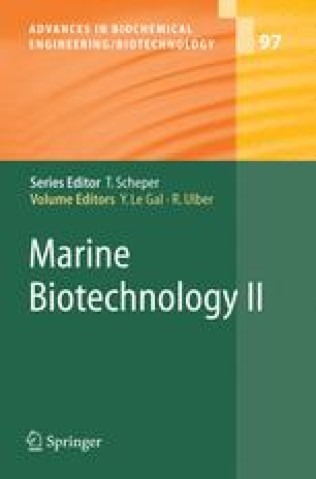
Marine Biotechnology II
This volume of Advances in Biochemical Engineering/Biotechnology illustrates several topics in line with the following broad objectives: thinking of marine biotechnology as the controlled production and use of marine organisms and molecules for useful purposes, firstly by exploring aspects of marine biodiversity and exploitation of biomass, then considering the identification, production and processing of marine products.
Mapping the Galaxy and Nearby Galaxies
This is a proceedings book of the symposium "Mapping the Galaxy and Nearby Galaxies" held on Ishigaki Island, Okinawa, Japan, on June 25 – 30, 2006. The symposium focused on mapping the interstellar media and other components in galaxies.

Magnetism and Structure in Functional Materials
Magnetism and Structure in Functional Materials addresses three distinct but related topics: (i) magnetoelastic materials such as magnetic martensites and magnetic shape memory alloys, (ii) the magnetocaloric effect related to magnetostructural transitions, and (iii) colossal magnetoresistance (CMR) and related magnanites. The goal is to identify common underlying principles in these classes of materials that are relevant for optimizing various functionalities. The emergence of apparently different magnetic/structural phenomena in disparate classes of materials clearly points to a need for common concepts in order to achieve a broader understanding of the interplay between magnetism and structure in this general class of new functional materials exhibiting ever more complex microstructure and function. The topic is interdisciplinary in nature and the contributors correspondingly include physicists, materials scientists and engineers. Likewise the book will appeal to scientists from all these areas.
