


Refine Results
Sort By
From
To

Mathematical Linguistics introduces the mathematical foundations of linguistics to computer scientists, engineers, and mathematicians interested in natural language processing. The book presents linguistics as a cumulative body of knowledge from the ground up, with no prior knowledge of linguistics being assumed, covering more than the average two-semester introductory course in linguistics.This comprehensive, reader-friendly volume offers readers a high-level orientation, discussing the foundations of the field and presenting both the classical work and the most recent results. It covers an extremely rich array of topics including not only syntax and semantics but also phonology and morphology, probabilistic approaches, complexity, learnability, and the analysis of speech and handwriting.
Inaugurates the new FoLLI LNAI subline. It constitutes the refereed proceedings of the 5th International Conference on Logical Aspects of Computational Linguistics, LACL 2005, held in Bordeaux, France in April 2005. The 25 revised full papers presented were carefully reviewed and selected from over 40 submissions. The papers address a wide range of logical and formal methods in computational linguistics with studies of particular grammar formalisms and their computational properties, language engineering, and traditional topics about the syntax/semantics interface.
Linear Genetic Programming examines the evolution of imperative computer programs written as linear sequences of instructions. In contrast to functional expressions or syntax trees used in traditional Genetic Programming (GP), Linear Genetic Programming (LGP) employs a linear program structure as genetic material whose primary characteristics are exploited to achieve acceleration of both execution time and evolutionary progress.
Learn to Tango with D introduces you to the powerful D language, with special attention given to the Tango software library. A concise yet thorough overview of the language's syntax and features is presented, followed by an introduction to Tango, the popular general–purpose library you'll find invaluable when building your D applications.
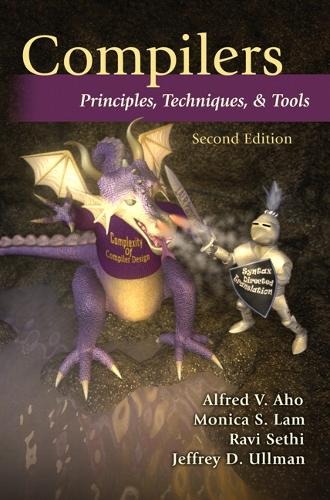
This introduction to compilers is the direct descendant of the well-known book by Aho and Ullman, Principles of Compiler Design. The authors present updated coverage of compilers based on research and techniques that have been developed in the field over the past few years. The book provides a thorough introduction to compiler design and covers topics such as context-free grammars, fine state machines, and syntax-directed translation.
C++/CLI: The Visual C++ Language for .NET introduces Microsoft's extensions to the C++ syntax that allow you to target the common language runtime the key to the heart of the .NET 3.0 platform. In 12 no-fluff chapters, Microsoft insider Gordon Hogenson takes you into the core of the C++/CLI language and explains both how the language elements work and how Microsoft intends them to be used.
Don't waste time on 1,000-page tomes full of syntax; this book is all you need to get ahead in XML development. Renowned web developer Sas Jacobs presents an essential guide to XML. Beginning XML with DOM and Ajax is practical and comprehensive. It includes everything you need to know to get up to speed with XML development quickly and painlessly.
Gain a fundamental understanding of Python's syntax and features with the second edition of Beginning Python, an up–to–date introduction and practical reference. Covering a wide array of Python–related programming topics, including addressing language internals, database integration, network programming, and web services, you'll be guided by sound development principles. Ten accompanying projects will ensure you can get your hands dirty in no time. Updated to reflect the latest in Python programming paradigms and several of the most crucial features found in Python 3.0 (otherwise known as Python 3000), advanced topics, such as extending Python and packaging/distributing Python applications, are also covered
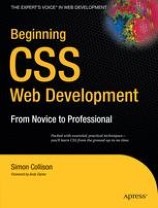
There are many books out there on CSS, but Beginning CSS Web Development is different—it doesn't waste time discussing theory, and it delves straight into the practical matter. It provides you with what you need to know, faster. It is also completely up to date, covering the most modern CSS standards and design techniques. In addition to the essential CSS basics, this book covers advanced techniques like accessibility, hacks, and filters. The book concludes with a case study, and features a CSS reference section that allows you to look up required syntax as quickly as possible.
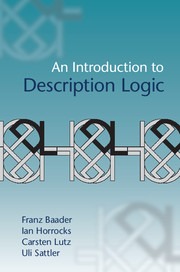
Designed so that domain knowledge can be described and so that computers can reason about this knowledge. DLs have recently gained increased importance since they form the logical basis of widely used ontology languages, in particular the web ontology language OWL. Written by four renowned experts, this is the first textbook on description logics. It is suitable for self-study by graduates and as the basis for a university course. Starting from a basic DL, the book introduces the reader to their syntax, semantics, reasoning problems and model theory and discusses the computational complexity of these reasoning problems and algorithms to solve them.

By introducing mathematical objects, it teaches students how to use a computer to perform numerical and symbolic calculations, define a function and calculate its values, plot and explore graphs, and execute simple algorithms. The course is rich in examples, applications, and models, drawn from economics, physics, biology, statistics, and mathematics itself. The analysis of these models constitutes, in a certain sense, the true purpose of the mathematical theory covered. Automatic calculation tools (mathematics software, spreadsheets) are used extensively to explore and illustrate concepts and properties. Mathcad® software, in particular, was used, both as a calculation tool and as a simple yet powerful programming language. Considerable space is devoted to approximation, emphasizing the distinction between numerical and symbolic calculation; to algorithms as a synthesis of the syntactic and semantic aspects of mathematical objects; and to computer simulation, interpreted as a "physical" experiment and a source of conjecture. The ability to use a calculator marks a sort of "democratization" of mathematics: even complex results, which have always required a broad background of knowledge and laborious calculations, are now quickly accessible to anyone who understands the meaning of mathematical objects and knows how to use the syntax.
This volume contains detailed introductions to human syntactic processing as well as to German syntax which will be helpful especially for readers less familiar with psycholinguistics and with Germanic.
The papers in this volume represent the results of a workshop on the syntax, semantics and acquisition of aspect held in 2002 whose purpose was to foment active cross-disciplinary communication. A number of the papers examine the syntactic representation of lexical or situation aspect, while others focus on the syntactic interaction of lexical aspect with grammatical aspect, and of grammatical aspect and tense. Other papers examine the role of aspect in discourse representations, while a third group of papers reports on results of empirical studies on the acquisition of aspect in both first and second language acquisition, and patterns of loss of morphosyntactic reflexes of aspect in language attrition.
Applied Linguistics and Language Teacher Education is aimed at applied linguists who are interested in understanding more about the learning of novice teachers in their classes. The 21 studies in this volume provide information on the complexity of novice teachers’ learning and use of knowledge in a variety of applied linguistics classes such as SLA, Syntax, Pragmatics, Sociolinguistics, Phonetics and Phonology, L2 Reading and Writing, Testing, and Content Based Instruction. These studies were conducted in a variety of contexts, from North and South America to Europe, Asia and Australia, and look at the preparation of teachers of English, Spanish and Chinese.
This book develops a hybrid architecture that allows to incorporate anaphora resolution into grammatical deduction while avoiding these consequences. To this end, the grammar logic is enriched with a connective that specifically deals with anaphora.After giving a self-contained introduction into Type Logical Grammar in general, the book discusses the formal properties of this connective. In the sequel, Jäger applies this machinery to numerous linguistic phenomena pertaining to the interaction of pronominal anaphora, VP ellipsis and quantification. In the final chapter, the framework is extended to indefiniteness, specificity and sluicing.

Daraa Highway - Ghabagheb - Syria
+963-15 2050 - 15 860 380 /1/2/3 - 11 662 3900