


Refine Results
Sort By
From
To


This book provides a comprehensive, self-contained and up-to-date treatment of the main topics in the theory of option pricing. The first part of the text starts with discrete-time models of financial markets, including the Cox-Ross-Rubinstein binomial model. The passage from discrete- to continuous-time models, done in the Black-Scholes model setting, assumes familiarity with basic ideas and results from stochastic calculus. However, an Appendix containing all the necessary results is included. This model setting is later generalized to cover standard and exotic options involving several assets and/or currencies. An outline of the general theory of arbitrage pricing is presented. The second part of the text is devoted to the term structure modelling and the pricing of interest-rate derivatives. The main emphasis is on models that can be made consistent with market pricing practice.

While the original works on Malliavin calculus aimed to study the smoothness of densities of solutions to stochastic differential equations, this book has another goal. It portrays the most important and innovative applications in stochastic control and finance, such as hedging in complete and incomplete markets, optimisation in the presence of asymmetric information and also pricing and sensitivity analysis. In a self-contained fashion, both the Malliavin calculus with respect to Brownian motion and general Lévy type of noise are treated. Besides, forward integration is included and indeed extended to general Lévy processes. The forward integration is a recent development within anticipative stochastic calculus that, together with the Malliavin calculus, provides new methods for the study of insider trading problems.

Offers an introduction to the mathematical, probabilistic and numerical methods that are the basis of the models for the valuation of derivative instruments, such as options and futures, dealt with in modern financial markets. The book is aimed at readers with scientific training, wishing to develop skills in the field of stochastic calculus applied to finance.

Considering the stupendous gain in importance, in the banking and insurance industries since the early 1990’s, of mathematical methodology, especially probabilistic methodology, it was a very natural idea for the French "Académie des Sciences" to propose a series of public lectures, accessible to an educated audience, to promote a wider understanding for some of the fundamental ideas, techniques and new tools of the financial industries. These lectures were given at the "Académie des Sciences" in Paris by internationally renowned experts in mathematical finance, and later written up for this volume which develops, in simple yet rigorous terms, some challenging topics such as risk measures, the notion of arbitrage, dynamic models involving fundamental stochastic processes like Brownian motion and Lévy processes.

Stochastic calculus and excursion theory are very efficient tools to obtain either exact or asymptotic results about Brownian motion and related processes. The emphasis of this book is on special classes of such Brownian functionals as: - Gaussian subspaces of the Gaussian space of Brownian motion; - Brownian quadratic funtionals; - Brownian local times, - Exponential functionals of Brownian motion with drift; - Winding number of one or several Brownian motions around one or several points or a straight line, or curves; - Time spent by Brownian motion below a multiple of its one-sided supremum.

The main purpose of the book is to give a rigorous, yet mostly nontechnical, introduction to the most important and useful solution methods of various types of stochastic control problems for jump diffusions and its applications.

The main purpose of the book is to give a rigorous, yet mostly nontechnical, introduction to the most important and useful solution methods of various types of stochastic control problems for jump diffusionsThe types of control problems covered include classical stochastic control, optimal stopping, impulse control and singular control. Both the dynamic programming method and the maximum principle method are discussed, as well as the relation between them. Corresponding verification theorems involving the Hamilton-Jacobi Bellman equation and/or (quasi-)variational inequalities are formulated. There are also chapters on the viscosity solution formulation and numerical methods.The text emphasises applications, mostly to finance. All the main results are illustrated by examples and exercises appear at the end of each chapter with complete solutions. This will help the reader understand the theory and see how to apply it.The book assumes some basic knowledge of stochastic analysis, measure theory and partial differential equations.
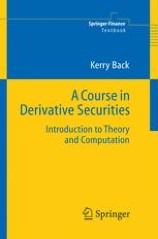
This book aims at a middle ground between the introductory books on derivative securities and those that provide advanced mathematical treatments. It is written for mathematically capable students who have not necessarily had prior exposure to probability theory, stochastic calculus, or computer programming. It provides derivations of pricing and hedging formulas (using the probabilistic change of numeraire technique) for standard options, exchange options, options on forwards and futures, quanto options, exotic options, caps, floors and swaptions, as well as VBA code implementing the formulas. It also contains an introduction to Monte Carlo, binomial models, and finite-difference methods.

The general framework is used to provide an understanding of the nature of stochastic volatility. The book is intended for a wide audience that includes quantitative analysts, postgraduate students and practitioners in finance, economics and insurance. It aims to be a self-contained, accessible but mathematically rigorous introduction to quantitative finance for readers that have a reasonable mathematical or quantitative background. Finally, the book should stimulate interest in the benchmark approach by describing some of its power and wide applicability.

Daraa Highway - Ghabagheb - Syria
+963-15 2050 - 15 860 380 /1/2/3 - 11 662 3900