



Page 72
Page 72
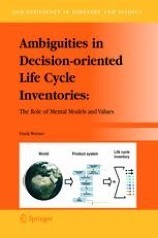
Ambiguities in Decision-oriented Life Cycle Inventories: The Role of Mental Models and Values
Shows for the first time how mental models and values influence this attribution in the life cycle inventory step of LCA. One of the key findings is that the different management rules for a sustainable use of materials must be taken into account for the attribution of material and energy flows to a product. Otherwise, improvement options recommended by an LCA might turn out to even worsen the environmental situation if reassessed from a meta-perspective. As a consequence of this book, the claim of unambiguitiy (‘objectivity’) of the life cycle inventory must be abandoned. A group-model building process for LCA is developed that allows one to grasp the decision makers' mental models and values in the inventory analysis on a case- and situation-specific basis. Only by this, LCA results will become relevant in a decision-making process. Two case studies on the modelling of recycling and other end-of-life options of aluminium windows and beech wood railway sleepers in LCA complement the methodological part.
Alzheimers Disease
Alzheimer’s disease (AD) is a neurodegenerative disease that robs the minds of our elderly population. Approximately one in every eight adults over the age of 65 and nearly half of those over 85 are afflicted with this disease. The aging population in developed societies will impose an ever increasing socioeconomic threat in the future. Current medicines for AD patients are mainly symptomatic treatments and a huge unmet medical need exists to slow the progression of this disease. A great deal of research has been dedicated to understanding the pathogenesis of AD from which comes many ideas for intervening with its progression. Some of these ideas have been fast-tracked to clinical trials due to the availability of medicines with proven clinical efficacies for other diseases (e.g. atorvastatin, simvastatin, rosiglitazone and clioquinol) while others represent novel chemical entities (e.g. glycogen synthase kinase-3 inhibitors).
Alzheimer : 100 Years and Beyond
Few medical or scientific addresses have so unmistakeably made history as the presentation delivered by Alois Alzheimer on November 4th, 1906 in Tübingen. The celebratory event, "Alzheimer 100 Years and Beyond" organized on the initiative of the Alzheimer community in Germany and worldwide, in collaboration with the Fondation Ipsen, at the very site of the original lecture, namely the Institute of Psychiatry at the University of Tübingen in Germany from November 2nd to 5th, 2006, was the highlight of the Alzheimer Year. Over the last century of Alzheimer research (1906-2006), remarkable progress has been achieved. Most of the authors of the major discoveries and the people involved in research in this field will present, during the meeting and in this volume, the pioneering research explaining the conditions under which they were conducted. The goal of this book is to honor the work accomplished, to summarize the most important knowledge and to provide material for the history of science.
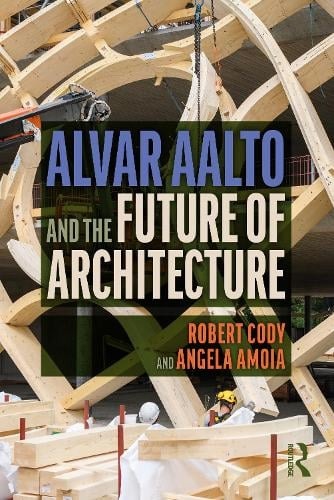
Alvar Aalto and the future of architecture
Exposes dialogue between history, theory, design, construction, technology, and sensory experience by means of digital simulations that enhance the assessment and values of our material choices. It offers a critical look to the past to inspire the future. This new edition looks to Alvar Aalto as the primary protagonist for channeling discussions related to these topics. Architects like ALA, Shigeru Ban, 3XN, Peter Zumthor, and others also play the role of contemporary guides in this review. The work of Aalto and selected contemporary architects, along with computer modeling software, showcase the importance of comprehensive design.
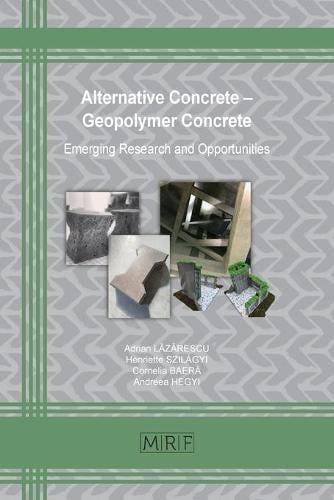
Alternative concrete - geopolymer concrete : Emerging research and opportunities
Focuses on fly ash-based alkali-activated geopolymer concrete, its production and characteristic properties. The re-use of waste materials and industrial by-products, such as fly ash, is not only economically of interest but also helps to reduce carbon dioxide emissions. The carbon footprint of these materials is much lower than that of concrete using ordinary Portland cement. They thus offer new sustainable solutions to the construction industry.
Alpha-1 antitrypsin : Methods and protocols
Provides a collection of protocols that will allow researchers to further explore the multiple, fascinating activities of Alpha-1 Antitrypsin (AAT) isoforms in innate immunity, and gene therapy. Written in the highly successful Methods in Molecular Biology series format, chapters include introductions to their respective topics, lists of the necessary materials and reagents, step-by-step, readily reproducible laboratory protocols, and tips on troubleshooting and avoiding known pitfalls.
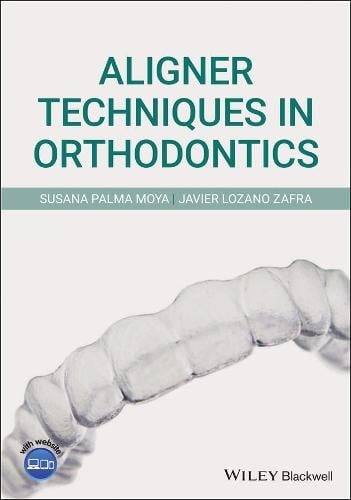
Aligner Techniques in Orthodontics
Filled with the theoretical and practical clinical information on the popular aligner techniques with a focus on Invisalign. Written by practicing orthodontists and noted experts on the topic, the book is designed to help practitioners develop their skills in using aligners in orthodontics. The authors describe in detail the clear and simple methods for treating patients using different aligner techniques, as well as material on treating any given malocclusion.
Aligner systems in invisible orthodontics: basic concepts and clinical management
Describes the processes, techniques and biomechanics involved in providing aligner treatment for different types of malocclusions. It opens with an overview of the material characteristics and the basic concepts of aligner therapy including topics like biocompatibility and intraoral deterioration. The main part of the book is dedicated to the various types of aligners, the methods used in their application and the practical aspects of delivery. It is structured based on the type of malocclusion being managed giving the reader a systematic pattern and a practical way of progressing through the book. The book closes with a discussion of the scientific data available.
Algorithms and Programming : Problems and Solutions
This book containing classical and well-known problems supplemented by clear and in-depth explanations. The material covered includes such topics as combinatorics, sorting, searching, queues, grammar and parsing, selected well-known algorithms and much more.

Algebraic Geometry : An Introduction
The book starts with easily-formulated problems with non-trivial solutions – for example, Bézout’s theorem and the problem of rational curves – and uses these problems to introduce the fundamental tools of modern algebraic geometry: dimension; singularities; sheaves; varieties; and cohomology. The treatment uses as little commutative algebra as possible by quoting without proof (or proving only in special cases) theorems whose proof is not necessary in practice, the priority being to develop an understanding of the phenomena rather than a mastery of the technique. A range of exercises is provided for each topic discussed, and a selection of problems and exam papers are collected in an appendix to provide material for further study.

Algebra ; Vol. I : Fields and Galois Theory
The present textbook is a lively, problem-oriented and carefully written introduction to classical modern algebra. The first volume focuses on field extensions. Galois theory and its applications are treated more thoroughly than in most texts. It also covers basic applications to number theory, ring extensions and algebraic geometry.The main focus of the second volume is on additional structure of fields and related topics. Much material not usually covered in textbooks appears here, including real fields and quadratic forms, diophantine dimensions of a field, the calculus of Witt vectors, the Schur group of a field, and local class field theory.
Algebra : Fields with structure, algebras and advanced topics
The present textbook is a lively, problem-oriented and carefully written introduction to classical modern algebra. The author leads the reader through interesting subject matter, while assuming only the background provided by a first course in linear algebra. The first volume focuses on field extensions. Galois theory and its applications are treated more thoroughly than in most texts. It also covers basic applications to number theory, ring extensions and algebraic geometry. The main focus of the second volume is on additional structure of fields and related topics. Much material not usually covered in textbooks appears here, including real fields and quadratic forms, the Tsen rank of a field, the calculus of Witt vectors, the Schur group of a field, and local class field theory.

Agricultural Implications of the Fukushima Nuclear Accident (III)
Reports on studies undertaken at contaminated sites such as farmland, forests, and marine and freshwater environments, with a particular focus on livestock, wild plants and mushrooms, crops, and marine products in those environments. It also provides additional data collected in the subsequent years to show how the radioactivity levels in agricultural products and their growing environments have changed with time and the route by which radioactive materials entered agricultural products as well as their movement between different components (e.g., soil, water, and trees) within an environmental system (e.g., forests). The book covers various topics, including radioactivity testing of food products; decontamination trials for rice and livestock production; the state of contamination in, trees, mushrooms, and timber; the dynamics of radioactivity distribution in paddy fields and upland forests; damage incurred by the forestry and fishery industries; and the change in consumers’ attitudes. Chapter 19 introduces a real-time radioisotope imaging system, a pioneering technique to visualize the movement of cesium in soil and in plants.
Ageing and the Glass Transition
Understanding cooperative phenomena far from equilibrium is one of fascinating challenges of present-day many-body physics. Glassy behaviour and the physical ageing process of such materials are paradigmatic examples. The present volume, primarily intended as introduction and reference for postgraduate students and nonspecialist researchers from related fields, collects six extensive lectures addressing selected experimental and theoretical issues in the field of glassy systems.
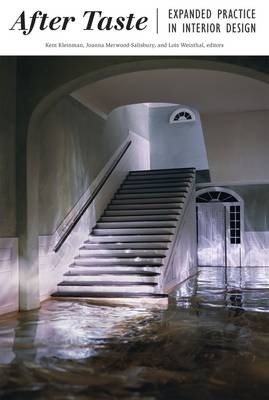
After Taste : Expanded Practice in Interior Design
Comprising texts, interviews and portfolios that collectively document new theories and emerging critical practices in the field of interior design. The material is informed by, but not limited to, the annual AfterTaste symposia hosted by Parsons The New School of Design. The book s central argument is that the field of interior design is inadequately served by its historical reliance on taste-making and taste-makers, and, more recently from a set of theoretical concerns derived from architecture; the volume seeks to set an expanded frame by advancing new voices and perspectives in both the theory and practice of interior design, considered as an independent discipline. In 2007, the Department of Architecture, Interior Design and Lighting at Parsons The New School for Design inaugurated an annual international symposium series dedicated to the critical study of the interior.
Advances on testing and experimentation in civil engineering : Materials, structures and buildings
Presents the most recent advances on testing and experimentation in civil engineering, especially in the branches of materials, structures, and buildings, complementing the authors’ publication Advances on Testing and Experimentation in Civil Engineering - Geotechnics, Transportation, Hydraulics and Natural Resources. It includes advances in physical modelling, monitoring techniques, data acquisition and analysis, and provides an invaluable contribution to the installation of new civil engineering experimental facilities.

Advances in the toxicity of construction and building materials
Presents the potential and toxic effects of building materials on human health, along with tactics on how to minimize exposure. Chapters are divided into four sections covering the toxicity of indoor environments, fire toxicity, radioactive materials, and toxicity from plastics, metals, asbestos, nanoparticles and construction wastes. Key chapters focus on the reduction of chemical emissions in houses with eco-labelled building materials and potential risks posed by indoor pollutants that may include volatile organic compounds (VOC), formaldehyde, semi-volatile organic compounds (SVOC), radon, NOx, asbestos and nanoparticles.
Advances in sustainable materials and technology
Discusses numerous relevant areas and innovative technologies, such as key construction materials and production, materials with lower energy impact, production processes encouraging less use of ever-depleting natural raw materials, minimization of the generation of greenhouse gases, development of new, environmentally friendly materials and agents, characterization of the properties of construction materials, and methodologies applied in the building of structures.

Advances in solid state physics ; Vol. 47
The present volume 47 of the Advances in Solid State Physics contains the written version of a large number of the invited talks of the 2007 Spring Meeting of the Arbeitskreis Festkörperphysik which was held in Regensburg, Germany, from March 26 to 30, 2007 in conjunction with the 71st Annual Meeting of the Deutsche Physikalische Gesellschaft.It gives an overview of the present status of solid state physics where low-dimensional systems such as quantum dots and quantum wires are dominating. The importance of magnetic materials is reflected by the large number of contributions in the part dealing with ferromagnetic films and particles. One of the most exciting achievements of the last couple of years is the successful application of electrical contacts to and the investigation of single layers of graphene.

Advances in solid state physics ; Vol. 46
Many topical talks given at the numerous symposia are included. Most of these were organized collaboratively by several of the divisions of the Arbeitskreis. The topis range from zero-dimensional physics in quantum dots, molecules and nanoparticles over one-dimensional physics in nanowires and 1d systems to more applied subjects like optoelectronics and materials science in thin films.
