



Page 6
Page 6
Liver MRI : Correlation with other Imaging Modalities and Histopathology
In this seminal manuscript the - thor described a new imaging technique which moved the single dimension of NMR spectroscopy to the dual dimension of spatial orientation, thereby resulting in the foundation of modern magnetic re- nance (MR) imaging. Over the ensuing years, MR imaging has assumed an increasingly important role in clinical imaging. It distinguishes itself from other imaging modalities, such as ultrasound (US) or computed tomography (CT), by the unique ability to visualize specific tissue components in a non-- vasive manner. In the earlier days, diagnostic MR imaging was limited to cerebral and musculoskeletal diseases. - aging of other areas which are more prone to movement through breathing (abdominal) or pulsation motions (cardiac) became available more recently, with the introduction of faster sequences and the - velopment of more dedicated MR imaging coils.
Lifetime Spectroscopy : A Method of Defect Characterization in Silicon for Photovoltaic Applications
Lifetime spectroscopy is one of the most sensitive diagnostic tools for the identification and analysis of impurities in semiconductors. Since it is based on the recombination process, it provides insight into precisely those defects that are relevant to semiconductor devices such as solar cells. This book introduces a transparent modeling procedure that allows a detailed theoretical evaluation of the spectroscopic potential of the different lifetime spectroscopic techniques. The various theoretical predictions are verified experimentally with the context of a comprehensive study on different metal impurities. The quality and consistency of the spectroscopic results, as explained here, confirms the excellent performance of lifetime spectroscopy.

Lie Algebras and Applications
This book, designed for advanced graduate students and post-graduate researchers, provides an introduction to Lie algebras and some of their applications to the spectroscopy of molecules, atoms, nuclei and hadrons. In the first part, a concise exposition is given of the basic concepts of Lie algebras, their representations and their invariants. The second part contains a description of how Lie algebras are used in practice in the treatment of bosonic and fermionic systems. Physical applications considered include rotations and vibrations of molecules (vibron model), collective modes in nuclei (interacting boson model), the atomic shell model, the nuclear shell model, and the quark model of hadrons. One of the key concepts in the application of Lie algebraic methods in physics, that of spectrum generating algebras and their associated dynamic symmetries, is also discussed. The book contains many examples that help to elucidate the abstract algebraic definitions. It provides a summary of many formulas of practical interest, such as the eigenvalues of Casimir operators and the dimensions of the representations of all classical Lie algebras.
Lattice Hadron Physics
This series of lectures draws upon the developments made in recent years in implementing chirality on the lattice via the overlap formalism. These developments exploit chiral effective field theory in order to extrapolate lattice results to physical quark masses, new forms of improving operators to remove lattice artefacts, analytical studies of finite volume effects in hadronic observables, and state-of-the-art lattice calculations of excited resonances. This volume is designed to assist those outside the field who want quickly to becoming literate in these topics. So it is intended for graduate students and experienced researchers in other areas of hadronic physics to provide the background through which they can appreciate, if not become active in, contemporary lattice gauge theory and its applications to hadronic phenomena.

L'astrofilo moderno = The modern amateur astronomer
In less than two decades, amateur astronomy has changed its face. The reason, of course, is technological progress. Cheap but high-quality telescopes, computer-controlled "go-to" mounts, autoguiders, CCD cameras, video cameras and (as always) computers and the Internet are just some of the elements that revolutionized 21st century astronomy. Not only have they made amateur astronomy more "friendly" and fun, but they have also greatly expanded the potential of the amateur astronomer. Martin Mobberley first tackles the basic issues and then analyzes in depth what tools are available on the market. From here he starts to review the revolutionary possibilities that open up for amateur astronomers, from imaging, to spectroscopy, to photometry, to the surveillance of Near-Earth objects - comets and asteroids that can come dangerously close to the Earth.
Laser-Tissue Interactions : Fundamentals and Applications
This essential work provides a thorough description of the fundamentals and applications in the field of laser-tissue interactions. Concepts such as the optical and thermal properties of tissue, and optical breakdown and its related effects, are treated in detail.

Lasers in the Conservation of Artworks ; LACONA V Proceedings, Osnabrück, Germany, Sept. 15-18, 2003
Since 1995, when Costas Fotakis first brought together restorers and scientists to discuss the potential of lasers in art conservation, the field has grown enormously in importance, and today restorers and laser scientists work together to develop new applications. This book presents the more than six dozen research papers prepared for LACONA V (Lasers in Art Conservation), held in Osnabrueck/Germany in September 2003. The fifth congress once again gathers restorers, art historians, museum staff, laser scientists and laser manufacturers. The topics include, among others: laser cleaning of artworks (case studies and side effects), removal of former conservation layers, fundamentals of laser-artwork interaction, online monitoring and process control, laser diagnostics, spectroscopy for monitoring and identification, networks and co-operation projects.
Laser Spectroscopy : Vol.2 Experimental Techniques
Keeping abreast of the latest techniques and applications, this new edition of the standard reference and graduate text on laser spectroscopy has been completely revised and expanded. While the general concept is unchanged, the new edition features a broad array of new material, e.g. frequency doubling in external cavities, reliable cw-parametric oscillators, tunable narrow-band UV sources, more sensitive detection techniques, tunable femtosecond and sub-femtosecond lasers (X-ray region and the attosecond range), control of atomic and molecular excitations, frequency combs able to synchronize independent femtosecond lasers, coherent matter waves, and still more applications in chemical analysis, medical diagnostics, and engineering.
Laser Spectroscopy : Vol.1 Basic Principles
Keeping abreast of the latest techniques and applications, this new edition of the standard reference and graduate text on laser spectroscopy has been completely revised and expanded. While the general concept is unchanged, the new edition features a broad array of new material, e.g., frequency doubling in external cavities, reliable cw-parametric oscillators, tunable narrow-band UV sources, more sensitive detection techniques, tunable femtosecond and sub-femtosecond lasers (X-ray region and the attosecond range), control of atomic and molecular excitations, frequency combs able to synchronize independent femtosecond lasers, coherent matter waves, and still more applications in chemical analysis, medical diagnostics, and engineering.

Laser Ablation and its Applications
Laser Ablation and its Applications emphasizes the wide range of these topics rather than focusing on one specialty or discipline. It is intended for a graduate course in laser interactions with plasmas and materials, but it should be accessible to anyone with a graduate degree in physics or engineering.

LASER 2004; Proceedings of the 6th International Workshop on Application of Lasers in Atomic Nuclei Research (LASER 2004) held in Poznan, Poland, 24-27 May, 2004
6th International Workshop on Application of Lasers in Atomic Nuclei Research, LASER 2004, held in Poznan, Poland, 24-27 May, 2004 Researchers and graduate students interested in the Mössbauer Effect and its applications will find this volume indispensable. The volume presents the most recent developments in the methodology of Mössbauer spectroscopy.

LACAME 2004 ; Proceedings of the 9th Latin American Conference on the Applications of the Mössbauer Effect, (LACAME 2004) held in Mexico City, Mexico, 19-24 September 2004
Proceedings of the 9th Latin American Conference on the Applications of the Mössbauer Effect, LACAME 2004, held in Mexico City, Mexico, 19-24 September 2004. Researchers and graduate students interested in the Mössbauer Effect and its applications will find this volume indispensable. The volume presents the most recent developments in the methodology of Mössbauer spectroscopy.
Kramers-Kronig Relations in Optical Materials Research
This is the first one-volume work to provide a thorough and comprehensive description of the physical background, rigorous theory and applications of Kramers-Kronig relations in the fields of linear and nonlinear optical spectroscopy. Currently, Kramers-Kronig relations have become basic tools in the investigation of the optical properties of materials. A brief presentation of the related data-retrieval technique, the maximum entropy method, is also given. The contents and style potentially make this a standard text for physicists, chemists and engineers interested in optical-materials research and development.

IWNMS 2004 ; Proceedings of the International Workshop on Nanomaterials, Magnetic Ions and Magnetic Semiconductors Studied Mostly by Hyperfine Interactions (IWNMS 2004) held in Baroda, India, 10-14 February 2004
Proceedings of the Baroda Workshop IWNMS 2004, held in Baroda, India, 10-14 February, 2004 Researchers and graduate students interested in the Mössbauer Effect and its applications will find this volume indispensable. The volume presents the most recent developments in the methodology of Mössbauer spectroscopy.

Charged Particle Traps : Physics and Techniques of Charged Particle Field Confinement
This book provides an introduction and guide to modern advances in charged particle (and antiparticle) confinement by electromagnetic fields. Confinement in different trap geometries, the influence of trap imperfections, classical and quantum mechanical description of the trapped particle motion, different methods of ion cooling to low temperatures, and non-neutral plasma properties (including Coulomb crystals) are the main subjects. They form the basis of such applications of charged particle traps as high-resolution optical and microwave spectroscopy, mass spectrometry, atomic clocks, and, potentially, quantum computing.
Cardiovascular Magnetic Resonance Imaging
Cardiovascular Magnetic Resonance Imaging (CMR) is a rapidly evolving tool for cardiovascular diagnosis, and is becoming increasingly important in guiding cardiovascular interventions. Cardiovascular Magnetic Resonance Imaging presents a state-of-the-art compilation of expert contributions to the field.

Carbon Nanotubes : From Basic Research to Nanotechnology
A nanotube can bend easily but still is very robust. The nanotubes can be manipulated and contacted to external electrodes. Their diameter is in the nanometer range, whereas their length may exceed several micrometers, if not several millimeters. In diameter, the nanotubes behave like molecules with quantized energy levels, while in length, they behave like a crystal with a continuous distribution of momenta. Depending on its exact atomic structure, a single-wall nanotube –that is to say a nanotube composed of just one rolled-up graphene sheet– may be either a metal or a semiconductor. The nanotubes can carry a large electric current, they are also good thermal conductors.

Carbon Nanotubes : Advanced Topics in the Synthesis, Structure, Properties and Applications
The carbon nanotubes field has evolved substantially since the publication of the bestseller "Carbon Nanotubes: Synthesis, Structure, Properties and Applications". The present volume builds on the generic aspects of the aforementioned book, which emphasizes the fundamentals, with the new volume emphasizing areas that have grown rapidly since the first volume, guiding future directions where research is needed and highlighting applications. The volume also includes an emphasis on areas like graphene, other carbon-like and other tube-like materials because these fields are likely to affect and influence developments in nanotubes in the next 5 years.
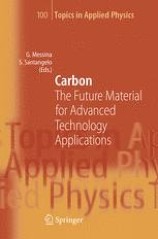
Carbon : The future material for advanced technology applications
Carbon-based materials and their applications constitute a burgeoning topic of scientific research among scientists and engineers attracted from diverse areas such as applied physics, materials science, biology, mechanics, electronics and engineering. Further development of current materials, advances in their applications, and discovery of new forms of carbon are the themes addressed by the frontier research in these fields. This book covers all the fundamental topics concerned with amorphous and crystalline C-based materials, such as diamond, diamond-like carbon, carbon alloys, carbon nanotubes. The goal is, by coherently progressing from growth - and characterisation techniques to technological applications for each class of material, to fashion the first comprehensive state-of-the-art review of this fast evolving field of research in carbon materials.

Breast MRI : Fundamentals and technical aspects
The text walks the reader through the basics of MRI, making it especially accessible to beginners. From a detailed outline of equipment prerequisites for obtaining high quality breast MRI to instructions on how to optimize image quality, expanded discussions on how to obtain optimized dynamic information.
