



Page 6
Page 6

Modern Control Theory
This book presents a unified, systematic description of basic and advanced problems, methods and algorithms of the modern control theory treated as a foundation for the design of computer control and management systems.
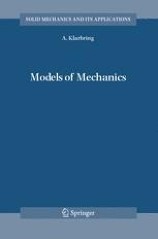
Models of Mechanics
This is a textbook on models and modeling in mechanics. It introduces a new unifying approach to applied mechanics: through the concept of the open scheme, a step-by-step approach to modeling evolves. The unifying approach enables a very large scope on relatively few pages: the book treats theories of mass points and rigid bodies, continuum models of solids and fluids, as well as traditional engineering mechanics of beams, cables, pipe flow and wave propagation.

Models and methods for management science
Introduces systems science as an entry point to present a basic introduction to research models and methods in management science (operation research). This textbook selects the classic quantitative models and methods as well as rich cases and detailed examples, which are suitable for students with a certain management and economics knowledge for further study, and helps to develop the abilities of using the basic models in real life

Models and Algorithms for Global Optimization : Essays Dedicated to Antanas Žilinskas on the Occasion of His 60th Birthday
The research of Antanas Žilinskas has focused on developing models for global optimization, implementing and investigating the corresponding algorithms, and applying those algorithms to practical problems. This volume, dedicated to Professor Žilinskas on the occasion of his 60th birthday, contains new survey papers in which leading researchers from the field present various models and algorithms for solving global optimization problems.

Modelling, Computation and Optimization in Information Systems and Management Sciences ; 2nd International Conference MCO 2008, Metz, France - Luxembourg, September 8-10, 2008. Proceedings
This book constitutes the refereed proceedings of the Second International Conference MCO 2008, Metz, France, September 2008.The 65 revised full papers presented were carefully reviewed and selected from 160 submissions. The papers are organized in topical sections on optimization and decision making; data mining theory, systems and applications; computer vision and image processing; computer communications and networks; optimization and search techniques for security, reliability, trust.

Modelling, Analysis and Optimization of Biosystems
Mathematical models in biology and medicine cannot be based on natural laws as it is the case with physics and chemistry. This is due to the fact that biological and medical processes are concerned with living organisms. Mathematical models, however, can be used as a language by which certain aspects of biological or medical processes can be expressed. In general, several mathematical models can be designed in order to describe a biological or medical process and there is no unique criterion which model gives the best description. This book presents several of these models and shows applications of them to different biological and medical problems. The book shows that operations research expertise is necessary in respect to modeling, analysis and optimization of biosystems.

Modelling in Mathematical Programming : Methodology and Techniques
This book provides basic tools for learning how to model in mathematical programming, from models without much complexity to complex system models. It presents a unique methodology for the building of an integral mathematical model, as well as new techniques that help build under own criteria. It allows readers to structure models from the elements and variables to the constraints, a basic modelling guide for any system with a new scheme of variables, a classification of constraints and also a set of rules to model specifications stated as logical propositions, helping to better understand models already existing in the literature. It also presents the modelling of all possible objectives that may arise in optimization problems regarding the variables values. The book is structured to guide the reader in an orderly manner, learning of the components that the methodology establishes in an optimization problem. The system includes the elements, which are all the actors that participate in the system, decision activities that occur in the system, calculations based on the decision activities, specifications such as regulations, impositions or actions of defined value and objective criterion, which guides the resolution of the system.

Modelling community structure in freshwater ecosystems
"The book presents approaches and methodologies for predicting the structure and diversity of key aquatic communities (namely diatoms, benthic macroinvertebrates and fish), under natural conditions and under man-made disturbance. Such an approach will make it possible to: 1) set up procedures for robust and sensitive ecosystem evaluation, based on the prediction of the excepted community structure; 2) model community structure in disturbed ecosystems, taking into account all the relevant ecological variables; 3) test ecosystem sensitivity to natural and anthropic disturbance; and 4) explore specific actions to be taken for the restoration of ecosystem integrity."--Jacket.

Modelling and Simulation : Exploring Dynamic System Behaviour
Modelling and Simulation: Exploring Dynamic System Behaviour provides the reader with a balanced and integrated presentation of the modelling and simulation activity for both Discrete Event Dynamic Systems (DEDS) and Continuous Time Dynamic Systems (CTDS). This book presents the fundamentals necessary to understand the many important facets of the modeling and simulation methodology.

Modelling and Optimization of Biotechnological Processes : Artificial Intelligence Approaches
The book begins with a historical introduction to the field of bioprocess control based on artificial intelligence approaches, followed by two chapters covering the optimization of fed-batch culture using genetic algorithms. Online biomass soft-sensors are constructed in Chapter 4 using recurrent neural networks. The bioprocess is then modelled in Chapter 5 by cascading two soft-sensor neural networks. Optimization and validation of the final product are detailed in Chapters 6 and 7. The general conclusions are drawn in Chapter 8.

Modeling, Simulation and Optimization of Complex Processes HPSC 2018 ; Proceedings of the 7th International Conference on High Performance Scientific Computing, Hanoi, Vietnam, March 19-23, 2018
The contributions cover a broad, interdisciplinary spectrum of scientific computing and showcase recent advances in theory, methods, and practical applications. Subjects covered include numerical simulation, methods for optimization and control, machine learning, parallel computing and software development, as well as the applications of scientific computing in mechanical engineering, airspace engineering, environmental physics, decision making, hydrogeology, material science and electric circuits.

Modeling, Simulation and Optimization of Complex Processes ; Proceedings of the Third International Conference on High Performance Scientific Computing, March 6–10, 2006, Hanoi, Vietnam
This proceedings volume contains a selection of papers presented at the Third International Conference on High Performance Scientific Computing held at the Hanoi Institute of Mathematics, Vietnamese Academy of Science and Technology (VAST), March 6-10, 2006. The conference has been organized by the Hanoi Institute of Mathematics, Interdisciplinary Center for Scientific Computing (IWR), Heidelberg, and its International PhD Program ``Complex Processes: Modeling, Simulation and Optimization'', and Ho Chi Minh City University of Technology. The contributions cover the broad interdisciplinary spectrum of scientific computing and present recent advances in theory, development of methods, and applications in practice. Subjects covered are mathematical modelling, numerical simulation, methods for optimization and control, parallel computing, software development, applications of scientific computing in physics, chemistry, biology and mechanics, environmental and hydrology problems, transport, logistics and site location, communication networks, production scheduling, industrial and commercial problems.

Modeling, Simulation and Optimization of Complex Processes ; Proceedings of the International Conference on High Performance Scientific Computing, March 10-14, 2003, Hanoi, Vietnam
This proceedings volume contains a selection of papers presented at the symposium "International Conference on High Performance Scientific Computing'' held at the Hanoi Institute of Mathematics of the Vietnam National Center for Natural Science and Technology (NCST). The contributions cover the broad interdisciplinary spectrum of scientific computing and present recent advances in theory, development of methods, and applications in practice. Subjects covered are mathematical modelling, numerical simulation, methods for optimization and optimal control, parallel computing, symbolic computing, software development, applications of scientific computing in physics, chemistry, biology and mechanics, environmental and hydrology problems, transport, logistics and site location, communication networks, production scheduling, industrial and commercial problems.

Modeling, Estimation and Control : Festschrift in Honor of Giorgio Picci on the Occasion of his Sixty-Fifth Birthday
Coefficients of Variations in Analysis of Macro-Policy Effects: An example of two-parameter Poisson-Dirichlet distributions.- How Many Experiments Are Needed to Adapt?- A Mutual Information Based Distance for Multivariate Gaussian Processes.- Differential Forms and Dynamical Systems.- An Algebraic Framework for Bayes Nets of Time Series.- A Birds Eye View on System Identification.- Further Results on the Byrnes-Georgiou-Lindquist Generalized Moment Problem.- Factor Analysis and Alternating Minimization.- Tensored PolynomialModels.- Distances Between Time-Series and Their Autocorrelation Statistics.- Global Identifiability of Complex Models, Constructed from Simple Submodels.- Identification of Hidden MarkovModels - Uniform LLN-s.- Identifiability and Informative Experiments in Open and Closed-Loop Identification.- On Interpolation and the Kimura-Georgiou Parametrization.- The Control of Error in Numerical Methods.- Contour Reconstruction and Matching Using Recursive Smoothing Splines.- Role of LQ Decomposition in Subspace Identification Methods.- Canonical Operators on Graphs.

Modeling Uncertainty : An Examination of Stochastic Theory, Methods, and Applications
Modeling Uncertainty: An Examination of Stochastic Theory, Methods, and Applications, is a volume undertaken by the friends and colleagues of Sid Yakowitz in his honor. Fifty internationally known scholars have collectively contributed 30 papers on modeling uncertainty to this volume. Each of these papers was carefully reviewed and in the majority of cases the original submission was revised before being accepted for publication in the book. The papers cover a great variety of topics in probability, statistics, economics, stochastic optimization, control theory, regression analysis, simulation, stochastic programming, Markov decision process, application in the HIV context, and others. There are papers with a theoretical emphasis and others that focus on applications. A number of papers survey the work in a particular area and in a few papers the authors present their personal view of a topic. It is a book with a considerable number of expository articles, which are accessible to a nonexpert - a graduate student in mathematics, statistics, engineering, and economics departments, or just anyone with some mathematical background who is interested in a preliminary exposition of a particular topic. Many of the papers present the state of the art of a specific area or represent original contributions which advance the present state of knowledge. In sum.

Modeling Performance Measurement : Applications and Implementation Issues in DEA
MODELING PERFORMANCE MEASUREMENT: Applications and Implementation Issues in DEA presents unified results from authors’ recent DEA research. These new DEA methodology and techniques are developed in application-driven scenarios that go beyond the identification of the best-practice frontier and seek solutions to aid managerial decisions. These new DEA developments are well-grounded in real world applications. Both DEA researchers and practitioners will find this book helpful. Theory is provided for DEA researchers for further development and possible extensions. However, it should also be mentioned that each theory is presented in practical terms with numerical examples, simple real management cases and verbal descriptions. It is felt that these concrete examples will be of value to researchers, students, and practitioners , This book also provides an easy-to-use DEA software — DEAFrontier (www.deafrontier.com). This DEA software is an Add-In for Microsoft Excel and provides a custom menu of DEA approaches The DEAFrontier does not set limit on the number of units, inputs or outputs.

Modeling of metal forming and machining processes : By finite element and soft computing methods
The physics of metal forming and metal removing is normally expressed using non-linear partial differential equations which can be solved using the finite element method (FEM). However, when the process parameters are uncertain and/or the physics of the process is not well understood, soft computing techniques can be used with FEM or alone to model the process.

Modeling Decisions for Artificial Intelligence ; 5th International Conference, MDAI 2008 Sabadell, Spain, October 30-31, 2008. Proceedings
This book constitutes the refereed proceedings of the 5th International Conference on Modeling Decisions for Artificial Intelligence, MDAI 2008, held in Sabadell, Spain, in October 2008.The 19 revised full papers presented together with 2 invited lectures were thoroughly reviewed and selected from 43 submissions; they are devoted to theory and tools for modeling decisions, as well as applications that encompass decision making processes and information fusion techniques. The papers are organized in topical sections on aggregation operators, decision making, clustering and similarity, computational intelligence and optimization, as well as data privacy.

Modeling Decisions for Artificial Intelligence ; 4th International Conference, MDAI 2007, Kitakyushu, Japan, August 16-18, 2007, Proceedings
Decision modeling is a key area in the developing field of AI, and this timely work connects researchers and professionals with the very latest research. It constitutes the refereed proceedings of the 4th International Conference on Modeling Decisions for Artificial Intelligence, held in Kitakyushu, Japan, in August 2007.

Modeling and Simulation in Scilab
Scilab is a free open-source software package for scientific computation. It includes hundreds of general purpose and specialized functions for numerical computation, organized in libraries called toolboxes, which cover such areas as simulation, optimization, systems and control, and signal processing. One important Scilab toolbox is Scicos. Scicos provides a block diagram graphical editor for the construction and simulation of dynamical systems. The objective of this book is to provide a tutorial for the use of Scilab/Scicos with a special emphasis on modeling and simulation tools. The book is divided into two parts. The first part concerns Scilab and includes a tutorial covering the language features, the data structures and specialized functions for doing graphics, importing, exporting data and interfacing external routines. It also covers in detail Scilab numerical solvers for ordinary differential equations and differential-algebraic equations. Even though the emphasis is placed on modeling and simulation applications, this part provides a global view of Scilab. The second part is dedicated to modeling and simulation of dynamical systems in Scicos. This type of modeling tool is widely used in industry because it provides a means for constructing modular and reusable models. This part contains a detailed description of the editor and its usage, which is illustrated through numerous examples.
