



Page 202
Page 202
Agent-oriented information systems IV ; 8th International bi-conference workshop, AOIS 2006, Hakodate, Japan, May 9, 2006 and Luxembourg, Luxembourg, June 6, 2006, Revised Selected Papers
In AOIS, we focus on the application of agent technology in information systems development and explore the potential for facilitating the increased usage of agent technology in the creation of information systems in the widest sense.
Agent-oriented information systems III ; 7th International bi-conference workshop, AOIS 2005, Utrecht, The Netherlands, July 26, 2005, and Klagenfurt, Austria, October 27, 2005, Revised Selected Papers
In 2005, two AOIS workshops were held internationally. The first was affiliated with the AAMAS 2005 meeting in July in Utrecht in The Netherlands and chaired by Henderson-Sellers and Winikoff and the second with ER 2005 in November in Klagenfurt in Austria and chaired by Kolp and Bresciani. The best papers from these meetings were identified and authors invited to revise and possibly extend their papers in the light of reviewers’ comments and feedback at the workshop. We have grouped these papers loosely under four headings: Agent behavior, communications and reasoning; Methodologies and ontologies; Agent-oriented software engineering; and Applications.
Agent-based Supply Network Event Management
Supply Chain Event Management (SCEM)" is one of the major topics in application-oriented Supply Chain Management. However, many solutions lack conceptual precision and currently available client-server SCEM-systems are ill-suited for complex supply networks in today's business environment,In this book a thorough analysis of the event management problem domain is the starting point to develop a generic agent-based approach to Supply Network Event Management. The concept is illustrated with prototypical implementations and assessed in a multi-dimensional evaluation of potential benefits. The main focus lies on practical issues of event management (e.g. semantic interoperability) and economic benefits to be achieved with agent technology in this state-of-the-art problem domain.
Agent-Based Simulation : From Modeling Methodologies to Real-World Applications; Post Proceedings of the Third International Workshop on Agent-Based Approaches in Economic and Social Complex Systems 2004
Agent-based modeling/simulation is an emerging field that uses bottom-up and experimental analysis in the social sciences. Selected research from that presented at the Third International Workshop on Agent-Based Approaches in Economic and Social Complex Systems 2004, held in May 2004 in Kyoto, Japan, is included in this book. The aim of the workshop was to employ the bottom-up approach to social and economic problems by modeling, simulation, and analysis using a software agent. This research area is an emerging interdisciplinary field among the social sciences and computer science, attracting broad attention because it introduces a simulation-based experimental approach to problems that are becoming increasingly complex in an era of globalization and innovation in information technology. The state-of-the-art research and findings presented in this book will be indispensable tools for anyone involved in this rapidly growing discipline.
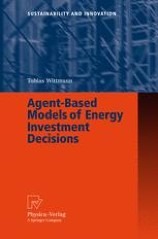
Agent-Based Models of Energy Investment Decisions
This book demonstrates how bounded rational decision models can be standardized and parameterized by socio-economic data. Focusing on private energy technology investment decisions, the author shows how different representative agents can be constructed using search rules, analysis tools and decision strategies. Diffusion curves for energy technologies such as solar collectors, boilers and efficiency upgrades for buildings are calculated. Further, the model is extended to study the impact of firms’ competition on technology diffusion. The modeling approach presented in this book may serve as a template for applications in other domain.
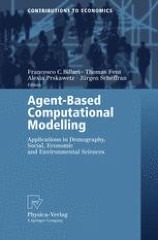
Agent-based computational modelling : Applications in demography, social, economic and environmental sciences
The present book describes the methodology to set up agent-based models and to study emerging patterns in complex adaptive systems resulting from multi-agent interaction. It offers the application of agent-based models in demography, social and economic sciences and environmental sciences. It presents and combines different approaches how to implement agent-based computational models and tools in an integrative manner that can be extended to other cases.
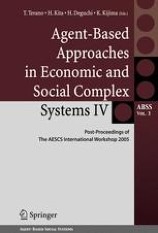
Agent-Based Approaches in Economic and Social Complex Systems IV ; Post Proceedings of The AESCS International Workshop 2005
Agent-Based Modeling/Simulation (ABM/ABS) is an emerging field that enables bottom-up and experimental analysis in social sciences such as economics, management, sociology and politics. The chapters of this book are the selected papers from those presented the Third International Workshop on Agent-Based Approaches in Economic and Social Complex Systems held in Tokyo, Japan in 2005. Articles in this book covers methodological issues, computational model/software, combination with gaming simulation, and real-world applications to economic, management/organizational and social issues.
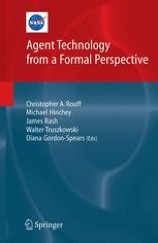
Agent Technology from a Formal Perspective
The field of agent & multi-agent systems is experiencing tremendous growth. At the same time the field of formal methods is blossoming and has proven its importance in industrial and government applications. The FAABS (Formal Approaches to Agent-Based Systems) workshops, merging the concerns of the two fields, provided a timely and compelling platform on which the growing concerns and requirement of agent-based systems users that systems should be accompanied by behavioral assurances, could be discussed. This book has arisen from the overwhelming response to FAABS ’00, ’02 & ’04 and all chapters are updated or represent new research, and are designed to provide a more in-depth treatment of the topic. Examples of how others have applied formal methods to agent-based systems are included, plus formal method tools & techniques that readers can apply to their own systems.
Agent Intelligence Through Data Mining
AGENT INTELLIGENCE THROUGH DATA MINING offers a self-contained overview of a relatively young but important area of research: the intersection of agent technology and data mining. This intersection leads to considerable advancements in the area of information technologies, drawing the increasing attention of both research and industrial communities. It can take two forms: a) the more mundane use of intelligent agents for improved data mining and; b) the use of data mining for smarter, more efficient agents. The second approach is the main focus of this volume. this book presents a methodology for developing multi-agent systems, describes available open-source tools to support this process, and demonstrates the application of the methodology on three different cases. AGENT INTELLIGENCE THROUGH DATA MINING is designed for a professional audience composed of researchers and practitioners in industry.
Agent Computing and Multi-Agent Systems ; 9th Pacific Rim International Workshop on Multi-Agents, PRIMA 2006, Guilin, China, August 7-8, 2006, Proceedings
PRIMA is a series of workshops on agent computing and multi-agent systems, integrating the activities in Asia and Pacific Rim countries. Agent computing and multi-agent systems are computational systems in which several autonomous or se- autonomous agents interact with each other or work together to perform some set of tasks or satisfy some set of goals. These systems may involve computational agents that are homogeneous or heterogeneous, they may involve activities on the part of agents having common or distinct goals, and they may involve participation on the part of humans and intelligent agents. The aim of PRIMA 2006 was to bring together Asian and Pacific Rim researchers and developers from academia and industry to report on the latest technical advances or domain applications and to discuss and explore scientific and practical problems as raised by the participants. PRIMA 2006 received 203 submitted papers.

Agent and Multi-Agent Systems : Technologies and Applications ; 2nd KES International Symposium, KES-AMSTA 2008, Incheon, Korea, March 26-28, 2008. Proceedings
The KES-AMSTA Symposium Series is a sub-series of the KES Conference Series. The aim of the symposium was to provide an international forum for scientific research into the technologies and applications of agent and multi-agent systems.

Agent and multi-agent systems : Technologies and applications ; 1st KES International Symposium, KES-AMSTA 2007, Wroclaw, Poland, May 31-June 1, 2007, Proceedings
The aim of the symposium was to provide an international forum for scientific - search in the technologies and applications of agent and multi-agent systems. Agents and multi-agent systems are related to the modern software which has long been r- ognized as a promising technology for constructing autonomous, complex and intel- gent systems. A key development in the field of agent and multi-agent systems has been the specification of agent communication languages and formalization of - tologies. Agent communication languages are intended to provide standard decla- tive mechanisms for agents to communicate knowledge and make requests of each other, whereas ontologies are intended for conceptualization of the knowledge - main.

African Biodiversity : molecules, organisms, ecosystems
BIOTA is an interdisciplinary research project focusing on sustainable use and conservation of biodiversity in Africa (http://www.biote-africa.de). Session titles were Biogeography and Speciation Processes, Phylogenetic Patterns and Systematics, Diversity Declines and Conservation, and Applied Biodiversity Informatics
Affine Density in Wavelet Analysis
Provides the first thorough and comprehensive treatment of irregular wavelet frames by introducing and employing a new notion of affine density as a highly effective tool for examining the geometry of sequences of time-scale indices.

Affective computing and intelligent interaction ; 2nd International Conference, ACII 2007, Lisbon, Portugal, September 12-14, 2007, Proceedings
Organized in topical sections on affective facial expression and recognition, affective body expression and recognition, affective speech processing, affective text and dialogue processing, recognising affect using physiological measures, computational models of emotion and theoretical foundations, affective databases, annotations, tools and languages, affective sound and music processing, affective interactions: systems and applications, as well as evaluating affective systems.
Affect and Emotion in Human-Computer Interaction : From Theory to Applications
The present book provides an account of the latest work on a variety of aspects related to affect and emotion in human-technology interaction. It covers theoretical issues, user experience and design aspects as well as sensing issues, and reports on a number of affective applications that have been developed in recent years.
Aesthetic Intelligence : How to boost it and use it in business and beyond
Aesthetic Intelligence can be learned. Indeed, people are born with far more capacity than they use, but even those that are naturally gifted must continue to refine their skills, lest their aesthetic advantage atrophy. Through a combination of storytelling and practical advice, the author shows how aesthetic intelligence creates business value and how executives, entrepreneurs and others can boost their own AI and successfully apply it to business. Brown offers research, strategies and practical exercises focused on four essential AI skills.
Aerosol Optics : Light Absorption and Scattering by Particles in the Atmosphere
Provides a comprehensive review of available techniques for the remote sensing of aerosols. Although mostly satellite remote sensing is considered, ground-based techniques are also discussed.describes techniques for the determination of the column concentration of aerosol particles and their optical sizing using spaceborne optical instrumentation. The majority of the techniques described in this book use a so-called "library method". This method relies upon the precalculated top-of-atmosphere reflectances (TOAR) for vaious atmospheric aerosol types. The comparison of measured and calculated TOARS allows one to characterize the optically-equivalent aerosol state.
Advertising in contemporary consumer culture
This is the first scholarly book dedicated to reading the work of contemporary filmmakers and their impact on modern marketing and advertising. Drawing from consumer culture theory, film and media studies, the author presents an expansive analysis of a range of renowned filmmakers who have successfully applied their aesthetic and narrative vision to commercial advertising. It challenges some traditional advertising tropes and sheds light on the changing nature of advertising in the contemporary media context. Utilising Deleuze and Guattari’s notion of assemblage, This book addresses themes of spatiality and time, narrative and aesthetics and consumer reception within a new frame of reference that re-contextualises classical concepts of genre, platform and aesthetic categories. These diverse elements are embedded into a larger discussion of the resonance of contemporary advertising for consumer culture and the implications of the hybridity characteristic of convergent media platforms for understanding the potential of advertising in the twenty-first century.

Advertising culture and translation : From colonial to global
A first comprehensive study combining and integrating advertising, culture and translation within the framework of colonial, Commonwealth, and postcolonial studies, and globalization. It addresses a number of controversial issues evident in two relatively young disciplines, as a result of decades of research and teaching in university courses. A cross-cultural approach to translational issues and the translatability of advertising cohesively is adopted here, exploring the dynamics of the conflict between the 'centre' and the 'periphery'. It introduces the concept of advertising English as lingua franca (AELF), marking new trends in the domain of varieties of English around the world (VEAW). The data examined here show the ambivalent polarity conditioning advertising and translation: both have been mutually exclusive, and both have been subject to bans, censorship and ideological control, racism, propaganda, and stereotyping. In their fundamental principles and concepts of theories and applications, however, neither discipline cannot exist outside a free market and total freedom of expression and trust
