



Page 2
Page 2

Form-oriented analysis : A new methodology to model form-based applications
Form-based applications range from simple web shops to complex enterprise resource planning systems. Draheim and Weber adapt well-established basic modeling techniques in a novel way to achieve a modeling framework optimized for this broad application domain. They introduce new modeling artifacts, such as page diagrams and form storyboards, and separate dialogue patterns to allow for reuse. In their implementation they have developed new constructs such as typed server pages, and tools for forward and reverse engineering of presentation layers. The methodology is explained using an online bookshop as a running example in which the user can experience the modeling concepts in action. The combination of theoretical achievements and hands-on practical advice and tools makes this book a reference work for both researchers in the areas of software architectures and submit-response style user interfaces, and professionals designing and developing such applications. More information and additional material is also available online.

Financial crisis management and democracy : Lessons from Europe and Latin America
This book discusses financial crisis management and policy in Europe and Latin America, with a special focus on equity and democracy. Based on a three-year research project by the Jean Monnet Network, this volume takes an interdisciplinary, comparative approach, analyzing both the role and impact of the EU and regional organizations in Latin America on crisis management as well as the consequences of crisis on the process of European integration and on Latin America’s regionalism.

Explorations of the Life-World : Continuing Dialogues with Alfred Schutz
This anthology originated from three conferences, which were held at Waseda University, Tokyo, Japan, on March 26-28, 1999, at the Univ- sity of Konstanz, Germany, on May 26-29, 1999 and a session at the SPHS annual meeting at the University of Oregon, USA, on October 5-7, 1999. With one exception the contributions to this volume are revised versions of papers read at these meetings. Each of these conferences took place in order to celebrate the centennial of the birthday of Alfred Schutz, who was born April 13, 1899, and died May 20, 1959. First of all we would like to thank Evelyn Schutz-Lang, the daughter of Alfred and Ilse Schutz, for her continuing support and encouragement.

Evaluation of Text and Speech Systems
Provides an overview of the state-of-the-art and best practice in several sub-fields of evaluation of text and speech systems and components. The evaluation aspects covered include speech and speaker recognition, speech synthesis, animated talking agents, part-of-speech tagging, parsing, and natural language software like machine translation, information retrieval, question answering, spoken dialogue systems, data resources, and annotation schemes. With its broad coverage and original contributions this book is unique in the field of evaluation of speech and language technology.

Ethical Dimensions of the Economy : Making Use of Hegel and the Concepts of Public and Merit Goods
This book reflects philosophically about the socio-political dimension of economics. Part I provides normative reflections on the economy: Section I reflects on the interconnections between the multiple discourses on the economy, section II presents Hegel's claim that the economic order is an ethical institution and defends his ontological view of the economy against the one of Adam Smith. Section III dialogues with economists about their concepts of public and merit goods. This section defends a Hegelian ontology of the economy through an analysis of technical concepts used by economists. Part II provides applications derived from the normative analysis: Section I presents the views of authors in different academic disciplines pointing to failures in late capitalism, in particular failures of American capitalism and section II asks the question: " What must one pay attention to in a transition from a command economy to a free market?" Section III draws attention to an overlap of ideas found in Catholic Social Thought and in the publications of some recent Nobel prize winners in economics (Buchanan, Sen, Stiglitz).

Education Outreach and Public Engagement
The programs, tools, and resources featured in this monograph will assist scientists and scientists-in-training in enhancing public awareness and understanding of science and considering its applications and implications. In addition, this monograph addresses the notion that public engagement goes beyond enhancing the layperson’s comprehension of science to engaging the public in real and meaningful dialogue about science.

Educating in the Arts : The Asian Experience: Twenty-Four Essays
Written by leaders in a wide range of creative fields and from all corners of the Asian region, this collection of essays presents arts and education programs which reflect traditional and contemporary practices. The volume brings together researchers, practitioners, educators, children and young people with shared interests in the arts and activities that cross disciplinary divisions and aims to encourage the use of the arts in developing international understanding, celebrating cultural diversity, building cultural bridges and creating cross-cultural dialogue throughout the Asian region.

Discovery Science ; Vol. 4265 ; 9th International Conference, DS 2006, Barcelona, Spain, October 7-10, 2006, Proceedings
This LNAI volume, containing the proceedings of the 9th International C- ference onDiscoveryScience, is structured in three parts. The ?rstpart contains the papers/abstracts of the invited talks, the second part contains the accepted long papers, and the third part the accepted regular (short) papers. Out of 87 submitted papers, 23 were accepted for publication as long papers, and 18 as regular papers. All the submitted papers were reviewed by two or three ref- ees. In addition to the presentations of accepted papers, the DS 2006 conference program consisted of three invited talks, two tutorials, the collocated ALT 2006 conference and the Pascal Dialogues workshop.

Dialogue for Intercultural Understanding : Placing Cultural Literacy at the Heart of Learning
This book is a result of an extensive, ambitious and wide-ranging pan-European project focusing on the development of children and young people’s cultural literacy and what it means to be European in the 21st century prioritising intercultural dialogue and mutual understanding.

Dialogue as a Means of Collective Communication
In the book, readers are introduced to five sections: Section I examines the historical and cultural perspectives of conversation. This examination helps to create a foundation for a deeper study of the emergent and salient aspects of conversation as it relates to cultural creativity and human systems design. Sections II offers the reader an examination of dialogue through different philosophical and theoretical perspectives as well as methodological ideas related to conversation. Section III explores different modalities of conversation and the application of design conversation within and across various types of design settings and human experiences. Section IV examines the field of practice as related to use of different forms of conversation.

Dialogue as a Collective Means of Design Conversation
Dialogue as a Collective Means of Design Conversation is the second volume edited by Patrick M. Jenlink and Bela H. Banathy to offer a cross-disciplinary approach to examining dialogue as a communicative medium. In this Compendium, the contributing authors set forth their ideas, experiences, and perspectives as the path of a learning journey—a journey of new meaning, of new understanding, and of becoming self-aware of design conversation as future creating and consciousness evolving. In particular, this volume comes at a time when we as a global society are faced with the question of how we shape our actions and in turn shape our future, through conversation that is focused on resolving global conflict and fostering world peace. The volume evokes in the reader a realization that our greatest potential rests, in no small measure, with our collective capacity for cultural creativity and in our capacity to achieve new levels of consciousness through dialogue and design conversation.

Dialogic Education and Technology : Expanding the Space of Learning
Dialogic Education and Technology is about using new technology to draw people into the kind of dialogues which take them beyond themselves into learning, thinking and creativity. The program of research reported in this book reveals key characteristics of learning dialogues and demonstrates ways in which computers and networks can deepen, enrich and expand such dialogues. A dialogic perspective is developed drawing upon recent work in communications theory, psychology, computer science and philosophy. The central argument of the book is that there is a convergence between this dialogic perspective in education and the affordances of new information and communications technology. A genuinely dialogic perspective is relatively new to the field of educational technology and there is a considerable amount of interest in this topic amongst researchers who wish to see what extra insights, if any, a dialogical approach can offer them.

Designing urban agriculture : A complete guide to the planning, design, construction, maintenance and management of edible landscapes
About the intersection of ecology, design, and community. Showcasing projects and designers from around the world who are forging new paths to the sustainable city through urban agriculture landscapes, it creates a dialogue on the ways to invite food back into the city and pave a path to healthier communities and environments.This full-color guide begins with a foundation of ecological principles and the idea that the food shed is part of a city's urban systems network. It outlines a design process based on systems thinking and developed for a lifecycle or regenerative-based approach. It also presents strategies, tools, and guidelines that enable informed decisions on planning, designing, budgeting, constructing, maintaining, marketing, and increasing the sustainability of this re-invented cityscape.

Designing human interface in speech technology
Designing Human Interface in Speech Technology bridges a gap between the needs of the technical engineer and cognitive researchers working in the multidisciplinary area of speech technology applications. The approach is systematic and the focus is on the utility of developing and designing speech related products. Included is coverage of topics such as neuroscience on the multimodal cortex, cognitive theories on multi-task performance, stress and workload, as well as human information process theory and ecological interface design theory for evaluating speech-related human-system interfaces.

Desertification in the Mediterranean Region : A security issue ; Proceedings of the NATO Mediterranean Dialogue Workshop, held in Valencia, Spain, 2-5 December 2003
This book focuses on two basic concepts: security and desertification in the Mediterranean Region and their linkages. Desertification is recognized as a process of land degradation in arid, semi-arid, and dry sub-humid areas of the world that is the result of natural phenomena (e.g. climate variation) and anthropogenic factors. The outcome of this type of degradation has typically been considered to be either a reduction or a loss of both biological and economic productivity. The scope of the book includes the identification of the physical processes of desertification specific to both the north and south Mediterranean Region. Additionally, it specifically questions how changing environmental conditions may potentially reduce stability and peace in the world and thus affect "environmental security."

Crossroads of Entrepreneurship
Crossroads of Entrepreneurship presents works from scholars belonging to a number of different disciplines - business history, economics, sociology and management - and addresses a cross section of issues in the entrepreneurship field. Contributions are arranged in different sections, emphasizing dialogue across disciplines and paradigms, rather than boundaries between them. The first section of the work is a compilation of papers that trace the historical roots of study in entrepreneurship in different disciplinary domains, and highlight the fundamental issues addressed by past research. A second section gathers empirical studies adopting various methods and investigating different aspects of entrepreneurial action. The third section collects contributions investigating the development of entrepreneurship in different national settings. The work reveals a convergence of issues and interests, despite paradigmatic differences, and the potential benefits of more intense conversation across disciplines.

Conviviality at the Crossroads : The Poetics and Politics of Everyday Encounters
Conviviality has lately become a catchword not only in academia but also among political activists. This open access book discusses conviviality in relation to the adjoining concepts cosmopolitanism and creolisation. The urgency of today’s global predicament is not only an argument for the revival of all three concepts, but also a reason to bring them into dialogue. Ivan Illich envisioned a post-industrial convivial society of ‘autonomous individuals and primary groups’ (Illich 1973), which resembles present-day manifestations of ‘convivialism’. Paul Gilroy refashioned conviviality as a substitute for cosmopolitanism, denoting an ability to be ‘at ease’ in contexts of diversity (Gilroy 2004)
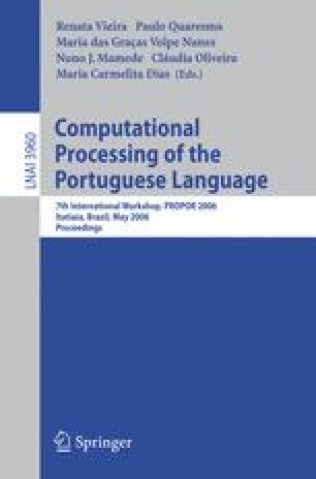
Computational Processing of the Portuguese Language ; 7th International Workshop, PROPOR 2006, Itatiaia, Brazil, May 13-17, 2006, Proceedings
Since 1993, PROPOR Workshops have become an important forum for - searchers involved in the Computational Processing of Portuguese,both written and spoken. The workshop and this book were structured around the following main t- ics, seven for full papers: (i) automatic summarization; (ii) resources; (iii) au- matic translation; (iv) named entity recognition; (v) tools and frameworks; (vi) systems and models; and another ?ve topics for short papers; (vii) information extraction; (viii) speech processing; (ix) lexicon; (x) morpho-syntactic studies; (xi) web, corpus and evaluation.

Machine Learning for Multimodal Interaction ; Vol.3869 ; 2nd International Workshop, MLMI 2005, Edinburgh, UK, July 11-13, 2005, Revised Selected Papers
The papers are organized in topical sections on multimodal processing, HCI and applications, discourse and dialogue, emotion, visual processing, speech and audio processing, and NIST meeting recognition evaluation

Machine Ethics : From Machine Morals to the Machinery of Morality
Offers the first systematic guide to machine ethics, bridging between computer science, social sciences and philosophy. Based on a dialogue between an AI scientist and a novelist philosopher, the book discusses important findings on which moral values machines can be taught and how. In turn, it investigates what kind of artificial intelligence (AI) people do actually want.
