



Page 19
Page 19
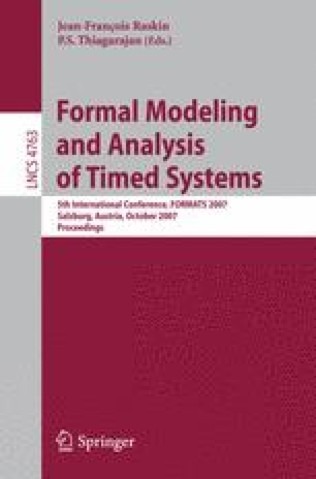
Formal Modeling and Analysis of Timed Systems ; 5th International Conference, FORMATS 2007, Salzburg, Austria, October 3-5, 2007, Proceedings
This volume consists of the proceedings of the Fifth International Conference on Formal Modelling and Analysis of Timed Systems (FORMATS 2007). The main goal of this series of conferences is to bring together diverse communities of researchers that deal with the timing aspects of computing systems.

Formal Methods and Stochastic Models for Performance Evaluation ; 4th European Performance Engineering Workshop, EPEW 2007, Berlin, Germany, September 27-28, 2007, Proceedings
This book constitutes the refereed proceedings of the 4th European Performance Engineering Workshop, EPEW 2007, held in Berlin, Germany, September 27-28, 2007.The 20 revised full papers presented were carefully reviewed and selected from 53 submissions.

Formal aspects in security and trust ; Vol. 173 ; IFIP TC1 WG1.7 Workshop on Formal Aspects in Security and Trust (FAST), World Computer Congress, August 22-27, 2004, Toulouse, France
The IFIP series publishes state-of-the-art results in the sciences and technologies of information and communication. The scope of the series includes: foundations of computer science; software theory and practice; education; computer applications in technology; communication systems; systems modeling and optimization; information systems; computers and society; computer systems technology; security and protection in information processing systems; artificial intelligence; and human-computer interaction. Proceedings and post-proceedings of referred international conferences in computer science and interdisciplinary fields are featured. These results often precede journal publication and represent the most current research. The principal aim of the IFIP series is to encourage education and the dissemination and exchange of information about all aspects of computing.

Formal approaches to software testing ; Vol. 3395 ; 4th International workshop, FATES 2004, Linz, Austria, September 21, 2004, Revised Selected Papers
Testing often accounts for more than 50% of the required e?ort during system development.Thechallengeforresearchistoreducethesecostsbyprovidingnew methods for the speci?cation and generation of high-quality tests. Experience has shown that the use of formal methods in testing represents a very important means for improving the testing process. Formal methods allow for the analysis andinterpretationofmodelsinarigorousandprecisemathematicalmanner.The use of formal methods is not restricted to system models only. Test models may alsobeexamined.Analyzingsystemmodelsprovidesthepossibilityofgenerating complete test suites in a systematic and possibly automated manner whereas examining test models allows for the detection of design errors in test suites and their optimization with respect to readability or compilation and execution time. Due to the numerous possibilities for their application, formal methods have become more and more popular in recent years. The Formal Approaches in Software Testing (FATES) workshop series also bene?ts from the growing popularity of formal methods. After the workshops in Aalborg (Denmark, 2001), Brno (Czech Republic, 2002) and Montr´ eal (Canada, 2003), FATES 2004 in Linz (Austria) was the fourth workshop of this series. Similar to the workshop in 2003, FATES 2004 was organized in a?liation with the IEEE/ACM Conference on Automated Software Engineering (ASE 2004). FATES 2004 received 41 submissions. Each submission was reviewed by at least three independent reviewers from the Program Committee with the help of some additional reviewers. Based on their evaluations, 14 full papers and one wo- in-progress paper from 11 di?erent countries were selected for presentation.

Fluid-structure interaction : Modelling, simulation, optimisation
Fluid-structure interactions (FSI), that is interactions of some movable or deformable structure with an internal or surrounding fluid flow, are among the most important and, with respect to both modelling and computational issues, the most challenging multi-physics problems. The variety of FSI occurrences is abundant and ranges from tent-roofs to micropumps, from parachutes via airbags to blood flow in arteries.

Flexible and Efficient Information Handling ; 23rd British National Conference on Databases, BNCOD 23, Belfast, Northern Ireland, UK, July 18-20, 2006, Proceedings
This book constitutes the refereed proceedings of the 23rd British National Conference on Databases, BNCOD 23, held in Belfast, Northern Ireland, July 2006. The volume presents 12 revised full papers and 6 revised short papers, together with 2 invited lectures and 13 poster papers. Topical sections include data modelling and architectures and transaction management, data integration and interoperability and information retrieval, query processing and optimisation, data mining, data warehousing and more.

Flexible AC Transmission Systems : Modelling and Control
The book presents the modelling of the latest FACTS controllers for power flow control, compensation and power quality (IPFC, GUPF, VSC HVDC and M-VSCHVDC, etc.) in power system analysis. The selection is evaluated by the actual and likely future practical relevance of each. The material is derived mainly from the research and industrial development in which the authors have been heavily involved. The book is timely and of great value to power engineering engineers and students of modelling, simulations and control design of FACTS for a broad practical range of power system operation, planning and control problems.

Finite Model Theory ; 2nd ed.
The book presents the main results of descriptive complexity theory, that is, the connections between axiomatizability of classes of finite structures and their complexity with respect to time and space bounds. The logics that are important in this context include fixed-point logics, transitive closure logics, and also certain infinitary languages; their model theory is studied in full detail. Other topics include DATALOG languages, quantifiers and oracles, 0-1 laws, and optimization and approximation problems. The book is written in such a way that the respective parts on model theory and descriptive complexity theory may be read independently. This second edition is a thoroughly revised and enlarged version of the original text.

Finite Mixture and Markov Switching Models
The prominence of finite mixture modelling is greater than ever. Many important statistical topics like clustering data, outlier treatment, or dealing with unobserved heterogeneity involve finite mixture models in some way or other. The area of potential applications goes beyond simple data analysis and extends to regression analysis and to non-linear time series analysis using Markov switching models.It is the first time that the Bayesian perspective of finite mixture modelling is systematically presented in book form. It is argued that the Bayesian approach provides much insight in this context and is easily implemented in practice. Although the main focus is on Bayesian inference, the author reviews several frequentist techniques, especially selecting the number of components of a finite mixture model, and discusses some of their shortcomings compared to the Bayesian approach. The aim of this book is to impart the finite mixture and Markov switching approach to statistical modelling to a wide-ranging community. This includes not only statisticians, but also biologists, economists, engineers, financial agents, market researcher, medical researchers or any other frequent user of statistical models. This book should help newcomers to the field to understand how finite mixture and Markov switching models are formulated, what structures they imply on the data, what they could be used for, and how they are estimated.

Fifth World Conference on Information Security Education ; Proceedings of the IFIP TC 11 WG 11.8, WISE 5, 19 to 21 June 2007, United States Military Academy, West Point, NY, USA
The scope of This book includes: foundations of computer science; software theory and practice; education; computer applications in technology; communication systems; systems modeling and optimization; information systems; computers and society; computer systems technology; security and protection in information processing systems; artificial intelligence; and human-computer interaction. Proceedings and post-proceedings of referred international conferences in computer science and interdisciplinary fields are featured. These results often precede journal publication and represent the most current research.

Fifth IFIP International Conference On Theoretical Computer Science - Tcs 2008 ; IFIP 20th World Computer Congress, TC 1, Foundations of Computer Science, September 7-10, 2008, Milano, Italy
Includes: foundations of computer science; software theory and practice; education; computer applications in technology; communication systems; systems modeling and optimization; information systems; computers and society; computer systems technology; security and protection in information processing systems; artificial intelligence; and human-computer interaction. Proceedings and post-proceedings of refereed international conferences in computer science and interdisciplinary fields are featured. These results often precede journal publication and represent the most current research. The principal aim of the IFIP series is to encourage education and the dissemination and exchange of information about all aspects of computing.

Field Models in Electricity and Magnetism
Covering the development of field computation in the past forty years, Field Models in Electricity and Magnetism intends to be a concise, comprehensive and up-to-date introduction to field models in electricity and magnetism, ranging from basic theory to numerical applications. The approach assumed throughout the whole book is to solve field problems directly from partial differential equations in terms of vector quantities. Theoretical issues are illustrated by practical examples. In particular, a single example is solved by different methods so that, by comparison of results, limitations and advantages of the various methods are made clear.

Field and service robotics : Results of the 6th international conference
This book presents the results of the sixth edition of Field and Service Robotics, FSR07, held in Chamonix, France, on 9th - 12th July 2007. The conference provided a forum for researchers, professionals and robot manufacturers to exchange up-to-date technical knowledge and experience. This book offers a collection of a broad range of topics including: Underwater Robots and Systems, Autonomous Navigation for Unmanned Aerial Vehicles, Simultaneous Localization and Mapping, Climbing Robotics, Sensor Fusion.

Feature Extraction : Foundations and Applications
This book is both a reference for engineers and scientists and a teaching resource, featuring tutorial chapters and research papers on feature extraction. "This book compiles some very promising techniques, coming from an extremely smart collection of researchers, delivering their best ideas in a competitive environment."

Feasibility and Infeasibility in Optimization : Algorithms and Computational Methods
Feasibility and Infeasibility in Optimization is a timely expository book that summarizes the state of the art in both classical and recent algorithms related to feasibility and infeasibility in optimization, with a focus on practical methods. All model forms are covered, including linear, nonlinear, and mixed-integer programs. Connections to related work in constraint programming are shown. Part I of the book addresses algorithms for seeking feasibility quickly, including new methods for the difficult cases of nonlinear and mixed-integer programs. Part II provides algorithms for analyzing infeasibility by isolating minimal infeasible (or maximum feasible) subsets of constraints, or by finding the best repair for the infeasibility. Infeasibility analysis algorithms have arisen primarily over the last two decades, and the book covers these in depth and detail. Part III describes applications in numerous areas outside of direct infeasibility analysis such as finding decision trees for data classification, analyzing protein folding, radiation treatment planning, automated test assembly, etc.

Fast, Efficient and Predictable Memory Accesses : Optimization Algorithms for Memory Architecture Aware Compilation
Fast, Efficient and Predictable Memory Accesses presents techniques for designing fast, energy-efficient and timing predictable memory systems. By using a careful combination of compiler optimizations and architectural improvements, we can achieve more than what would be feasible at one of the levels in isolation. The described optimization algorithms achieve the goals of high performance and low energy consumption. In addition to these benefits, the use of scratchpad memories significantly improves the timing predictability of the entire system, leading to tighter worst case execution time bounds (WCET). The WCET is a relevant design parameter for all timing critical systems. In addition, the book covers algorithms to exploit the power down modes of main memories in SDRAM technology, as well as the execute-in-place feature of Flash memories. The final chapter considers the impact of the register file, which is also part of the memory hierarchy.

Fast Motions in Biomechanics and Robotics : Optimization and Feedback Control
In the past decades, much progress has been made in the field of walking robots. The current state of technology makes it possible to create humanoid robots that nearly walk like a human being, climb stairs, or avoid small - stacles. However, the dream of a robot running as fast and as elegantly as a human is still far from becoming reality. Control of such fast motions is still a big technological issue in robotics, and the maximum running speed of contemporary robots is still much smaller than that of human track runners. The conventional control approach that most of these robots are based on does not seem to be suitable to increase the running speeds up to a biological level.

Fabbriche, sistemi, organizzazioni : Storia dell'ingegneria industriale = Factories, systems, organizations : A history of industrial engineering
This book examines the origin of the technological and organizational challenges of industry in Europe and the United States and the stages of its theoretical formulation; the creation of the figure of the industrial engineer between the nineteenth and twentieth centuries; and the elaboration of the technological disciplines and of the language and of the fundamental concepts (system, automation, control, optimization, network) of modern industrial engineering. Divided into three chronologically organized parts, each chapter is accompanied by readings, bibliographic information for in-depth study and illustrative sheets of historical, biographical aspects (relating to some great engineers, scientists and philosophers), terminological and mathematical-technical aspects.

Extreme Financial Risks : From Dependence to Risk Management
Portfolio analysis and optimization, together with the associated risk assessment and management, require knowledge of the likely distributions of returns at different time scales and insights into the nature and properties of dependences between the different assets. This book offers an original and thorough treatment of these two domains, focusing mainly on the concepts and tools that remain valid for large and extreme price moves. Strong emphasis is placed on the theory of copulas and their empirical testing and calibration, because they offer intrinsic and complete measures of dependences.

Extending the Horizons : Advances in Computing, Optimization, and Decision Technologies
Computer Science and Operations Research continue to have a synergistic relationship and this book represents the results of cross-fertilization between OR/MS and CS/AI. It is this interface of OR/CS that makes possible advances that could not have been achieved in isolation. Taken collectively, these articles are indicative of the state-of-the-art in the interface between OR/MS and CS/AI and of the high caliber of research being conducted by members of the INFORMS Computing Society.
