


Refine Results
Sort By
From
To


This book addresses four standard business school subjects: microeconomics, macroeconomics, finance and information systems as they relate to trading, liquidity, and market structure. It provides a detailed examination of the impact of trading costs and other impediments of trading that the authors call “frictions”. It also presents an interactive simulation model of equity market trading, TraderEx, that enables students to implement trading decisions in different market scenarios and structures. Addressing these topics shines a bright light on how a real-world financial market operates, and the simulation provides students with an experiential learning opportunity that is informative and fun.

Analyses two key aspects of network management in the public sector: leadership and performance. It investigates what integrative leadership is, and how it differentiates from leadership in single-agency structures. It also examines the performance of public interest networks by proposing an analytical framework that highlights which factors lead to high performance networks.
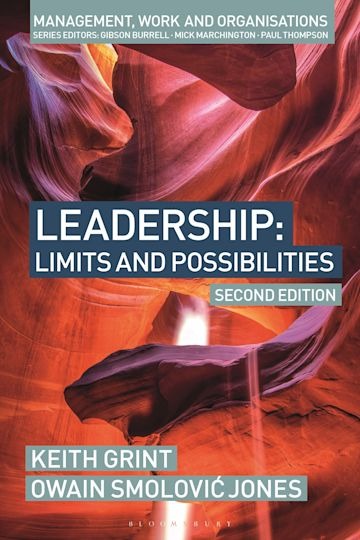
Leadership: Limits and Possibilities offers a critical discussion of leadership that draws upon a wide range of approaches, material and examples to demonstrate the complex and challenging role of leadership and through this debate suggests possible ways to improve as a leader. It is structured around 5 key aspects of leadership: person, product, position, process and purpose, providing a useful organizing framework. It combines theoretical discussions with lively examples to bring the subject alive.

Aimed at students and managers who seek detailed insights into contemporary knowledge management (KM). It explains the concepts, theories, and technologies that provide the foundation for knowledge management; the systems and structures that constitute KM solutions; and the processes for developing, deploying, and evaluating these KM solutions. It serves as a complete introduction to the subject of knowledge management, incorporating technical and social aspects, as well as concepts, practical examples, traditional KM approaches, and emerging topics. This third edition has been revised and expanded to include more coverage of emergent trends such as cloud computing, online communities, crowdsourcing and artificial intelligence.

This monograph presents a general equilibrium methodology for microeconomic policy analysis. It is intended to serve as an alternative to the now classical, axiomatic general equilibrium theory as exposited in Debreu`s Theory of Value (1959) or Arrow and Hahn`s General Competitive Analysis (1971). The methodology proposed in this monograph does not presume the existence of market equilibrium, accepts the inherent indeterminancy of nonparametric general equlibrium models, and offers effective algorithms for computing counterfactual equilibria in these models. It consists of several essays written over the last decade, some with colleagues or former graduate students, and an appendix by Charles Steinhorn on the elements of O-minimal structures, the mathematical framework for our analysis.
This monograph introduces new concepts of unstable periodic orbits and chaotic saddles which are unstable structures embedded in a chaotic attractor, responsible for economic intermittency.

CELLULAR GENETIC ALGORITHMS defines a new class of optimization algorithms based on the concepts of structured populations and Genetic Algorithms (GAs). The authors explain and demonstrate the validity of these cellular genetic algorithms throughout the book. This class of genetic algorithms is shown to produce impressive results on a whole range of domains, including complex problems that are epistatic, multi-modal, deceptive, discrete, continuous, multi-objective, and random in nature. The focus of this book is twofold. On the one hand, the authors present new algorithmic models and extensions to the basic class of Cellular GAs in order to tackle complex problems more efficiently. On the other hand, practical real world tasks are successfully faced by applying Cellular GA methodologies to produce workable solutions of real-world applications.

Provides a structured, industry-independent and at the same time practical insight into all types of business partnerships. Both relationships with external business partners and internal partnerships with colleagues and employees are considered in depth. The focus is on people as partner and individual with interests and goals. The comparison to private partnerships is quite intentional and illustrates the explanations. Findings from brain research, learning and cooperation are also included.

Business Financial Information Secrets shows you how to produce, understand, and utilize financial information to the greatest effect for your business and the economy at large. This book guides you through the surprisingly clean and simple process of proper accounting and reporting, regardless of your organization’s size or structure. Cash flow and business capital management are covered extensively throughout the book as without a thorough understanding of these all-important concepts, you could be lacking critical information about the lifeline of your business.

1 The tools of modern portfolio theory are in general use in the equity markets, either in the form of portfolio optimization software or as an accepted frame- 2 work in which the asset managers think about stock selection. In the ?xed income market on the other hand, these tools seem irrelevant or inapplicable. Bond portfolios are nowadays mainly managed by a comparison of portfolio 3 4 risk measures vis ¶a vis a benchmark. The portfolio manager’s views about the future evolution of the term structure of interest rates translate th- selves directly into a positioning relative to his benchmark, taking the risks of these deviations from the benchmark into account only in a very crude 5 fashion, i.e. without really quantifying them probabilistically. This is quite surprising since sophisticated models for the evolution of interest rates are commonly used for interest rate derivatives pricing and the derivation of ?xed 6 income risk measures.
This book investigates the origins and evolution of Asia’s new institutional architecture in trade, finance, and security from both a theoretical and empirical perspective. The traditional institutional equilibrium in Asia has come under heavy strain in the "post triple shocks period" - the post-Cold War, the post-financial crisis of 1997-98, and the post-9-11 attacks. The new dynamics of rivalry and cooperation among states at both the intraregional and transregional levels is now shaping a new institutional architecture. Political and business leaders from Northeast and Southeast Asia interact with each other more frequently. South Asia’s participation in the rest of Asia in recent years is truly impressive. As we show, the future institutional trajectory of Asia is still open, but we believe that the book provides a timely examination of key shifts in the region. In doing so, our hope is to provide policymakers and analysts with an institutional road map for the future.

Alternative Investments is the definitive guide to understanding non-traditional asset classes. Alternatives are a disparate group of investments that are distinguished from long-only, publicly traded investments in stocks, bonds, and cash (often referred to as traditional investments). Alternative investments include real estate, commodities, infrastructure, and other non-traditional investments such as private equity or debt and hedge funds.

This book provides a multi-perspective approach to the caravan trade in the Sahara during the 19th century. Based on travelogues from European travelers, recently found Arab sources, historical maps and results from several expeditions, the book gives an overview of the historical periods of the caravan trade as well as detailed information about the infrastructure which was necessary to establish those trade networks.

"Market quality" is a complex, ambiguous term that means different things to different people. How should it be defined, measured, monitored, and improved? What is the evidence about the current state of our markets? How effective have recent innovations been? How can we better meet investor needs? These are some of the questions that we address in this book, along with a broad range of issues concerning equity market structure, regulation, and the quest for best execution. Throughout, particular attention is given to the perspective of front line participants on the buy-side and sell-side trading desks.

Ordinarily, only the interests of shareholders, debtholders, and corporate management are taken into account when analyzing corporate financial decisions while the interests of non-financial stakeholders are often neglected. Gregor Gossy develops a so-called stakeholder rationale for risk management arguing that firms which are more dependent on implicit claims from their non-financial stakeholders, such as customers, suppliers, and employees, prefer conservative financial policies. In order to perform panel data analyses of the determinants of corporate financial decisions, the author uses data from Austrian and German industrial companies. He shows that variables for a firm’s most important non-financial stakeholders explain the firm’s capital structure and cash holding decisions. His findings suggest that a firm’s choice of accounting standards have a moderating effect on the determinants of corporate finance decisions.

Customer integration in the early innovation phase has been considered the method of choice in theory and practice. Growing experience with the concept has shown unexpected side effects that may even outweigh its recognized advantages. Therefore, management needs to be able to assess in advance whether the involvement of customers will add overall value to each particular innovation project. To support but not to replace the final managerial decision, a mathematical formula is developed. It can be applied to all kinds of process structures, takes into account the risks and benefits contingent on a company's situation as well as risk-reducing and benefit-increasing measures and translates them into numerical values. The resulting figure indicates the prospective value of customer integration in a specific project.

Organizations need to identify risks and chances of environmental changes in order to adapt to or possibly even to influence them. Early warning which comprises scanning and interpretation plays an important role in this process. Whereas the traditional contingency approach considers early warning as a part of the organizational structure, the extended contingency theory assumes the additional influence of an individual’s personality on early warning. Andreas Kirschkamp empirically analyses the early warning behavior of Chief Executive Officers in German medium-sized companies. First, he presents the design variables of early warning, then the influencing contingency variables. On the basis of the scholarly research on psychological and contingency theory, the author deduces hypotheses and tests them. The results show that early warning behavior is not only influenced by traditional contingency variables but also by personal attitudes.

Making with Data: Physical Design and Craft in a Data-Driven World provides a snapshot of the diverse practices contemporary creators are using to produce objects, spaces, and experiences imbued with data. Across 25+ beautifully-illustrated chapters, international artists, designers, and scientists each explain the process of creating a specific data-driven piece—illustrating their practice with candid sketches, photos, and design artifacts from their own studios. Featuring influential voices in computer science, data science, graphic design, art, craft, and architecture, Making with Data is accessible and inspiring for enthusiasts and experts alike.

Explores the pluriverse of art and design through epistemological and methodological considerations. What kinds of sustainable ways are there for knowledge transfer, supporting plural agendas, finding novel ways for unsettling conversations, unlearning and learning and challenging power structures with marginalised groups and contexts through art and design? The main themes of the book are art and design methods, epistemologies and practices that provide critical, interdisciplinary, pluriversal and decolonial considerations. The book challenges the domination of the white logic of art and design and shifts away from the Anglo-European one-world system towards the pluriverse.

Deals with all the tasks related to brick and stone masonry structures, from the initial identification of defects and their diagnosis to their treatment and monitoring of its cost-effectiveness.

Daraa Highway - Ghabagheb - Syria
+963-15 2050 - 15 860 380 /1/2/3 - 11 662 3900