



Page 10
Page 10
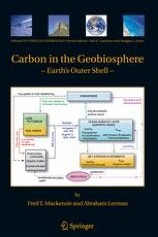
Carbon in the Geobiosphere : Earth's outer shell
Carbon and carbon dioxide always played an important role in the geobiosphere that is part of the Earth’s outer shell and surface environment. The book’s eleven chapters cover the fundamentals of the biogeochemical behavior of carbon near the Earth’s surface, in the atmosphere, minerals, waters, air-sea exchange, and inorganic and biological processes fractionating the carbon isotopes, and its role in the evolution of inorganic and biogenic sediments, ocean water, the coupling to nutrient nitrogen and phosphorus cycles, and the future of the carbon cycle in the Anthropocene. This book is mainly a reference text for Earth and environmental scientists; it presents an overview of the origins and behavior of the carbon cycle and atmospheric carbon dioxide, and the human effects on them. The book can also be used for a one-semester course at an intermediate to advanced level addressing the behavior of the carbon and related cycles.
Capital Markets, Globalization, and Economic Development
The progression of globalization is having profound effects on the capital markets and economic development. The major issues addressed in the book are: The Basel II capital accord / Bank safety nets / Corruption / Credit ratings and credit spread / International stock exchanges and bond markets / Microfinance / Project finance

Business process management Workshops ; Vol. 4103 : BPM 2006 International Workshops, BPD, BPI, ENEI, GPWW, DPM, semantics4ws, Vienna, Austria, September 4-7, 2006, Proceedings
BPM 2006 was the fourth in a conference series that provides a forum for - searchers and practitioners in all areas of business process management. In c- junction with BPM 2006, a series of workshops were held. They were meant to facilitate the exchange of ideas and experiences between active researchers, and to stimulate discussions on new and emerging topics in line with the conference topics. We see the workshops as a necessary extension to the main conference. BPM has established itself rapidly as a high quality conference with a highly competitive selection process.

Brain thoughts recognition
Humans controlling machines with their minds may sound like something from a scifi movie, but it’s becoming a reality through brain-computer interfaces BCI. Where BCI technology allows a human brain and an external device to talk to each other—to exchange signals. It gives humans the ability to directly control machines, without the physical constraints of the body. There are two ways to implement the BCI: Noninvasive tools often use sensors applied on or near the head to track and record brain activity, or Invasive BCI would require surgery. Electronic devices would need to be implanted beneath the skull, directly into the brain, to target specific sets of neurons. In order to implement a non-invasive BCI in a mobile phone, this study developed a mobile application to help paralyzed people who do not have the ability to use their phones to spend their basic daily needs, such as using the keyboard and interacting with PDF, etc.
Boundary Representation Modelling Techniques
Boundary representation is the principle solid modelling method used in modern CAD/CAM systems. There have been a long series of developments on which currently available systems are based, full details of which are only partially known. Ian Stroud’s thorough coverage of these developments puts this technology in perspective. Ian Stroud started working with boundary representation solid modelling in 1977. Since then he has researched and is researching a wide variety of topics in and around this field. The information in the book comes from the results of this research.

Biotechnology for Fuels and Chemicals : The Twenty-Ninth Symposium
In Biotechnology for Fuels and Chemicals: The Twenty-Ninth Symposium, leading US and international researchers from academia, industry, and government exchange cutting-edge technical information and update current trends in the development and application of biotechnology for sustainable production of fuels and chemicals. This symposium emphasizes advances in biotechnology to produce high-volume, low-price products from renewable resources, while improving the environment. The major areas of interest include advanced feedstock production and processing, enzymatic and microbial biocatalysis, bioprocess research and development, opportunities in biorefineries, and commercialization of biobased products. International and domestic progress on producing liquid biofuels, especially ethanol and biodiesel, is highlighted, and related topics, including bioseparations and optimal integration of biochemical and thermochemical conversion technologies, are featured.
Biotechnology for fuels and chemicals : The Twenty-Eighth symposium
In Biotechnology for Fuels and Chemicals: The Twenty-Eighth Symposium, leading US and international researchers from academia, industry, and government exchange cutting-edge technical information and update current trends in the development and application of biotechnology for sustainable production of fuels and chemicals. This symposium emphasizes advances in biotechnology to produce high-volume, low-price products from renewable resources, while improving the environment. The major areas of interest include advanced feedstock production and processing, enzymatic and microbial biocatalysis, bioprocess research and development, opportunities in biorefineries, and commercialization of biobased products.

Biologics in General Medicine
The idea for this book was born during the symposium on biologics organized by ZAFES (Center for Drug Research, Development and Safety at the University of Frankfurt am Main) in September 2005. Highly distinguished researchers special- ing in the field of biologics had gathered together to exchange information on this relatively new subject. Realizing that this symposium was one of the few sources of condensed information on biologics, it became obvious that we had to create a means of informing an interested wider circle of scientists and especially general c- nicians. Therefore, the editors of this book suggested to the researchers at the symposium andalsotoprominent scientists andcliniciansinvolvedinthe developmentand application of biologics as their major field of interest the idea of assembling this compendium. We received an overwhelmingly positive response – thankfully also from the publisher – most being more than willing to support this innovative project with highly relevant chapters on the latest state of the art.
Biologically-Inspired Collaborative Computing ; IFIP 20th World Computer Congress, 2nd IFIP TC 10 International Conference on Biologically-Inspired Collaborative Computing, September 8–9, 2008, Milano, Italy
The IFIP series publishes state-of-the-art results in the sciences and technologies of information and communication. The principal aim of the IFIP series is to encourage education and the dissemination and exchange of information about all aspects of computing.
Biologically Inspired Algorithms for Financial Modelling
Then Part I provides a thorough guide to the various bioinspired methodologies – neural networks, evolutionary computing (particularly genetic algorithms and grammatical evolution), particle swarm and ant colony optimization, and immune systems. Part II brings the reader through the development of market trading systems. Finally, Part III examines real-world case studies where BIA methodologies are employed to construct trading systems in equity and foreign exchange markets, and for the prediction of corporate bond ratings and corporate failures.
Biological and artificial intelligence environments
The book reports the proceedings of the 15th Italian workshop on neural networks issued by the Italian Society on Neural Networks SIREN. The longevity recipe of this conference stands in three main points that normally renders the reading of these proceedings so interesting as appealing. 1. The topics of the neural networks is considered an attraction pole for a set of researches centered on the inherent paradigm of the neural networks, rather than on a specific tool exclusively. Thus, the subsymbolic management of the data information content constitutes the key feature of papers in various fields such as Pattern Recognition, Stochastic Optimization, Learning, Granular Computing, and so on, with a special bias toward bioinformatics operational applications. An excerpt of all these matters may be found in the book. 2. Though managed at domestic level, the conference attracts contributions from foreign researchers as well, so that in the book the reader may capture the flavor of the state of the art in the international community. 3. The conference is a meeting of friends as well. Thus the papers generally reflect a relaxed atmosphere where researchers meet to generously exchange their thought and explain their actual results in view of a common cultural growing of the community.
Binomial models in finance
This book deals with many topics in modern financial mathematics in a way that does not use advanced mathematical tools and shows how these models can be numerically implemented in a practical way. The book is aimed at undergraduate students, MBA students, and executives who wish to understand and apply financial models in the spreadsheet computing environment.The basic building block is the one-step binomial model where a known price today can take one of two possible values at the next time. In this simple situation, risk neutral pricing can be defined and the model can be applied to price forward contracts, exchange rate contracts, and interest rate derivatives.
Big data-enabled internet of things
Covers analytical techniques for handling the huge amount of data generated by the Internet of Things, from architectures and platforms to security and privacy issues, applications, and challenges as well as future directions. The fields of Big Data and the Internet of Things (IoT) have seen tremendous advances, developments, and growth in recent years. The IoT is the inter-networking of connected smart devices, buildings, vehicles and other items which are embedded with electronics, software, sensors and actuators, and network connectivity that enable these objects to collect and exchange data. The IoT produces a lot of data. Big data describes very large and complex data sets that traditional data processing application software is inadequate to deal with, and the use of analytical methods to extract value from data. This edited book covers analytical techniques for handling the huge amount of data generated by the Internet of Things, from architectures and platforms to security and privacy issues, applications, and challenges as well as future directions.
Big data and artificial intelligence in digital finance : Increasing personalization and trust in digital finance using big data and AI
This book presents how cutting-edge digital technologies like Machine Learning, Artificial Intelligence (AI), and Blockchain are set to disrupt the financial sector. The book illustrates how recent advances in these technologies facilitate banks, FinTechs, and financial institutions to collect, process, analyze, and fully leverage the very large amounts of data that are nowadays produced and exchanged in the sector. To this end, the book also introduces some of the most popular Big Data, AI and Blockchain applications in the sector, including novel applications in the areas of Know Your Customer (KYC), Personalized Wealth Management and Asset Management, Portfolio Risk Assessment, as well as variety of novel Usage-based Insurance applications based on Internet-of-Things data.
Beyond the limits to growth : New ideas for sustainability from Japan
This book offers an optimistic view of the future and provides a road map for societies to get there. Drawing upon extensive research and many years as a thought leader in environmental and sustainability issues in Japan and internationally, Hiroshi Komiyama analyzes the most pressing challenges to the attainment of sustainability of economically advanced nations and argues forcefully for Japan to lead them out of the present dilemma through active promotion of creative consumer and societal demand. He shows how an active industry–government–academic partnership can provide the environment needed to promote such new creative demand and illustrates its potential through presentation of a Platinum Society Network that was launched on a regional basis in Japan in 2010 to facilitate the solution of common issues through the exchange of information and ideas.
Asset prices, booms and recessions : Financial economics from a dynamic perspective
Studies the interaction of the financial market, economic activity and the macroeconomy from a dynamic perspective. The financial market to be studied here encompasses the money and bond market, credit market, stock market and foreign exchange market. Economic activity is described by the activity of firms, banks, households, governments and countries. The book shows how economic activity affects asset prices and the financial market and how asset prices and financial market volatility feed back to economic activity. The focus in this book is on theories, dynamic models and empirical evidence.
Asian economy and finance : A post-crisis perspective
Topicality of Asian economy has refused to fade for almost four decades; if anything it has been levitating. The Asian economy has changed markedly since the economic and financial crisis of 1997-1998 and is continuing to evolve. As a scholarly subject matter, Asian economy has not stopped attracting academicians, policy mandarins, decision makers in the arena of business and students of Asian economy. The Asian crisis was a cataclysmic event for the region and brought to the surface several systemic limitations, like those in the financial sector, corporate governance, regulatory oversight, legal framework, and exchange rate management. Managers of Asian economy need to get to the bottom of these acutely problematical systemic issues. Additionally, Asian economies need to change with the demands of time and devise their post-crisis development strategy. Asia’s growth model, that served it so well for four decades, is overdue for renewal so that it can re-strengthen its bonds with the ever-evolving regional and global economic reality. The old growth model is likely to be less relevant and effective in the post-crisis future of the Asian economies. It is sure to run into the wall of diminishing returns.

Artificial oxygen carrier; its frontline
This volume of the Keio University International Symposia for Life Sciences and Medicine contains the proceedings of the 13th symposium held under the sponsorship of the Keio University Medical Science Fund. The fund was est- lished by the generous donation of the late Dr. Mitsunada Sakaguchi. The Keio University International Symposia for Life Sciences and Medicine constitute one of the core activities sponsored by the fund,of which the objective is to contribute to the international community by developing human resources, promoting scienti?c knowledge, and encouraging mutual exchange. Each year, the Committee of the International Symposia for Life Sciences and Medicine selects the most signi?cant symposium topics from applications received from the Keio medical community. The publication of the proce- ings is intended to publicize and distribute the information arising from the lively discussions of the most exciting and current issues presented during the symposium.

Artificial intelligence in theory and practice II : IFIP 20th World Computer Congress, TC 12 : IFIP AI 2008 Stream, September 7-10, 2008, Milano, Italy
The IFIP series publishes state-of-the-art results in the sciences and technologies of information and communication. The principal aim of the IFIP series is to encourage education and the dissemination and exchange of information about all aspects of computing.

Artificial intelligence for customer relationship management : Keeping customers informed
Providing a forum for the exchange of ideas in AI, this book provides a concise yet comprehensive coverage of methodologies, tools, issues, applications, and future trends for professionals, managers, and researchers in the CRM field together with AI and IT professionals.
