


Refine Results
Sort By
From
To

The book describes the major physical theories of comets in the past two millennia. It demonstrates the evolution of ideas about the nature, position, motion and physical constitution of comets from Aristotle to Whipple. Unlike the available works on the history of comets, which either illustrate relatively short periods in the history of physical cometology or portray a landscape view without adequate details, the present study focuses on details of each theory. It also investigates the interaction between observational and mathematical astronomy, and the physical sciences in defining the properties of comets.

Features contributions from several Italian research groups that are working on the field of biomedicine. Each chapter in this book deals with a specific subfield, with the aim of providing an overview of the subject and an account of the research results.

Provides new and updated chapters covering computational and mathematical techniques and concepts related to the field of comparative genomics. The topics covered in the chapters range from those that address general techniques and concepts that apply to all organisms to others that are specialized and apply to specific biological systems such as viruses, bacteria, nematodes, and insects.
Writes the editor, "If used properly, CDSS have the potential to change the way medicine has been taught and practiced." As clinical decision support systems (CDSS) gain an increasingly central role in the delivery of high quality health care, it becomes more important for the health care community to understand their use. This text is designed as a resource for practicing clinicians, informaticians, teachers and students alike, and provides the most current, comprehensive look a the development and evaluation of clinical decision support systems.
Cell Surface Receptors: A Short Course on Theory and Methods, 3rd Edition, links theoretical insights into drug-receptor interactions described in mathematical models with the experimental strategies to characterize the biological receptor of interest.

The book is rich in references and leaves no aspect of the problem untouched. The morphological, pharmacological, physiological and mathematical modeling aspects of different components of the subject are treated to exhaustion...the book is richly illustrated and down-right comprehensive. It will delight those interested in the field, will inform those who need a context for their research efforts and is a must for graduate and medical libraries.

This book provides a practical introduction to analysing ecological data using real data sets collected as part of postgraduate ecological studies or research projects. The first part of the book gives a largely non-mathematical introduction to data exploration, univariate methods (including GAM and mixed modelling techniques), multivariate analysis, time series analysis (e.g. common trends) and spatial statistics. The second part provides 17 case studies, mainly written together with biologists who attended courses given by the first authors. The case studies include topics ranging from terrestrial ecology to marine biology.
This Festschrift volume contains the proceedings of the conference Mathematical Methods in Computer Science, MMICS 2008, which was held during December 17-19, 2008, in Karlsruhe, Germany, in memory of Thomas Beth.The themes of the conference reflected the many interests of Thomas Beth. Although, these interests might seem diverse, mathematical methods and especially algebra as a language constituted the common denominator of all of his scientific achievements.
Mathematical Linguistics introduces the mathematical foundations of linguistics to computer scientists, engineers, and mathematicians interested in natural language processing. The book presents linguistics as a cumulative body of knowledge from the ground up, with no prior knowledge of linguistics being assumed, covering more than the average two-semester introductory course in linguistics.This comprehensive, reader-friendly volume offers readers a high-level orientation, discussing the foundations of the field and presenting both the classical work and the most recent results. It covers an extremely rich array of topics including not only syntax and semantics but also phonology and morphology, probabilistic approaches, complexity, learnability, and the analysis of speech and handwriting.
This book considers the potential and limitations of the various mathematical approaches and thereby aims to give a balanced view of the usability of each mathematical approach. Written with both student and professional in mind, this book assists the reader in applying mathematical methods to solve practical problems that are relevant to software engineers. It is suitable for coursework or self-study and there is helpful material on tools to support the various mathematical approaches.
Provides students with the fundamental knowledge and practical tools needed to conduct research and build data-driven products. The authors prioritize geometric intuition and algorithmic thinking, and include detail on all the essential mathematical prerequisites, to offer a fresh and accessible way to learn. Practical applications are emphasized, with examples from disciplines including computer vision, natural language processing, economics, neuroscience, recommender systems, physics, and biology.
The book is organized in four parts: The first focuses on technical aspects, basic mathematical notions and elementary machine learning techniques. The second provides an extensive survey of most relevant machine learning techniques for media processing, while the third part focuses on applications and shows how techniques are applied in actual problems. The fourth part contains detailed appendices that provide notions about the main mathematical instruments used throughout the text
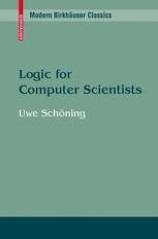
This book introduces the notions and methods of formal logic from a computer science standpoint, covering propositional logic, predicate logic, and foundations of logic programming. It presents applications and themes of computer science research such as resolution, automated deduction, and logic programming in a rigorous but readable way.The style and scope of the work, rounded out by the inclusion of exercises, make this an excellent textbook for an advanced undergraduate course in logic for computer scientists.
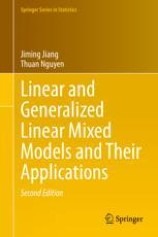
This book covers two major classes of mixed effects models—linear mixed models and generalized linear mixed models—and it presents an up-to-date account of theory and methods in analysis of these models as well as their applications in various fields. It offers a systematic approach to inference about non-Gaussian linear mixed models. Furthermore, it discusses the latest developments and methods in the field, incorporating relevant updates since publication of the first edition. These include advances in high-dimensional linear mixed models in genome-wide association studies (GWAS), advances in inference about generalized linear mixed models with crossed random effects, new methods in mixed model prediction, mixed model selection, and mixed model diagnostics.
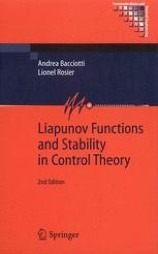
Presents a modern and self-contained treatment of the Liapunov method for stability analysis, in the framework of mathematical nonlinear control theory. A Particular focus is on the problem of the existence of Liapunov functions (converse Liapunov theorems) and their regularity, whose interest is especially motivated by applications to automatic control.
Addresses the fundamentals of kernel methods for machine learning by considering relevant math problems and building Python programs. The book’s main features are as follows: Includes 100 exercises, which have been carefully selected and refined. As their solutions are provided in the main text, readers can solve all of the exercises by reading the book. / The mathematical premises of kernels are proven and the correct conclusions are provided, helping readers to understand the nature of kernels. / Source programs and running examples are presented to help readers acquire a deeper understanding of the mathematics used. / Once readers have a basic understanding of the functional analysis topics covered in Chapter 2, the applications are discussed in the subsequent chapters. Here, no prior knowledge of mathematics is assumed. / Considers both the kernel for reproducing kernel Hilbert space (RKHS) and the kernel for the Gaussian process; a clear distinction is made between the two.

Expand your knowledge of Java with this entertaining learning guide, which features 100+ exercises and programming challenges. Java Challenges will prepare you for your next exam or job interview, and covers many practical topics, such as strings, arrays, data structures, recursion, and date and time. The APIs and other material included in this book are Java 17 compatible. You will: Improve your Java knowledge by solving enjoyable but challenging programming puzzles / Solve mathematical problems, recursions, strings, arrays and more / Manage data processing and data structures like lists, sets, maps / Handle advanced recursion as well as binary trees, sorting and searching / Gamify key fundamentals for fun and easier reinforcement
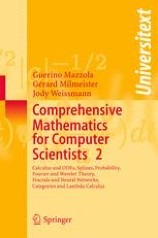
This second volume of a comprehensive tour through mathematical core subjects for computer scientists completes the ?rst volume in two - gards: Part III ?rst adds topology, di?erential, and integral calculus to the t- ics of sets, graphs, algebra, formal logic, machines, and linear geometry, of volume 1. With this spectrum of fundamentals in mathematical e- cation, young professionals should be able to successfully attack more involved subjects, which may be relevant to the computational sciences. In a second regard, the end of part III and part IV add a selection of more advanced topics. In view of the overwhelming variety of mathematical approaches in the computational sciences, any selection, even the most empirical, requires a methodological justi?cation. Our primary criterion has been the search for harmonization and optimization of thematic - versity and logical coherence. This is why we have, for instance, bundled such seemingly distant subjects as recursive constructions, ordinary d- ferential equations, and fractals under the unifying perspective of c- traction theory.
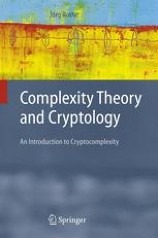
Modern cryptology employs mathematically rigorous concepts and methods from complexity theory. Conversely, current research in complexity theory often is motivated by questions and problems arising in cryptology. This book takes account of this trend, and therefore its subject is what may be dubbed "cryptocomplexity,'' some sort of symbiosis of these two areas. This textbook is suitable for undergraduate and graduate students of computer science, mathematics, and engineering, and can be used for courses on complexity theory and cryptology, preferably by stressing their interrelation. Starting from scratch, it is an accessible introduction to cryptocomplexity and works its way to the frontiers of current research. It provides the necessary mathematical background, has numerous figures, exercises, and examples, and presents some central, up-to-date research topics and challenges. Due to its comprehensive bibliography and subject index, it is also a valuable source for researchers, teachers, and practitioners working in these fields.
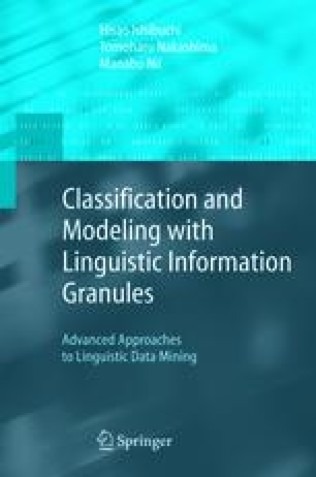
Many approaches have already been proposed for classification and modeling in the literature. These approaches are usually based on mathematical mod els. Computer systems can easily handle mathematical models even when they are complicated and nonlinear (e.g., neural networks). On the other hand, it is not always easy for human users to intuitively understand mathe matical models even when they are simple and linear. This is because human information processing is based mainly on linguistic knowledge while com puter systems are designed to handle symbolic and numerical information. A large part of our daily communication is based on words. We learn from various media such as books, newspapers, magazines, TV, and the Inter net through words. We also communicate with others through words. While words play a central role in human information processing, linguistic models are not often used in the fields of classification and modeling. If there is no goal other than the maximization of accuracy in classification and modeling, mathematical models may always be preferred to linguistic models. On the other hand, linguistic models may be chosen if emphasis is placed on interpretability.

Daraa Highway - Ghabagheb - Syria
+963-15 2050 - 15 860 380 /1/2/3 - 11 662 3900