



Page 141
Page 141

Artificial intelligence for oral health care : Applications and future prospects
Offers a deeper understanding of the foundational concepts of AI, its practical applications in oral health, and the possibilities that lie ahead. From oral pathology to maxillofacial surgery, prosthodontics to orthodontics, and endodontics to dental education, it presents compelling, evidence-based insights into how AI is changing the landscape of dentistry.
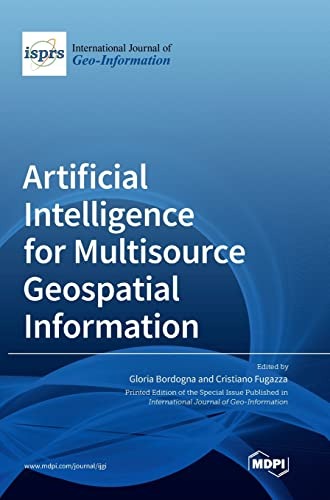
Artificial intelligence for multisource geospatial information
Collects 10 original research contributions published in the Special Issue entitled “Artificial Intelligence for Multisource Geospatial Information” of the ISPRS International Journal of Geo-Information. The focus is on different methods of Geospatial Artificial Intelligence (GeoAI) based on deep learning using different network architectures, clustering, soft computing, and semantic approaches. They are proposed to deal with a variety of Geospatial Big Data (GBD), such as georeferenced texts and photos in social networks, remote sensing images, cartographic maps, multidimensional geo databases, metadata in spatial data infrastructures, and for different tasks, such as for multisource georeferenced text integration and geodata flexible querying, for social sensing by applying sentiment analysis, clustering and geo analysis, for segmentation of roads, clouds and snow, and for detection of small targets and people on the streets.

Artificial intelligence for multimedia signal processing
Artificial intelligence technologies are also actively applied to broadcasting and multimedia processing technologies. A lot of research has been conducted in a wide variety of fields, such as content creation, transmission, and security, and these attempts have been made in the past two to three years to improve image, video, speech, and other data compression efficiency in areas related to MPEG media processing technology. Additionally, technologies such as media creation, processing, editing, and creating scenarios are very important areas of research in multimedia processing and engineering. This book contains a collection of some topics broadly across advanced computational intelligence algorithms and technologies for emerging multimedia signal processing as: Computer vision field, speech/sound/text processing, and content analysis/information mining.
Artificial intelligence for marketing management
Artificial intelligence (AI) has driven businesses to adopt new business practices rapidly, enhance product development and services, has helped to power AI-based market intelligence and customer insights, and improve customer relationship management. This timely book addresses the use of AI in marketing.
Artificial intelligence for customer relationship management : Solving customer problems
This book describes a number of applications of Artificial Intelligence in the field of Customer Relationship Management with the focus of solving customer problems. We design a system that tries to understand the customer complaint, his mood, and what can be done to resolve an issue with the product or service. To solve a customer problem efficiently, we maintain a dialogue with the customer so that the problem can be clarified and multiple ways to fix it can be sought. We introduce dialogue management based on discourse analysis: a systematic linguistic way to handle the thought process of the author of the content to be delivered. We analyze user sentiments and personal traits to tailor dialogue management to individual customers. We also design a number of dialogue scenarios for CRM with replies following certain patterns and propose virtual and social dialogues for various modalities of communication with a customer.

Artificial intelligence for customer relationship management : Keeping customers informed
Providing a forum for the exchange of ideas in AI, this book provides a concise yet comprehensive coverage of methodologies, tools, issues, applications, and future trends for professionals, managers, and researchers in the CRM field together with AI and IT professionals.

Artificial Intelligence for Cloud and Edge Computing
Discusses the future possibilities of AI with cloud computing and edge computing. Aims to conduct analyses, implementation and discussion of many tools (of artificial intelligence, machine learning and deep learning and cloud computing, fog computing, and edge computing including concepts of cyber security) for understanding integration of these technologies. Readers can quickly get an overview of these emerging topics and get many ideas of the future of AI with cloud, edge, and in many other areas. Topics include machine and deep learning techniques for Internet of Things based cloud systems; security, privacy and trust issues in AI based cloud and IoT based cloud systems; AI for smart data storage in cloud-based IoT; blockchain based solutions for AI based cloud and IoT based cloud systems.This book is relevent to researchers, academics, students, and professionals. Presents fusion of cloud computing services and AI technology for bringing a significant change in the technology industry; Includes self-assessment problems for increasing knowledge of real world problems, i.e., how AI and cloud/edge computing can change business for the better; Provides innovative results of integrations of AI in other applications such as healthcare, finance, manufacturing, transportation, agriculture, etc.
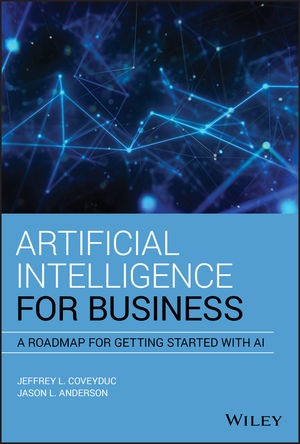
Artificial intelligence for business : A roadmap for getting started with AI
Artificial Intelligence for Business: A Roadmap for Getting Started with AI will provide the reader with an easy to understand roadmap for how to take an organization through the adoption of AI technology. It will first help with the identification of which business problems and opportunities are right for AI and how to prioritize them to maximize the likelihood of success. Specific methodologies are introduced to help with finding critical training data within an organization and how to fill data gaps if they exist.

Artificial intelligence for asset management and investment : A strategic perspective
The rise of artificial intelligence is nothing short of a technological revolution. AI is poised to completely transform asset management and investment banking, yet its current application within the financial sector is limited and fragmented. Existing AI implementations tend to solve very narrow business issues, rather than serving as a powerful tech framework for next-generation finance. Artificial Intelligence for Asset Management and Investment provides a strategic viewpoint on how AI can be comprehensively integrated within investment finance, leading to evolved performance in compliance, management, customer service, and beyond.
Artificial Intelligence for a better future : An ecosystem perspective on the ethics of AI and emerging digital technologies
This book proposes a novel approach to Artificial Intelligence (AI) ethics. AI offers many advantages: better and faster medical diagnoses, improved business processes and efficiency, and the automation of boring work.

Artificial intelligence based nutrition app
As AI becomes a giant trend in the business world, mobile apps are one of the usage areas, which people can benefit from. People can automate their tasks with AI-based mobile apps. As the mobile app understand how processes work, it can automate some procedures and reduce the duration of them. In this way, people can save time and improve their productivity. In addition, personalized content also improves user engagement and meets user expectations more. Many other features of AI can be integrated into mobile apps and improve user experience.
Artificial intelligence based cancer nanomedicine : Diagnostics, therapeutics and bioethics
Nanomedicine is evolving with novel drug formulations devised for multifunctional approaches towards diagnostics ad therapeutics. Nanomedicine-based drug therapy is normally explored at a fixed dose. The drug action is time-dependent, dose-dependent and patient-specific. To overcome challenges of nanomedicine testing, artificial intelligence (AI) serves as a helping tool for optimizing the drug and dose parameters. Real time conversions between these two features enables upgradation of patient data acquisition and improved design of nanomaterials. In this scenario, AI-based pattern analysis and algorithms models can greatly improve accuracy of diagnostics and therapeutics.
Artificial intelligence applied to medical imaging and computational biology
Medical imaging and computational biology continuously pose new fundamental medical and biological questions that often give rise to novel challenges in Artificial Intelligence. These research fields present an increasing need for the application of cutting-edge computational approaches that generally involve machine learning or computational intelligence techniques, which can effectively perform bioimage and biosignal processing in different clinical areas.
Artificial Intelligence Applications for Health Care
Covers topics on health care and artificial intelligence. Data sets related to biomedical signals (ECG, EEG, EMG) and images (X-rays, MRI, CT) are explored, analyzed, and processed through different computation intelligence methods. Applications of computational intelligence techniques like artificial and deep neural networks, swarm optimization, expert systems, decision support systems, clustering, and classification techniques on medial datasets are explained. Survey of medical signals, medial images, and computation intelligence methods are also provided.

Artificial intelligence applications and innovations II; IFIP TC12 and WG12.5 ; 2nd IFIP conference on artificial intelligence applications and innovations (AIAI-2005), Sept. 7-9, 2005, Beijing, China
Artificial Intelligence is one of the oldest and most exciting subfields of computing, covnering such areas as intelligent robotics, intelligent planning and scheduling, model-based reasoning, fault diagnosis, natural language processing, maching translation, knowledge representation and reasoning, knowledge-based systems, knowledge engineering, intelligent agents, machine learning, neural nets, genetic algorithms and knowledge management. The papers in this volume comprise the refereed proceedings of the Second International Conference on Artificial Intelligence Applications and Innovations,held in Beijing, China in 2005.
Artificial intelligence applications and innovations ; 3rd IFIP Conference on Artificial Intelligence Applications and Innovations (AIAI), 2006, June 7-9, 2006, Athens, Greece
The IFIP series publishes state-of-the-art results in the sciences and technologies of information and communication. The scope of the series includes: foundations of computer science; software theory and practice; education; computer applications in technology; communication systems; systems modeling and optimization; information systems; computers and society; computer systems technology; security and protection in information processing systems; artificial intelligence; and human-computer interaction. Proceedings and post-proceedings of referred international conferences in computer science and interdisciplinary fields are featured. These results often precede journal publication and represent the most current research.

Artificial intelligence applications and innovations ; 16th IFIP WG 12.5 International Conference, AIAI 2020, Neos Marmaras, Greece, June 5–7, 2020, Proceedings, Part I
This 2 volume-set of IFIP AICT 583 and 584 constitutes the refereed proceedings of the 16th IFIP WG 12.5 International Conference on Artificial Intelligence Applications and Innovations, AIAI 2020, held in Neos Marmaras, Greece, in June 2020.* The 70 full papers and 5 short papers presented were carefully reviewed and selected from 149 submissions. They cover a broad range of topics related to technical, legal, and ethical aspects of artificial intelligence systems and their applications

Artificial intelligence applications and innovations . AIAI 2020 IFIP WG 12.5 International Workshops ; MHDW 2020 and 5G-PINE 2020, Neos Marmaras, Greece, June 5–7, 2020, Proceedings
This book constitutes the refereed proceedings of two International Workshops held as parallel events of the 16th IFIP WG 12.5 International Conference on Artificial Intelligence Applications and Innovations, AIAI 2020, in Neos Marmaras, Greece, in June 2020: the 9th Mining Humanistic Data Workshop, MHDW 2020, and the 5th Workshop on 5G-Putting Intelligence to the Network Edge, 5G-PINE 2020.*

Artificial intelligence and symbolic computation ; 8th International Conference, AISC 2006, Beijing, China, September 20-22, 2006, Proceedings
This book constitutes the refereed proceedings of the 8th International Conference on Artificial Intelligence and Symbolic Computation, AISC 2006, held in Beijing, China in September 2006. The 18 revised full papers presented together with 4 invited papers were carefully reviewed and selected from 39 submissions. Based on heuristics and mathematical algorithmics, artificial intelligence and symbolic computation are two views and approaches for automating (mathematical) problem solving. The papers address all current aspects in the area of symbolic computing and AI: mathematical foundations, implementations, and applications in industry and academia. The papers are organized in topical sections on artificial intelligence and theorem proving, symbolic computation, constraint satisfaction/solving, and mathematical knowledge management.

Artificial intelligence and soft computing ; 19th International conference, ICAISC 2020, Zakopane, Poland, October 12-14, 2020, Proceedings, Part II
The two-volume set LNCS 12415 and 12416 constitutes the refereed proceedings of of the 19th International Conference on Artificial Intelligence and Soft Computing, ICAISC 2020, held in Zakopane, Poland*, in October 2020. The 112 revised full papers presented were carefully reviewed and selected from 265 submissions. The papers included in the first volume are organized in the following six parts: neural networks and their applications; fuzzy systems and their applications; evolutionary algorithms and their applications; pattern classification; bioinformatics, biometrics and medical applications; artificial intelligence in modeling and simulation. The papers included in the second volume are organized in the following four parts: computer vision, image and speech analysis; data mining; various problems of artificial intelligence; agent systems, robotics and control.
