



Page 1
Page 1

Time-Varying Network Optimization
Network flow optimization analyzes optimization problems on networks; hence, network optimization is reflected in many application fields including transportation, telecommunication, computer networking, financial planning, logistics and supply chain management, energy systems, etc. However, to date, most network optimization problems that have been studied are static network optimization problems. But "real world networks" are time-varying in essence, and therefore any flow within a network must take a certain amount of time to traverse an arc. Moreover, the parameters of "real world networks" may change over time.

Swarm Intelligence : Introduction and Applications
The laws that govern the collective behavior of social insects, flocks of birds, or fish schools continue to mesmerize researchers. While individuals are rather unsophisticated, in cooperation they can solve complex tasks, a prime example being the ability of ant colonies to find shortest paths between their nests and food sources. Task-solving results from self-organization, which often evolves from simple means of communication, either directly or indirectly via changing the environment, the latter referred to as stigmergy. Scientists have applied these principles in new approaches, for example to optimization and the control of robots. Characteristics of the resulting systems include robustness and flexibility. This field of research is now referred to as swarm intelligence.

Paths : Why is life filled with so many detours?
This book explores the amazing similarity between paths taken by people and many other things in life, and its impact on the way we live, teach and learn. Offering insights into the new scientific field of paths as part of the science of networks, it entertainingly describes the universal nature of paths in large networked structures. It also shows the amazing similarity in the ways humans and other – even nonliving – things navigate in a complex environment, to allow readers to easily grasp how paths emerge in many walks of life, and how they are navigated.

Network Models and Optimization : Multiobjective Genetic Algorithm Approach
Network Models and Optimization: Multiobjective Genetic Algorithm Approach extensively covers algorithms and applications, including shortest path problems, minimum cost flow problems, maximum flow problems, minimum spanning tree problems, travelling salesman and postman problems, location-allocation problems, project scheduling problems, multistage-based scheduling problems, logistics network problems, communication network problem, and network models in assembly line balancing problems, and airline fleet assignment problems.

Graphs, networks and algorithms ; 3rd ed.
The third edition of this standard textbook contains additional material: two new application sections (on graphical codes and their decoding) and about two dozen further exercises (with solutions, as throughout the text). Moreover, recent developments have been discussed and referenced, in particular for the travelling salesman problem. The presentation has been improved in many places (for instance, in the chapters on shortest paths and on colorings), and a number of proofs have been reorganized, making them more precise or more transparent.

Column Generation
Column Generation is an insightful overview of the state of the art in integer programming column generation and its many applications. The volume begins with "A Primer in Column Generation" which outlines the theory and ideas necessary to solve large-scale practical problems, illustrated with a variety of examples. Other chapters follow this introduction on "Shortest Path Problems with Resource Constraints," "Vehicle Routing Problem with Time Window," "Branch-and-Price Heuristics," "Cutting Stock Problems," each dealing with methodological aspects of the field. Three chapters deal with transportation applications: "Large-scale Models in the Airline Industry," "Robust Inventory Ship Routing by Column Generation," and "Ship Scheduling with Recurring Visits and Visit Separation Requirements." Production is the focus of another three chapters: "Combining Column Generation and Lagrangian Relaxation," "Dantzig-Wolfe Decomposition for Job Shop Scheduling," and "Applying Column Generation to Machine Scheduling." The final chapter by François Vanderbeck, "Implementing Mixed Integer Column Generation," reviews how to set-up the Dantzig-Wolfe reformulation, adapt standard MIP techniques to the column generation context (branching, preprocessing, primal heuristics), and deal with specific column generation issues (initialization, stabilization, column management strategies).
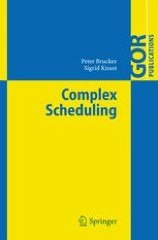
Complex Scheduling
This book deals with such complex scheduling problems and methods to solve them. It consists of three parts: The ?rst part (Chapters 1 and 2) contains a description of basic scheduling models with applications and an introduction into discrete optimization (covering complexity, shortest path algorithms, linear programming, network ?ow algorithms and general optimization methods). In the second part (Chapter 3) resource-constrained project scheduling problems are considered. Especially, methods like constraint propagation, branch-a- bound algorithms and heuristic procedures are described. Furthermore, lower bounds and general objective functions are discussed.
Algorithms on Trees and Graphs : With Python Code
Introduces graph algorithms on an intuitive basis followed by a detailed exposition using structured pseudocode, with correctness proofs as well as worst-case analyses. Centered around the fundamental issue of graph isomorphism, the content goes beyond classical graph problems of shortest paths, spanning trees, flows in networks, and matchings in bipartite graphs. Advanced algorithmic results and techniques of practical relevance are presented in a coherent and consolidated way. Numerous illustrations, examples, problems, exercises, and a comprehensive bibliography support students and professionals in using the book as a text and source of reference. Furthermore, Python code for all algorithms presented is given in an appendix. Topics and features: Algorithms are first presented on an intuitive basis, followed by a detailed exposition using structured pseudocode / Correctness proofs are given, together with a worst-case analysis of the algorithms / Full implementation of all the algorithms in Python / An extensive chapter is devoted to the algorithmic techniques used in the book / Solutions to all the problems
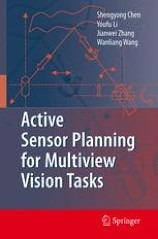
Active Sensor Planning for Multiview Vision Tasks
Describes some effective strategies to generate a sequence of viewing poses and sensor settings for optimally completing a perception task. Several methods are proposed to solve the problems in both model-based and nonmodel-based vision tasks. For model-based applications, the method involves determination of the optimal sensor placements and a shortest path through these viewpoints for automatic generation of a perception plan.
