



Page 1
Page 1

Obstructions in Security-Aware Business Processes : Analysis, Detection, and Handling
This book explores the dilemma-like stalemate between security and regulatory compliance in business processes on the one hand and business continuity and governance on the other. The growing number of regulations, e.g., on information security, data protection, or privacy, implemented in increasingly digitized businesses can have an obstructive effect on the automated execution of business processes. Such security-related obstructions can particularly occur when an access control-based implementation of regulations blocks the execution of business processes. By handling obstructions, security in business processes is supposed to be improved. For this, the book presents a framework that allows the comprehensive analysis, detection, and handling of obstructions in a security-sensitive way. Thereby, methods based on common organizational security policies, process models, and logs are proposed. The Petri net-based modeling and related semantic and language-based research, as well as the analysis of event data and machine learning methods finally lead to the development of algorithms and experiments that can detect and resolve obstructions and are reproducible with the provided software.

Multiagent System Technologies ; 6th German Conference, MATES 2008, Kaiserslautern, Germany, September 23-26, 2008. Proceedings
This book constitutes the refereed proceedings of the 6th German Conference on Multiagent Systems Technologies, MATES 2008, held in Kaiserslautern, Germany, in September 2008 - co-located with the 31st German Conference on Artificial Intelligence, KI 2008.The 16 revised full papers presented together with 2 invited talks were carefully reviewed and selected from 35 submissions. The papers present and discuss the latest advances of research and development in the area of autonomous agents and multiagent systems ranging from theoretical and methodological issues to applications in various fields.

Modelling and Analysis of Hybrid Supervisory Systems : A Petri Net Approach
Modelling and Analysis of Hybrid Supervisory Systems introduces a modelling formalism that merges Petri nets, differential equation systems and object-oriented methods; a formalism that is adequate for modelling complex and large-scale systems. To guide the designer and conduct hybrid modelling, the book describes a method that starts from the requirements of a supervisory system and results in a proposal for such a system. The method is mainly based on Unified Modelling Language diagrams, well-known tools in both academia and industry. In order to ensure that the supervisory system will behave as expected under any operational circumstances, a validation procedure that allows verification of the formal properties of the hybrid model is presented.

Modeling and Control of Discrete-event Dynamic Systems : with Petri Nets and Other Tools
Discrete-event dynamic systems (DEDs) permeate our world, being of great importance in modern manufacturing processes, transportation and various forms of computer and communications networking. Modeling and Control of Discrete-event Dynamic Systems begins with the mathematical basics required for the study of DEDs and moves on to present various tools used in their modeling and control. Among the instruments explained are many forms of Petri net, Grafcet (the sequential function chart), state charts, formal languages and max-plus algebra; all essential for control students to become proficient with DEDs and to make use of them in practical applications.

Membrane Computing; 8th International Workshop, WMC 2007 Thessaloniki, Greece, June 25-28, 2007 Revised Selected and Invited Papers
This volume contains a selection of papers presented at the Eighth Workshop on Membrane Computing, WMC8, which took place in Thessaloniki, Greece, during June 25–28, 2008. Special attention was paid to the interaction of membrane computing with biology and computer science, focusing on the - ological roots of membrane computing, on applications of membrane computing in biology and medicine, and on possible electronically based implementations.
Membrane Computing ; Vol. 3850 ; 6th International Workshop, WMC 2005, Vienna, Austria, July 18-21, 2005, Revised Selected and Invited Papers
The papers in this volume cover all the main directions of research in membrane computing, ranging from theoretical topics in mathematics and computer science, to application issues, especially in biology. More specifically, these papers present research on topics such as: computational power and complexity classes, new types of P systems, relationships to Petri nets, quantum computing, and brane calculi, determinism vs. nondeterminism, hierarchies, the size of small families, algebraic approaches, and designing polynomial solutions to NP-complete problems through the use of membrane systems. Like the previous workshops,

Max-Plus Linear Stochastic Systems and Perturbation Analysis
This book provides a thorough treatment of the theory of stochastic max-plus linear systems. Max-plus algebra is an algebraic approach to discrete event systems (DES), like queuing networks that are prone to synchronization. Perturbation analysis studies the sensitivity of the performance of DES with respect to changes in a particular system parameter.

Introduction to Discrete Event Systems
Introduction to Discrete Event Systems is a comprehensive introduction to the field of discrete event systems, offering a breadth of coverage that makes the material accessible to readers of varied backgrounds. The book emphasizes a unified modeling framework that transcends specific application areas, linking the following topics in a coherent manner: language and automata theory, supervisory control, Petri net theory, Markov chains and queueing theory, discrete-event simulation, and concurrent estimation techniques

Intelligent Agents and Multi-Agent Systems ; 7th Pacific Rim International Workshop on Multi-Agents, PRIMA 2004, Auckland, New Zealand, August 8-13, 2004, Revised Selected Papers
A Combined System for Update Logic and Belief Revision.- Using Messaging Structure to Evolve Agents Roles in Electronic Markets.- Specifying DIMA Multi-agents Models Using Maude.- picoPlangent: An Intelligent Mobile Agent System for Ubiquitous Computing.- An Approach to Safe Continuous Planning.- Modeling e-Procurement as Co-adaptive Matchmaking with Mutual Relevance Feedback.- Price Determination and Profit Sharing for Bidding Groups in Agent-Mediated Auctions.- Agent Based Risk Management Methods for Speculative Actions.- Handling Emergent Resource Use Oscillations.- The Role of Agents in Intelligent Mobile Services.

Integrated formal methods ; 3rd International Conference, IFM 2002, Turku, Finland, May 15-18, 2002. Proceedings.
IFM 2002 explored the relations between formal methods and graphical notations, especially the industrial standard language for software design, the Unified Modeling Language (UML). The themes of IFM 2002 reflect what we believe is a growing trend in the Formal Methods and Software Engineering research communities. Over the last threedecades,computer scientists have developed a range of formalisms focusing on particular aspects of behavior or analysis, such as sequential program structures, concurrent program structures, data and information structures, temporal reasoning, deductive proof, and model checking. Much effort is now being devoted to integrating these methods in order to combine their advantages and ensure they scale up to industrial needs. Graphical notations are now widely used in software engineering and there is growing recognition of the importance of providing these with the for mal underpinnings and form alanalysis capabilities found in formal methods.
Graph Transformation ; 13th International Conference, ICGT 2020, Held as Part of STAF 2020, Bergen, Norway, June 25–26, 2020, Proceedings
This book constitutes the refereed proceedings of the 13th International Conference on Graph Transformation, ICGT 2020, in Bergen, Norway, in June 2020.* The 16 research papers and 4 tool paper presented in this book were carefully reviewed and selected from 40 submissions. One invited paper is also included. The papers deal with the following topics: theoretical advances; application domains; and tool presentations.

Fundamentals of Algebraic Graph Transformation
Graphs are widely used to represent structural information in the form of objects and connections between them. Graph transformation is the rule-based manipulation of graphs, an increasingly important concept in computer science and related fields. This is the first textbook treatment of the algebraic approach to graph transformation, based on algebraic structures and category theory.

Foundations of software science and computation structures ; 21st International conference, FOSSACS 2018, Held as part of the European joint conferences on theory and practice of software, ETAPS 2018, Thessaloniki, Greece, April 14–20, 2018. proceedings
Contains the papers presented at the 21st International Conference on Foundations of Software Science and Computation Structures (FoSSaCS 2018), which was held April 16–19, 2018, in Thessaloniki, Greece. The conference is dedicated to foundational research with a clear significance for software science and brings together research on theories and methods to support the analysis, integration, synthesis,transformation, and verification of programs and software systems.

Foundations of Multi-Paradigm Modelling for Cyber-Physical Systems
This book coherently gathers well-founded information on the fundamentals of and formalisms for modelling cyber-physical systems (CPS). Highlighting the cross-disciplinary nature of CPS modelling, it also serves as a bridge for anyone entering CPS from related areas of computer science or engineering.

Formal Techniques for Networked and Distributed Systems - FORTE 2006 ; 26th IFIP WG 6.1 International Conference, Paris, France, September 26-29, 2006, Proceedings
This book constitutes the refereed proceedings of the 26th IFIP WG 6.1 International Conference on Formal Techniques for Networked and Distributed Systems, FORTE 2006, held in Paris, France, in September 2006. The 26 revised full papers and 4 short papers presented together with 3 invited lectures were carefully reviewed and selected from 177 submissions. The papers focus on the construction of middleware and services using formalised and verified approaches.

Formal Modeling and Analysis of Timed Systems ; Vol.4202 ; 4th International Conference, FORMATS 2006, Paris, France, September 25-27, 2006, Proceedings
The aim of FORMATS is to promote the study of fundamental and practical aspects of timed systems, and to bring together researchers from di?erent d- ciplines that share interests in modelling and analysis of timed systems. In this volume, there are articles on: – Foundations and Semantics: contributions to the theoretical foundations of timed systems and timed formal languages as well as comparison between di?erentmodelsusedbydi?erentcommunities(timedautomata,timedPetri nets, timed MSCs, hybrid automata, timed process algebra, timed temporal logics, timed abstract state machines, as well as probabilistic models). – Methods and Tools: techniques, algorithms, data structures, and software toolsforanalyzingtimedsystemsandresolvingtemporalconstraints(mod- checking, simulation, robustness analysis, scheduling, etc).

Formal Modeling and Analysis of Timed Systems ; Vol. 3829 ; 3rd International Conference, FORMATS 2005, Uppsala, Sweden, September 26-28, 2005, Proceedings
This book constitutes the thoroughly refereed post-proceedings of the Third International Conference on Formal Modeling and Analysis of Timed Systems, FORMATS 2005, held in Uppsala, Sweden in September 2005 in conjunction with ARTIST2 summer school on Component Modelling, Testing and Verification, and Static analysis of embedded systems. The 19 revised full papers presented together with the abstracts of 3 invited talks were carefully selected from 43 submissions. The papers cover work on semantics and modeling of timed systems, formalisms for modeling and verification including timed automata, hybrid automata, and timed petri nets, games for verification and synthesis, model-checking, case studies and issues related to implementation, security and performance analysis.

Formal Modeling and Analysis of Timed Systems ; 6th International Conference, FORMATS 2008, Saint Malo, France, September 15-17, 2008. Proceedings
This book constitutes the refereed proceedings of the 6th International Conference on Formal Modeling and Analysis of Timed Systems, FORMATS 2008, held in Saint Malo, France, September 2008.The 17 revised full papers presented together with 3 invited talks were carefully reviewed and selected from 37 submissions. The papers are organized in topical sections on extensions of timed automata and semantics; timed games and logic; case studies; model-checking of probabilistic systems; verification and test; timed petri nets.
Formal Modeling and Analysis of Timed Systems ; 5th International Conference, FORMATS 2007, Salzburg, Austria, October 3-5, 2007, Proceedings
This volume consists of the proceedings of the Fifth International Conference on Formal Modelling and Analysis of Timed Systems (FORMATS 2007). The main goal of this series of conferences is to bring together diverse communities of researchers that deal with the timing aspects of computing systems.
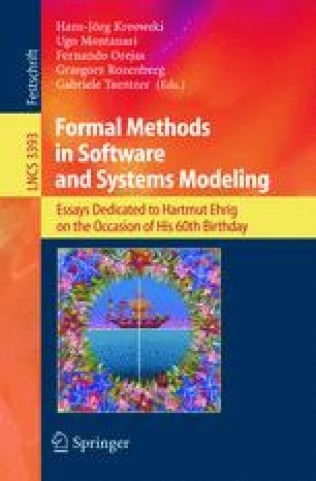
Formal Methods in Software and Systems Modeling : Essays Dedicated to Hartmut Ehrig on the Occasion of His 60th Birthday
By presenting state-of-the-art research results on various aspects of formal and visual modeling of software and systems, this book commemorates the 60th birthday of Hartmut Ehrig. The 24 invited reviewed papers are written by students and collaborators of Hartmut Ehrig who are established researchers in their fields. Reflecting the scientific interest and work of Hartmut Ehrig, the papers fall into three main parts on graph transformation, algebraic specification and logic, and formal and visual modeling.
