



Page 1
Page 1

Mathematics and Mechanics of Granular Materials
Granular or particulate materials arise in almost every aspect of our lives, including many familiar materials such as tea, coffee, sugar, sand, cement and powders. At some stage almost every industrial process involves a particulate material, and it is usually the cause of the disruption to the smooth running of the process. In the natural environment, understanding the behaviour of particulate materials is vital in many geophysical processes such as earthquakes, landslides and avalanches. This book is a collection of current research from some of the major contributors in the topic of modelling the behaviour of granular materials. Papers from every area of current activity are included, such as theoretical, numerical, engineering and computational approaches. This book illustrates the numerous diverse approaches to one of the outstanding problems of modern continuum mechanics.

Investigation and management of soft rock cliffs
Cliff recession and coastal landsliding of soft rock cliffs present significant threats to land use and development. Investigation and management of soft rock cliffs presents state-of-the-art guidance on how eroding cliffs can best be managed, stressing the need to consider both structural and non-structural solutions to cliff recession problems. This authoritative text outlines the investigation approaches, measurement and monitoring techniques, and prediction methods available for obtaining the necessary cliff recession information.

International conference on terrain and geohazard challenges facing onshore oil and gas pipelines : Evaluation, routing, resign, construction, operation ; Proceedings of a three day international conference on terrain and geohazard challenges facing onshore oil and gas pipelines, organised by the Institution of Civil Engineers in association with BP Exploration and held at the Institution of Civil Engineers, London, UK, on 2 – 4 June 2004
To access global oil and gas deposits, major pipelines must traverse remote regions with extreme terrains. There are a significant number of pipeline projects, active or planned, in tropical jungles, mountains and deserts, in permafrost and in areas of wetland. Each of these natural environments is associated with a range of geohazards, which may include landslides, soil erosion, karst, river migration, and seismic or volcanic activity. At the same time, society demands increasing availability and reliability of supply, together with improved environmental standards, all making for substantial challenges.

Ground improvement and reinforced soil structures ; Proceedings of Indian Geotechnical Conference 2020 Vol. 2
This volume comprises the select proceedings of the Indian Geotechnical Conference (IGC) 2020. The contents focus on recent developments in geotechnical engineering for sustainable tomorrow. The volume covers the topics related advances in ground improvement of weak foundation soils for various civil engineering projects and design/construction of reinforced soil structures with different fill materials using synthetic and natural reinforcements in different forms.

Geotechnical Slope Analysis
The influence of initial stresses, pore water pressures and seismic forces has been explored not only on performance indicators such as the ‘Factor of Safety’ but also on the location of critical slip surfaces. In addition to these factors, it is shown that the chosen method of analysis may also have a significant influence on the location of the critical slip surface. This book focuses on research studies concerning slope behaviour, the occurrence of landslides and the use of alternative methods of analysis and interpretation. The importance of uncertainties in slope performance and, more broadly, in geotechnical engineering is emphasised.
Geotechnical Engineering for Disaster Mitigation and Rehabilitation ; Proceedings of the 2nd International Conference GEDMAR08, Nanjing, China 30 May – 2 June, 2008
"Geotechnical Engineering for Disaster Mitigation and Rehabilitation" presents the latest developments and case studies in the field. All contributions to this proceedings were rigorously reviewed to cover the newest developments in disasters related to earthquakes, landslides and slopes, soil dynamics, risk assessment and management, disaster mitigation and rehabilitation, and others.

Eco-and ground bio-engineering : The use of vegetation to improve slope stability ; Proceedings of the 1st International Conference on Eco-Engineering 13-17 September 2004
In an era where climate change, natural catastrophes and land degradation are major issues, the conservation of soil and vegetation in mountainous or sloping regions has become an international priority. How to avoid substrate mass movement through landslides and erosion using sustainable and ecologically sound techniques is rapidly becoming a scientific domain where knowledge from many different fields is required. These proceedings bring together papers from geotechnical and civil engineers, biologists, ecologists and foresters, who discuss current problems in slope stability research, and how to address those problems using ground bio- and eco-engineering techniques.

Developing Tsunami-Resilient Communities : The National Tsunami Hazard Mitigation Program
Tsunamis remain an ever-present threat to lives and property along the coasts of most of the world’s oceans. Because of the geographical extent of U.S. coastlines, an earthquake in Alaska can generate a local tsunami for Alaskans and, hours later, a distant tsunami for communities in Hawaii and along the Pacific Coast . This volume chronicles the development and accomplishments of a joint State/Federal partnership that was forged to reduce tsunami hazards along U.S. coastlines – the National Tsunami Hazard Mitigation Program. By integrating hazard assessment, warning guidance, and mitigation activities, the program has created a roadmap and a set of tools to develop communities more resilient to local and distant tsunamis. Among the set of tools are tsunami forecasting, educational experiments, early alerting systems, and design guidance for tsunami-resilient communities. Part of this book has already been published in a recent journal issue.

Debris-flow Hazards and Related Phenomena
Debris Flow Hazards and Related Phenomena is set to become the standard reference on debris flows, debris avalanches and related phenomena. The editors provide a complete treatment of all aspects of debris flow and debris avalanche research whilst making the book a useful tool for experts, researchers and students. Case studies are provided on a global basis which will illustrate graphically the real problems and real solutions associated with this devastating phenomena. The number of published articles in journals on landslides is literally exploding and where climate change is beginning to affect landslide activity, this book will be a much needed and long sought addition to the literature currently available.
Landslides in research, theory and practice ; Proceedings of the 8th International Symposium on Landslides held in Cardiff on 26–30 June 2000
Contains vital information from throughout the world on landslide and slope instability problems. Every four years the worlds leading scientists and engineers dealing with landslides, have the opportunity to meet up and engage in the exchange of ideas and experiences at a symposium run under the auspices of ISSMGE Technical Committee 11. These volumes, taken from the 8th symposium in the series, detail investigations into landslide causes, mechanisms and hazards, together with accounts of monitoring and mapping.
Landslides from Massive Rock Slope Failure
Amongst the thematic topics discussed are global frequency, impacts on society, analysis of initial rock slope failure, monitoring of rock slope movement, analysis and modeling of post-failure behaviour, volcanic landslides, and influences of massive rock slope failure on the geomorphological evolution of mountain regions. Regional contributions include reports on rockslides and rock avalanches in Norway, western Canada, the Andes of Argentina, the Karakoram Himalaya, the European Alps, the Appennines, and the mountains of Central Asia.
Landslides : Risk Analysis and Sustainable Disaster Management
Based on contributions to the first General Assembly of the International Consortium on Landslides, this reference and status report emphasizes the mechanisms of different types of landslides, landslide risk analysis, and sustainable disaster management. It comprises the achievements of the ICL over the past three years, since the Kyoto assembly. It consists of three parts: research results of the International Programme on Landslides (IPL); contributions on landslide risk analysis; and articles on sustainable disaster management. The contributions reflect a wide range of topics and concerns, randing from field studies, identification of objects of cultural heritage at landslide risk, as well as landslide countermeasures.
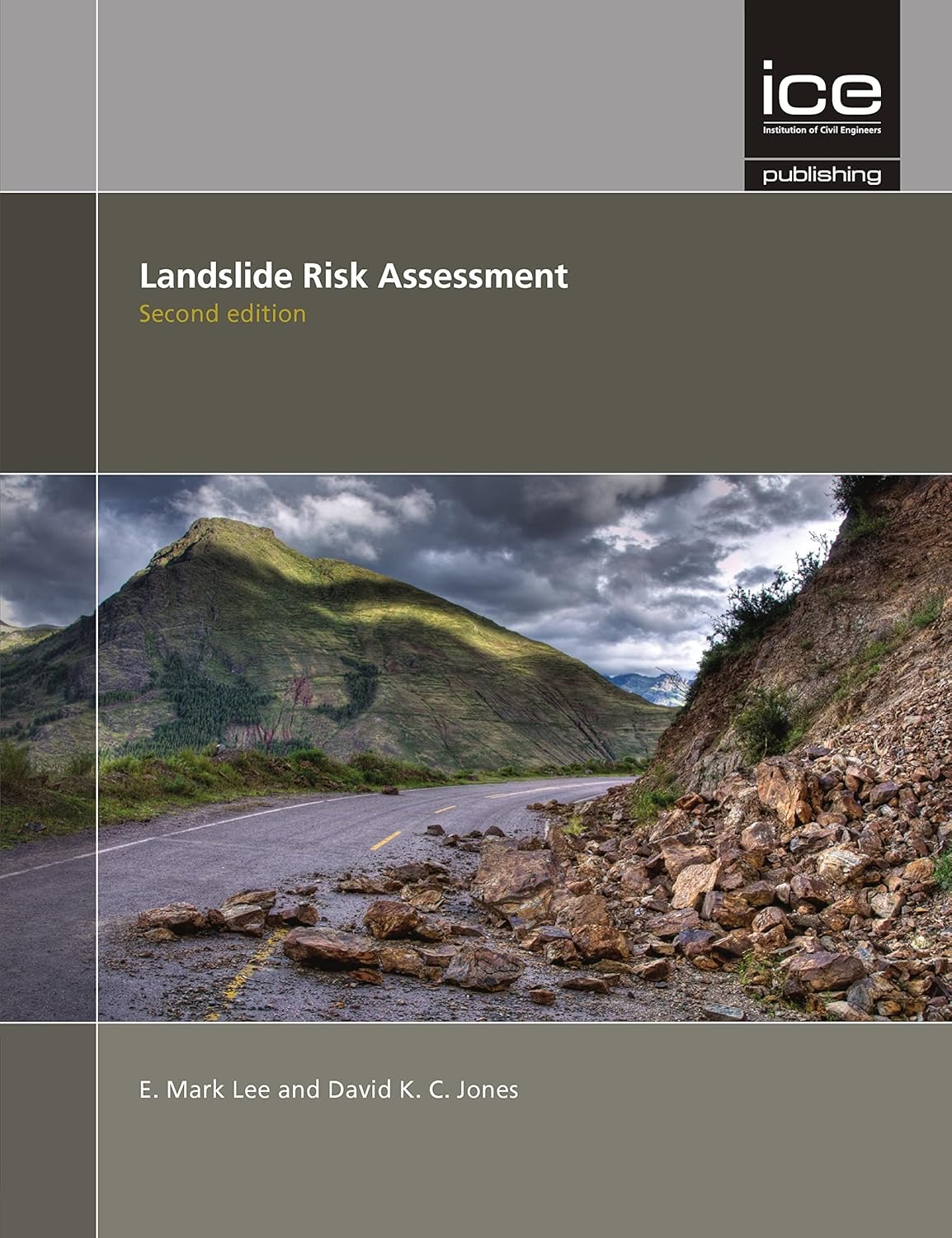
Landslide Risk Assessment ; 2nd ed.
Provides guidance to practitioners on establishing the likelihood and extent to which future slope failures could adversely impact society and affect people and property. The only book to focus on risk and landslides, using examples from across the globe, Landslide Risk Assessment examines a variety of approaches to landslide risk assessment and management, introducing the key challenges that practitioners will need to overcome: estimating the probability and consequences of landsliding, combining these to develop a measure of the risk, and making the transition between risk assessment and risk management.

Landslide risk assessment
Over the past decade there has been a gradual shift away from simply relying on engineering solutions to individual landslide problems, to the use of a variety of strategies to manage the problems over a broad area. Such alternative strategies include the use of building codes, land use planning controls, preventing water leakage, early warning systems and insurance schemes. This book addresses these developments and provides a multidisciplinary perspective on landslide management.
Civil engineering for disaster risk reduction
Brings together all diverse disciplines of civil engineering and related areas (for example, geotechnical engineering, water resources engineering, structural engineering, transportation engineering, environmental engineering, construction management, GIS, and remote sensing) towards a common goal of disaster resilience through an interdisciplinary approach. It contains methods and case studies focusing on civil engineering solutions to reduce the disaster risk. The book contents are aligned in line with the priorities set by UN-Sendai Framework for Disaster Risk Reduction and UN-SDGs to promote a global culture of risk-awareness and disaster reduction. The book will be a useful comprehensive reference for disaster risk reduction beneficial for engineering students, teaching faculty, researchers, industry professionals and policymakers.

Avalanche Dynamics : Dynamics of Rapid Flows of Dense Granular Avalanches
Avalanches, debris, mudflows and landslides are common and natural phenomena that occur worldwide, predominantly in mountainous regions. With an emphasis on snow avalanches, this book sets out to provide a survey and discussion about the motion of avalanche-like flows from initiation to run out. An important aspect of this book is the formulation and investigation of a simple but appropriate continuum mechanical model for the realistic prediction of geophysical flows of granular material. This will help the practitioners in the field to better understand the physical input and provide them with a tool for their work. Originating from many lectures the authors have given over the years, this instructive volume brings the reader to the forefront of research - an aim also supported by an extensive bibliogrpahy of almost 500 entries.
Advancing Culture of Living with Landslides ; Vol. 1 : ISDR-ICL Sendai Partnerships 2015-2025
Contains peer-reviewed papers from the Fourth World Landslide Forum organized by the International Consortium on Landslides (ICL), the Global Promotion Committee of the International Programme on Landslides (IPL), University of Ljubljana (UL) and Geological Survey of Slovenia in Ljubljana, Slovenia from May 29 to June 2, 2017. The complete collection of papers from the Forum is published in five full-color volumes

Advanced computational methods and geomechanics
Helps readers comprehensively grasp the intrinsic features of typical advanced computational methods. These methods are created in recent three decades for the understanding of the post-failure of geo-materials accompanied with discontinuous and finite deformation/dislocation, as well as the violent fluid-structure interaction accompanied with strong distortion of water surface. The strong points and weak points of the formalisms for governing equations, the discretization schemes, the nodal interpolation /approximation of field variables, and their connectivity (via support domains, covers, or enrichments), the basic algorithms, etc., are clarified.
