



Page 1
Page 1

The Grammar of Technology Development
Includes the keynote lecture and fourteen selected papers that - scribe a general guideline and supporting concepts and tools for conceiving technology development as a grammar. The papers collected in this book focus on such new approaches based on these practical requirements. The editors are confident this collection will contribute to the acceleration of technology development through the application of the grammar of technology presented here.

Statistical Design
Although statistical design is one of the oldest branches of statistics, its importance is ever increasing, especially in the face of the data flood that often faces statisticians. It is important to recognize the appropriate design, and to understand how to effectively implement it, being aware that the default settings from a computer package can easily provide an incorrect analysis. The goal of this book is to describe the principles that drive good design, paying attention to both the theoretical background and the problems arising from real experimental situations. Designs are motivated through actual experiments, ranging from the timeless agricultural randomized complete block, to microarray experiments, which naturally lead to split plot designs and balanced incomplete blocks.

Recent Advances in Linear Models and Related Areas : Essays in Honour of Helge Toutenburg
The theory of linear models and regression analysis plays an essential role in the development of methods for the statistical modelling of data. The book presents the most recent developments in the theory and applications of linear models and related areas of active research. The contributions include topics such as boosting, Cox regression models, cluster analysis, design of experiments, feasible generalized least squares, information theory, matrix theory, measurement error models, missing data models, mixture models, panel data models, penalized least squares, prediction, regression calibration, spatial models and time series models. Several contributions illustrate applications in biomedical research, economics, finance, genetic epidemiology and medicine.

Introduction to Engineering Statistics and Six Sigma : Statistical Quality Control and Design of Experiments and Systems
Introduction to Engineering Statistics and Six Sigma contains precise descriptions of all of the many related methods and details case studies showing how they have been applied in engineering and business to achieve millions of dollars of savings. Specifically, the methods introduced include many kinds of design of experiments (DOE) and statistical process control (SPC) charting approaches, failure mode and effects analysis (FMEA), formal optimization, genetic algorithms, gauge reproducibility and repeatability (R&R), linear regression, neural nets, simulation, quality function deployment (QFD) and Taguchi methods. A major goal of the book is to help the reader to determine exactly which methods to apply in which situation and to predict how and when the methods might not be effective.

Designing and evaluating e-management decision tools : The integration of decision and negotiation models into internet-multimedia technologies
Presents the most relevant concepts for designing intelligent decision tools in an Internet-based multimedia environment and assessing the tools using concepts of statistical design of experiments. The book covers : Decision modeling paradigms , Visual interactive decision modeling , Online preference elicitation , collaborative decision making , negotiation and conflict resolution , marketing decision optimization , and guidelines for designing and evaluating decision support tools. This book is designed for the following uses: 1) for researchers and engineers, who are seeking recent advances and who are developing e-management systems; 2) for practitioners and managers, who seek insights about ICT potential and using ICT for business intelligence management; and 3) for students, who seek theoretical and practical concepts of building and evaluating prototype decision tools.

Design and Analysis of Simulation Experiments
This is an advanced expository book on statistical methods for the Design and Analysis of Simulation Experiments (DASE). Though the book focuses on DASE for discrete-event simulation (such as queuing and inventory simulations), it also discusses DASE for deterministic simulation (such as engineering and physics simulations). The text presents both classic and modern statistical designs. Classic designs (e.g., fractional factorials) assume only a few factors with a few values per factor. The resulting input/output data of the simulation experiment are analyzed through low-order polynomials, which are linear regression (meta)models. Modern designs allow many more factors, possible with many values per factor. These designs include group screening (e.g., Sequential Bifurcation, SB) and space filling designs (e.g., Latin Hypercube Sampling, LHS). The data resulting from these modern designs may be analyzed through low-order polynomials for group screening and various metamodel types (e.g., Kriging) for LHS.

Computer Aided Pharmaceutics and Drug Delivery : An Application Guide for Students and Researchers of Pharmaceutical Sciences
Examines the role of computer-assisted techniques for discovering, designing, optimizing and manufacturing new, effective, and safe pharmaceutical formulations and drug delivery systems. The book discusses computational approaches, statistical modeling and molecular modeling for the development and safe delivery of drugs in humans. The application of concepts of QbD (Quality by Design), DoE (Design of Experiments), artificial intelligence and in silico pharmacokinetic assessment/simulation have been made a lot easier with the help of commercial software and expert systems. This title provides in-depth knowledge of such useful software with illustrations from the latest researches. The book also fills in the gap between pharmaceutics and molecular modeling at micro, meso and maro scale by covering topics such as advancements in computer-aided Drug Design (CADD), drug-polymer interactions in drug delivery systems, molecular modeling of nanoparticles and pharmaceutics/bioinformatics.

Collecting spatial data : Optimum design of experiments for random fields
The book is concerned with the statistical theory for locating spatial sensors. It bridges the gap between spatial statistics and optimum design theory. The revised edition contains additional material on design for detecting spatial dependence and for estimating parametrized covariance functions.
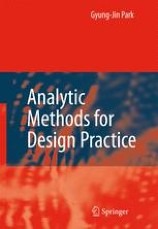
Analytic Methods for Design Practice
In the competitive world of modern engineering, rigorous and definite design methodologies are needed. However, many parts of engineering design are performed in either an ad-hoc manner or based on the intuition of the engineer.Analytic Methods for Design Practice is the first book to look at both stages of the design process – conceptual design and detailed design – and detail design methodologies for every step of the entire design process. The book introduces the following analytic design methodologies and explores their usefulness with many mathematical and practical examples: Axiomatic design; Optimization; Design of experiments; Robust design; Structural optimization; Dynamic response optimization; and Multidisciplinary optimization. A chapter of the book is devoted to case studies showing how practical design problems can be solved with analytic design methods based on Professor Park’s experiences of teaching design engineering over the past ten years.
