



Page 1
Page 1

Particle physics reference library ; Vol.3 : Accelerators and colliders
This third volume of the handbook series deals with accelerator physics, design, technology and operations, as well as with beam optics, dynamics and diagnostics.

Particle Physics Reference Library ; Vol.1 : Theory and Experiments
This first volume of the handbook series contains articles on the standard model of particle physics, both from the theoretical and experimental perspective. It also covers related topics, such as heavy-ion physics, neutrino physics and searches for new physics beyond the standard model.

Particle Accelerator Physics
Particle Accelerator Physics is an in-depth and comprehensive introduction to the field of high-energy particle acceleration and beam dynamics. This textbook is suitable for an intensive two-semester course starting at the advanced undergraduate level.

Particle Accelerator Physics
The present 4th edition has been significantly revised, updated and expanded. The newly conceived Part I is an elementary introduction to the subject matter for undergraduate students. Part II gathers the basic tools in preparation of a more advanced treatment, summarizing the essentials of electrostatics and electrodynamics as well as of particle dynamics in electromagnetic fields. Part III is an extensive primer in beam dynamics, followed, in Part IV, by an introduction and description of the main beam parameters and including a new chapter on beam emittance and lattice design. Part V is devoted to the treatment of perturbations in beam dynamics. Part VI then discusses the details of charged particle acceleration. Parts VII and VIII introduce the more advanced topics of coupled beam dynamics and describe very intense beams – a number of additional beam instabilities are introduced and reviewed in this new edition. Part IX is an exhaustive treatment of radiation from accelerated charges and introduces important sources of coherent radiation such as synchrotrons and free-electron lasers.

Obsessed by a Dream: The Physicist Rolf Widerøe – a Giant in the History of Accelerators
This biography chronicles the life and achievements of the Norwegian engineer and physicist Rolf Widerøe. Readers who meet him in the pages of this book will wonder why he isn't better known.
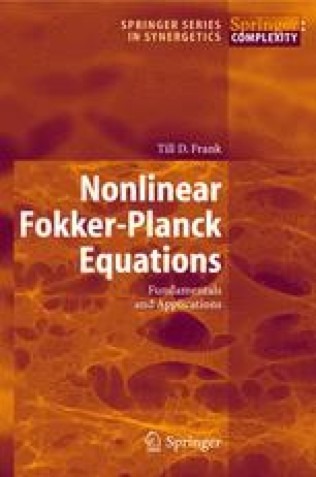
Nonlinear Fokker-Planck Equations : Fundamentals and Applications
Providing an introduction to the theory of nonlinear Fokker-Planck equations, this book discusses fundamental properties of transient and stationary solutions, emphasizing the stability analysis of stationary solutions by means of self-consistency equations, linear stability analysis, and Lyapunov's direct method. Also treated are Langevin equations and correlation functions. Nonlinear Fokker-Planck Equations addresses various phenomena such as phase transitions, multistability of systems, synchronization, anomalous diffusion, cut-off solutions, travelling-wave solutions and the emergence of power law solutions. A nonlinear Fokker-Planck perspective to quantum statistics, generalized thermodynamics, and linear nonequilibrium thermodynamics is given. Theoretical concepts are illustrated where possible by simple examples. The book also reviews several applications in the fields of condensed matter physics, the physics of porous media and liquid crystals, accelerator physics, neurophysics, social sciences, population dynamics, and computational physics.

Electromagnetic Radiation : Variational Methods, Waveguides and Accelerators
This is a graduate level textbook on the theory of electromagnetic radiation and its application to waveguides, transmission lines, accelerator physics and synchrotron radiation. It has grown out of lectures and manuscripts by Julian Schwinger prepared during the war at MIT's Radiation Laboratory, updated with material developed by Schwinger at UCLA in the 1970s and 1980s, and by Milton at the University of Oklahoma since 1994. The book includes a great number of straightforward and challenging exercises and problems. It is addressed to students in physics, electrical engineering, and applied mathematics seeking a thorough introduction to electromagnetism with emphasis on radiation theory and its applications.

Construction of Mappings for Hamiltonian Systems and Their Applications
Based on the method of canonical transformation of variables and the classical perturbation theory, this innovative book treats the systematic theory of symplectic mappings for Hamiltonian systems and its application to the study of the dynamics and chaos of various physical problems described by Hamiltonian systems. It develops a new, mathematically-rigorous method to construct symplectic mappings which replaces the dynamics of continuous Hamiltonian systems by the discrete ones. Applications of the mapping methods encompass the chaos theory in non-twist and non-smooth dynamical systems, the structure and chaotic transport in the stochastic layer, the magnetic field lines in magnetically confinement devices of plasmas, ray dynamics in waveguides, etc. The book is intended for postgraduate students and researches, physicists and astronomers working in the areas of plasma physics, hydrodynamics, celestial mechanics, dynamical astronomy, and accelerator physics. It should also be useful for applied mathematicians involved in analytical and numerical studies of dynamical systems.
