



Page 1
Page 1

Open IT-Based Innovation : Moving Towards Cooperative IT Transfer and Knowledge Diffusion ; IFIP TC8 WG 8.6 International Working Conference October 22–24, 2008, Madrid, Spain
The IFIP series publishes state-of-the-art results in the sciences and technologies of information and communication. The scope of the series includes: foundations of computer science; software theory and practice; education; computer applications in technology; communication systems; systems modeling and optimization; information systems; computers and society; computer systems technology; security and protection in information processing systems; artificial intelligence; and human-computer interaction. Proceedings and post-proceedings of refereed international conferences in computer science and interdisciplinary fields are featured.

Ontology Management : Semantic Web, Semantic Web Services, and Business Applications
This volume describes relevant tasks, practical and theoretical challenges, limitations and methodologies, plus available software tools. The editors discuss integrating the conceptual and technical dimensions with a business view on using ontologies, by stressing the cost dimension of ontology engineering and by providing guidance on how up-to-date tooling helps to build, maintain, and use ontologies. Also included is a one-stop reference on all aspects of managing ontological data and best practices on ontology management for a number of application domains.
Ontologies-Based Databases and Information Systems ; 1st and Second VLDB Workshops, ODBIS 2005/2006 Trondheim, Norway, September 2-3, 2005 Seoul, Korea, September 11, 2006 Revised Papers
This book constitutes the refereed post-proceedings of the First and Second VLDB Workshop Ontologies-based techniques for DataBases and Information Systems, held in Trondheim, Norway, September 2005 and Seoul, Korea, September 2006.

Ontologies for Urban Development
Action C21 of the European programme for Cooperation in the field of Scientific and Technical Research (COST—http://www.cost.esf.org/) is dedicated to investigating urban ontologies for an improved communication in urban civil engineering projects. The Action, known informally as "Towntology", brings together a large and heterogeneous grouping from across Europe, whose interests range from construction to urban tourism and from transport infrastructure to resource visualisation. On 6-7 November 2006, in Geneva, the Action convened a successful workshop to address emerging issues in the field. This volume presents the contributions to that workshop, in many cases revised afterwards to capture some of the outcomes of discussion.
Ontologies for Software Engineering and Software Technology
The editors structured the contributions into three parts: first, a detailed introduction into the use of ontologies in software engineering and software technology in general; second, the use of ontologies to conceptualize different process-related domains such as software maintenance, software measurement, or SWEBOK, initiated by IEEE; third, the use of ontologies as artifacts in several software processes, like, for example, in OMG’s MOF or MDA.
Ontologies for Agents : Theory and Experiences
On the other hand, ontologies have established themselves as a powerful tool to enable kno- edge sharing, and a growing number of applications have bene?ted from the use of ontologies as a means to achieve semantic interoperability among heterogeneous, distributed systems. In principle ontologies and agents are a match made in heaven, that has failed to happen. What makes a simple piece of software an agent is its ability to communicate in a ”social” environment, to make autonomous decisions, and to be proactive on behalf of its user. Communication ultimately depends on und- standing the goals, preferences, and constraints posed by the user. Autonomy is theabilitytoperformataskwithlittleornouserintervention,whileproactiveness involves acting autonomously with no need for user prompting. Communication, but also autonomy and proactiveness, depend on knowledge. The ability to c- municate depends on understanding the syntax (terms and structure) and the semantics of a language. Ontologies provide the terms used to describe a domain and the semantics associated with them. In addition, ontologies are often comp- mented by some logical rules that constrain the meaning assigned to the terms. These constraints are represented by inference rules that can be used by agents to perform the reasoning on which autonomy and proactiveness are based.
Ontologies : A Handbook of Principles, Concepts and Applications in Information Systems
The primary objective of ONTOLOGIES: A Handbook of Principles, Concepts and Applications in Information Systems is to mobilize a collective awareness in the research community to the leading and emerging developments in ODIS, and consequently, highlight the enormous potential of ODIS research to both fundamentally transform and create innovative solutions to several problems in various domains. This book is a compilation of 32 leading-edge chapter contributions from some of the top researchers in the community working in various fundamental and applied disciplines related to ODIS. These chapters are organized into four broad themes: Foundations of ODIS, Ontological Engineering, ODIS Architectures, and ODIS Applications.

One Hundred Years of Chemical Warfare : Research, Deployment, Consequences
On April 22, 1915, the German military released 150 tons of chlorine gas at Ypres, Belgium. Carried by a long-awaited wind, the chlorine cloud passed within a few minutes through the British and French trenches, leaving behind at least 1,000 dead and 4,000 injured. This chemical attack, which amounted to the first use of a weapon of mass destruction, marks a turning point in world history. The preparation as well as the execution of the gas attack was orchestrated by Fritz Haber, the director of the Kaiser Wilhelm Institute for Physical Chemistry and Electrochemistry in Berlin-Dahlem. During World War I, Haber transformed his research institute into a center for the development of chemical weapons (and of the means of protection against them).

Oncogenes Meet Metabolism : From Deregulated Genes to a Broader Understanding of Tumour Physiology
In 1920s, Otto Warburg described the phenomenon of ‘aerobic glycolysis’, the ability of tumour cells to convert glucose to lactate in the presence of normal oxygen conditions. Warburg’s hypothesis of an altered metabolism in cancer cells found no immediate acceptance, though it was latter confirmed for most human tumours. With the advent of molecular biology the focus in tumour research has shifted towards the search for oncogenes. However, the interest in cancer molecular profiling eventually led to a renaissance of the Warburg effect trying to combine genetic alterations with effects on metabolism with the help of modern analytic technologies to rapidly analyze broad varieties of metabolites in various tissues and bodyfluids (metabonomics).

On the Way to the Web : The Secret History of the Internet and its Founders
On the Way to the Web: The Secret History of the Internet and Its Founders is an absorbing chronicle of the inventive, individualistic, and often cantankerous individuals who set the Internet free. Michael A. Banks describes how the online population created a new culture and turned a new frontier into their vision of the future. This book will introduce you to the innovators who laid the foundation for the Internet and the World Wide Web, the man who invented online chat, and the people who invented the products all of us use online every day. Learn where, when, how and why the Internet came into being, and exactly what hundreds of thousands of people were doing online before the Web. See who was behind it all, and what inspired them.
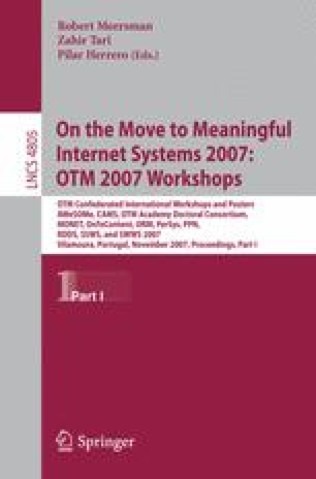
On the move to meaningful internet systems 2007 : OTM 2007 Workshops ; OTM Confederated International Workshops and Posters, AWeSOMe, CAMS, OTM Academy Doctoral Consortium, MONET, OnToContent, ORM, PerSys, PPN, RDDS, SSWS, and SWWS 2007, Vilamoura, Portugal, November 25-30, 2007,
it is clear that there is an acute and increasing need to address and discuss in an integrated forum the implied software and system issues as well as methodological, semantical, theoretical and application issues. As we all know, e-mail, the Internet, and even video conferences are not sufficient for effective and efficient scientific exchange. This is why the OnTheMove (OTM) Federated Conferences series has been created to cover the increasingly wide yet closely connected range of fundamental technologies such as data and Web Semantics.

On the move to meaningful internet systems 2007 : OTM 2007 Workshops ; OTM Confederated International Workshops and Posters, AWeSOMe, CAMS, OTM Academy Doctoral Consortium, MONET, On To Content, ORM, PerSys, PPN, RDDS, SSWS, and SWWS 2007, Vilamoura, Portugal, November 25-30, 2007, Proceedings, Part II
This two-volume set LNCS 4805/4806 constitutes the refereed proceedings of 10 international workshops and papers of the OTM Academy Doctoral Consortium held as part of OTM 2007 in Vilamoura, Portugal, in November 2007. The first volume begins with 23 additional revised short or poster papers of the OTM 2007 main conferences.
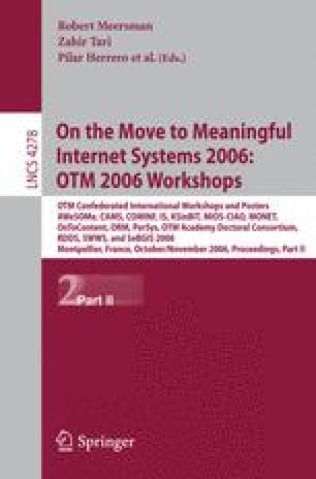
On the move to meaningful internet systems 2006 : OTM 2006 Workshops ; Vol.4278 ; OTM Confederated International Conferences and Posters, AWeSOMe, CAMS, COMINF ,IS, KSinBIT, MIOS-CIAO, MONET, On To Content, ORM, PerSys, OTM Academy Doctoral Consortium, RDDS,SWWS,SeBGIS 2006, Montpellier, France, October 29 - November 3, 2006, Proceedings, Part II
This two-volume set LNCS 4277/4278 constitutes the refereed proceedings of 14 international workshops held as part of OTM 2006 in Montpellier, France in October/November 2006. The first volume begins with 26 additional revised short or poster papers of the OTM 2006 main conferences.
On the move to meaningful internet systems 2005 : OTM 2005 Workshops ; OTM Confederated International Workshops and Posters, AWeSOMe, CAMS, GADA. MIOS+INTEROP, ORM, PhDS, SeBGIS. SWWS. and WOSE 2005, Agia Napa, Cyprus, October 31 - November 4, 2005, Proceedings
This book constitutes the joint refereed proceedings of nine international workshops held as part of OTM 2005 in Agia Napa, Cyprus in October/November 2005.The 145 revised full papers presented were carefully reviewed and selected from a total of 268 submissions. Topics addressed are agents, Web services and ontologies merging (AWeSOMe 2005), context-aware mobile systems (CAMS 2005), grid computing and its application to data analysis (GADA 2005), inter-organizational systems and interoperability of enterprise software and applications (MIOS+INTEROP 2005), object-role modeling (ORM 2005), a PHD symposium (PhDS 2005), semantic-based geographical information systems (SeBGIS 2005), Web semantics (SWWS 2005), and ontologies, semantics and e-learning (WOSE 2005)

On the move to meaningful internet systems : OTM 2008 Workshops ; OTM Confederated International Workshops and Posters, ADI, AWeSoMe, COMBEK, EI2N, IWSSA, MONET, OnToContent + QSI, ORM, PerSys, RDDS, SEMELS, and SWWS 2008, Monterrey, Mexico, November 9-14, 2008. Proceedings
This volume constitutes the refereed proceedings of 13 international workshops held as part of OTM 2008 in Monterrey, Mexico, in November 2008.The 106 revised full papers presented were carefully reviewed and selected from a total of 171 submissions to the workshops. The volume starts with 19 additional revised poster papers of the OTM 2008 main conferences CoopIS and ODBASE. Topics of the workshop papers are ambient data integration (ADI 2008), agents and web services merging in distributed environment (AWeSoMe 2008), community-based evolution of knowledge-intensive systems (COMBEK 2008), enterprise integration, interoperability and networking (EI2N 2008), system/software architectures .

On the construction of engineering handbooks : With an Illustration from the railway safety domain
This book is the first to reflect upon the question of how to construct a desktop handbook. It is demonstrated how concept analysis can be used for identifying settled knowledge as the key ingredient by utilizing the assembled data for classification; a presentation scheme for handbook articles is developed and demonstrated to be suitable. The sketched approach is then illustrated by an example from the railway safety domain. Finally, the limitations of the presented methods are discussed.

omputer science : Theory and applications ; 3rd International computer science symposium in Russia, CSR 2008 Moscow, Russia, June 7-12, 2008 Proceedings
This book constitutes the refereed proceedings of the Third International Computer Science Symposium in Russia, CSR 2008, held in Moscow, Russia, June 7-12, 2008.

Omega-3 fatty acids : Keys to nutritional health
Argues for the importance of essential nutrients in our diet. Over the last two decades there has been an explosion of research on the relationship of Omega-3 fatty acids and the importance of antioxidants to human health. Expert authors discuss the importance of a diet rich in Omega-3 Fatty acids for successful human growth and development and for the prevention of disease. Chapters highlight their contribution to the prevention and amelioration of a wide range of conditions such as heart disease, diabetes, arthritis, cancer, obesity, mental health and bone health.

OMDoc : An Open Markup Format for Mathematical Documents [version 1.2]
Computers arechanging the way wethink. Of course,nearly all desk-workers have access to computers and use them to email their colleagues, search the Web for information and prepare documents. But I’m not referring to that. I mean that people have begun to think about what they do in compu- tional terms and to exploit the power of computers to do things that would previously have been unimaginable. This observation is especially true of mathematicians.

Olfactory knows the truth
Olfaction, the sense of smell detects and discriminate odors as well as social cues which influence our innate responses. The olfactory system in human beings is found to be weak as compared to other animals; however, it seems to be very precise. It can detect and discriminate millions of chemical moieties (odorants) even in minuscule quantities. The sense of smell is greatly underappreciated, despite the fact that it monitors the intake of airborne agents into the human respiratory system and determine to a large degree the flavor and palatability of foods and beverage. In addition to enhancing quality of life, this primary sensory system warns of spoiled foods, leaking natural gas, polluted air and smoke, and mediates basic elements of communication (e.g., mother-infant interaction). It is now apparent that smell dysfunction is among the first clinical signs of such neurodegenerative diseases as Alzheimer’s disease and sporadic Parkinson’s disease.
