



Page 1
Page 1
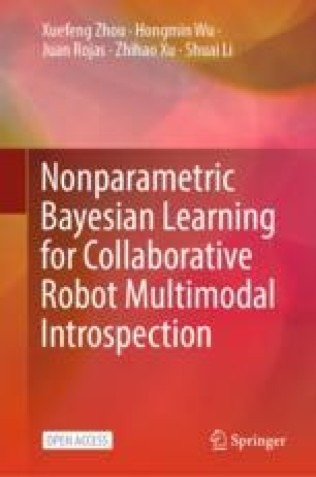
Nonparametric Bayesian Learning for Collaborative Robot Multimodal Introspection
This book focuses on robot introspection, which has a direct impact on physical human–robot interaction and long-term autonomy, and which can benefit from autonomous anomaly monitoring and diagnosis, as well as anomaly recovery strategies.

Nonbayesian Decision Theory : Beliefs and Desires as Reasons for Action
This book aims to present an account of rational choice from a non-Bayesian point of view. Rational agents maximize subjective expected utility, but contrary to what is claimed by Bayesians, the author argues that utility and subjective probability should not be defined in terms of preferences over uncertain prospects. To some extent, the author’s non-Bayesian view gives a modern account of what decision theory could have been like, had decision theorists not entered the Bayesian path discovered by Ramsey, Savage, and Jeffrey. The author argues that traditional Bayesian decision theory is unavailing from an action-guiding perspective. For the deliberating Bayesian agent, the output of decision theory is not a set of preferences over alternative acts - these preferences are on the contrary used as input to the theory.

New Introduction to Multiple Time Series Analysis
This reference work and graduate level textbook considers a wide range of models and methods for analyzing and forecasting multiple time series. The models covered include vector autoregressive, cointegrated,vector autoregressive moving average, multivariate ARCH and periodic processes as well as dynamic simultaneous equations and state space models. Least squares, maximum likelihood and Bayesian methods are considered for estimating these models. Different procedures for model selection and model specification are treated and a wide range of tests and criteria for model checking are introduced. Causality analysis, impulse response analysis and innovation accounting are presented as tools for structural analysis. The book is accessible to graduate students in business and economics. In addition, multiple time series courses in other fields such as statistics and engineering may be based on it. Applied researchers involved in analyzing multiple time series may benefit from the book as it provides the background and tools for their tasks. It bridges the gap to the difficult technical literature on the topic.

Multivariate Statistical Machine Learning Methods for Genomic Prediction
This book brings together the latest genome base prediction models currently being used by statisticians, breeders and data scientists. It provides an accessible way to understand the theory behind each statistical learning tool, the required pre-processing, the basics of model building, how to train statistical learning methods, the basic R scripts needed to implement each statistical learning tool, and the output of each tool. To do so, for each tool the book provides background theory, some elements of the R statistical software for its implementation, the conceptual underpinnings, and at least two illustrative examples with data from real-world genomic selection experiments.

Multi-Sensor Data Fusion : An Introduction
This textbook provides a comprehensive introduction to the theories and techniques of multi-sensor data fusion. It is aimed at advanced undergraduate and first-year graduate students in electrical engineering and computer science, as well as researchers and professional engineers. The book is intended to be self-contained. No previous knowledge of multi-sensor data fusion is assumed, although some familiarity with the basic tools of linear algebra, calculus and simple probability theory is recommended.

Multiscale Modeling : A Bayesian Perspective
The book is aimed at statisticians, applied mathematicians, and engineers working on problems dealing with multiscale processes in time and/or space, such as in engineering, finance, and environmetrics. The book will also be of interest to those working on multiscale computation research. The main prerequisites are knowledge of Bayesian statistics and basic Markov chain Monte Carlo methods. A number of real-world examples are thoroughly analyzed in order to demonstrate the methods and to assist the readers in applying these methods to their own work. To further assist readers, the authors are making source code (for R) available for many of the basic methods discussed herein.

Multiple Classifier Systems ; 7th International Workshop, MCS 2007, Prague, Czech Republic, May 23-25, 2007, Proceedings
These proceedings are a record of the Multiple Classifier Systems Workshop, MCS 2007, held at the Institute of Information Theory and Automation, Czech Academy of Sciences, Prague in May 2007. the workshop achieved its objective of bringing together researchers from diverse communities (neural networks, pattern rec- nition, machine learning and statistics) concerned with this research topic.

Modeling Decisions for Artificial Intelligence ; Vol.3885 ; 3rd International Conference, MDAI 2006, Tarragona, Spain, April 3-5, 2006, Proceedings
This book constitutes the refereed proceedings of the Third International Conference on Modeling Decisions for Artificial Intelligence, MDAI 2006, held in Tarragona, Spain, in April 2006.

Modeling biological systems : Principles and applications
This extensively revised second edition of Modeling Biological Systems: Principles and Applications describes the essentials of creating and analyzing mathematical and computer simulation models for advanced undergraduates and graduate students. It offers a comprehensive understanding of the underlying principle, as well as details and equations applicable to a wide variety of biological systems and disciplines. Students will acquire from this text the tools necessary to produce their own models. The text contains two major sections: Principles and Applications. The first section discusses the principles of biological systems with a thorough description of the essential modeling activities of formulation, implementation, validation, and analysis. These activities are illustrated by a set of example models taken from recent and classical literature, chosen for their breadth of coverage and current timeliness. The new edition updates extensively many of these topics, especially quantitative model formulation, validation and model discrimination using information theory measures and Bayesian probability, and stability analysis and non-dimensionalization.

Model-Based Reasoning in Science, Technology, and Medicine
The volume is based on the papers that were presented at the international conference Model-Based Reasoning in Science and Medicine (MBR’06 China), held at Sun Yat-sen University, Guangzhou, P.R. China in July 2006. The presentations given at the conference explored how scientific thinking uses models and explanatory reasoning to produce creative changes in theories and concepts. Some addressed the problem of model-based reasoning in technology, and stressed the issue of technological innovation and medical reasoning. The various contributions of the book are written by interdisciplinary researchers who are active in the area of creative reasoning in science and technology: the most recent results and achievements about the topics above are illustrated in detail in the papers.
Introduction to Bayesian Statistics
This is the second and translated edition of the German book “Einf ̈uhrung in die Bayes-Statistik, Springer-Verlag, Berlin Heidelberg New York, 2000”. It has been completely revised and numerous new developments are pointed out together with the relevant literature. The Chapter 5.2.4 is extended by the stochastic trace estimation for variance components. The new Chapter 5.2.6 presents the estimation of the regularization parameter of type Tykhonov regularization for inverse problems as the ratio of two variance components.The reconstruction and the smoothing of digital three-dimensional images is demonstrated in the new Chapter 5.3. The Chapter 6.2.1 on importance sampling for the Monte Carlo integration is rewritten to solve a more general integral. This chapter contains also the derivation of the SIR (sampling-importance-resampling) algorithm as an alternative to the rejection method for generating random samples. Markov Chain Monte Carlo methods are now frequently applied in Bayesian statistics.
Introduction to Bayesian Scientific Computing : Ten Lectures on Subjective Computing
Inverse problems are closely related to statistical inference problems, where the observations are used to infer on an underlying probability distribution. This connection between statistical inference and inverse problems is a central topic of the book. Inverse problems are typically ill-posed: small uncertainties in data may propagate in huge uncertainties in the estimates of the unknowns. To cope with such problems, efficient regularization techniques are developed in the framework of numerical analysis. The counterpart of regularization in the framework of statistical inference is the use prior information.

Intelligent Tutoring Systems ; 8th International Conference, ITS 2006, Jhongli, Taiwan, June 26-30, 2006 Proceedings
This book constitutes the refereed proceedings of the 8th International Conference on Intelligent Tutoring Systems, ITS 2006, held in Jhongli, Taiwan in June 2006. The 67 revised full papers and 40 poster papers presented together with abstracts of 6 keynote talks were carefully reviewed and selected from over 200 submissions. The papers are organized in topical sections on assessment, authoring tools, bayesian reasoning and decision-theoretic approaches, case-based and analogical reasoning, cognitive models, collaborative learning, elearning and web-based intelligent tutoring systems, error detection and handling, feedback, gaming behavior, learner models, motivation, natural language techniques for intelligent tutoring systems, scaffolding, simulation, as well as tutorial dialogue and narrative.

Intelligent information processing III ; IFIP TC12 International Conference on Intelligent Information Processing (IIP 2006), September 20-23, Adelaide, Australia
The IFIP series publishes state-of-the-art results in the sciences and technologies of information and communication. The principal aim of the IFIP series is to encourage education and the dissemination and exchange of information about all aspects of computing.

Intelligent data engineering and automated Learning - IDEAL 2008 ; 9th International Conference Daejeon, South Korea, November 2-5, 2008 Proceedings
This book constitutes the refereed proceedings of the 9th International Conference on Intelligent Data Engineering and Automated Learning, IDEAL 2008, held in Daejeon, Korea, in November 2008.The 56 revised full papers presented together with 10 invited papers were carefully reviewed and selected from numerous submissions for inclusion in the book. The papers are organized in topical sections on learning and information processing, data mining and information management, bioinformatics and neuroinformatics, agents and distributed systems, as well as financial engineering and modeling.

Intelligent Algorithms in Ambient and Biomedical Computing
The rapid growth in electronic systems in the past decade has boosted research in the area of computational intelligence. As it has become increasingly easy to generate, collect, transport, process, and store huge amounts of data, the role of intelligent algorithms has become prominent in order to visualize, manipulate, retrieve, and interpret the data. For instance, intelligent search techniques have been developed to search for relevant items in huge collections of web pages, and data mining and interpretation techniques play a very important role in making sense out of huge amounts of biomolecular measurements. As a result, the added value of many modern systems is no longer determined by hardware only, but increasingly by the intelligent software that supports and facilitates the user in realizing his or her objectives.

Innovations in Bayesian Networks : Theory and Applications
Bayesian networks currently provide one of the most rapidly growing areas of research in computer science and statistics. In compiling this volume we have brought together contributions from some of the most prestigious researchers in this field.

Information Processing in Medical Imaging ; 20th International Conference, IPMI 2007, Kerkrade, The Netherlands, July 2-6, 2007, Proceedings
The 20th International Conference on Information Processing in Medical Im- ing(IPMI)washeldduringJuly2–6,2007,atRolducAbbey,locatedinKerkrade in the south of the Netherlands. IPMI is one of the longest running conferences in medical imaging.

Information criteria and statistical modeling
One of the main objectives of this book is to provide comprehensive explanations of the concepts and derivations of the AIC and related criteria, including Schwarz’s Bayesian information criterion (BIC), together with a wide range of practical examples of model selection and evaluation criteria. A secondary objective is to provide a theoretical basis for the analysis and extension of information criteria via a statistical functional approach. A generalized information criterion (GIC) and a bootstrap information criterion are presented, which provide unified tools for modeling and model evaluation for a diverse range of models, including various types of nonlinear models and model estimation procedures such as robust estimation, the maximum penalized likelihood method and a Bayesian approach.

Inference in Hidden Markov Models
This book is a comprehensive treatment of inference for hidden Markov models, including both algorithms and statistical theory. Topics range from filtering and smoothing of the hidden Markov chain to parameter estimation, Bayesian methods and estimation of the number of states.In a unified way the book covers both models with finite state spaces, which allow for exact algorithms for filtering, estimation etc. and models with continuous state spaces (also called state-space models) requiring approximate simulation-based algorithms that are also described in detail. Simulation in hidden Markov models is addressed in five different chapters that cover both Markov chain Monte Carlo and sequential Monte Carlo approaches. Many examples illustrate the algorithms and theory. The book also carefully treats Gaussian linear state-space models and their extensions and it contains a chapter on general Markov chain theory and probabilistic aspects of hidden Markov models.
