



Page 1
Page 1

Ontology Management : Semantic Web, Semantic Web Services, and Business Applications
This volume describes relevant tasks, practical and theoretical challenges, limitations and methodologies, plus available software tools. The editors discuss integrating the conceptual and technical dimensions with a business view on using ontologies, by stressing the cost dimension of ontology engineering and by providing guidance on how up-to-date tooling helps to build, maintain, and use ontologies. Also included is a one-stop reference on all aspects of managing ontological data and best practices on ontology management for a number of application domains.

Ontology Learning and Population from Text: Algorithms, Evaluation and Applications
Ontology Learning and Population from Text: Algorithms, Evaluation and Applications presents approaches for ontology learning from text and will be relevant for researchers working on text mining, natural language processing, information retrieval, semantic web and ontologies. Containing introductory material and a quantity of related work on the one hand, but also detailed descriptions of algorithms, evaluation procedures etc. on the other, this book is suitable for novices, and experts in the field, as well as lecturers.

Ontologies-Based Business Integration
E-business integration is a vision we have developed over a long period of time. As we have worked in business practice for many years prior to and in parallel with our academic research, we have always thought of such - tegration not only as an intellectual challenge but also as a real business tool. Consequently, when we started our project on Ontologies-based R- onciliation for Business Integration (ORBI) in 2004, not only pure science but also business objectives were at the center of our research. We were very happy to be able to form a project consortium that consisted not only of renowned researchers but also of experienced business practitioners from a range of companies. Each played a specific role – as user, provider or co-developer of the application components that are based on the me- ods we have developed. So may this book find its way not only to the desks of researchers and students, but also into the offices and minds of business practitioners worldwide who are dealing with the challenge of integrating their business processes, applications and information.
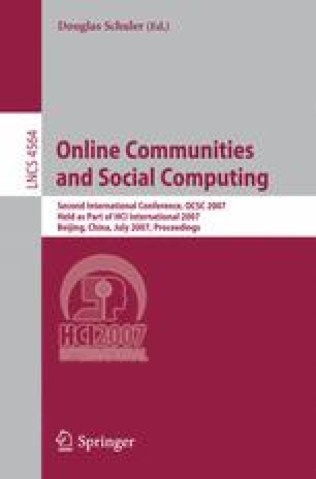
Online Communities and Social Computing ; 2nd International Conference, OCSC 2007, Held as Part of HCI International 2007, Beijing, China, July 22-27, 2007, Proceedings
The 12th International Conference on Human-Computer Interaction, HCI Inter- tional 2007, was held in Beijing, P.R. China, 22-27 July 2007. This volume, edited by Douglas Schuler, contains papers in the thematic area of Online Communities and Social Computing, addressing the following major topics: • Designing and Developing On-line Communities • Knowledge, Collaboration, Learning and Local On-line Communities

On the move to meaningful internet systems : OTM 2008 ; OTM 2008 Confederated International Conferences, CoopIS, DOA, GADA, IS, and ODBASE 2008, Monterrey, Mexico, November 9-14, 2008, Proceedings, Part I
This two-volume set LNCS 5331/5332 constitutes the refereed proceedings of the five confederated international conferences on Cooperative Information Systems (CoopIS 2008), Distributed Objects and Applications (DOA 2008), Grid computing, high performAnce and Distributed Applications (GADA 2008), Information Security (IS 2008), and Ontologies, Databases and Applications of Semantics (ODBASE 2008), held as OTM 2008 in Monterrey, Mexico, in November 2008.

OMDoc : An Open Markup Format for Mathematical Documents [version 1.2]
Computers arechanging the way wethink. Of course,nearly all desk-workers have access to computers and use them to email their colleagues, search the Web for information and prepare documents. But I’m not referring to that. I mean that people have begun to think about what they do in compu- tional terms and to exploit the power of computers to do things that would previously have been unimaginable. This observation is especially true of mathematicians.

New Frontiers in Applied Artificial Intelligence ; 21st International Conference on Industrial, Engineering and Other Applications of Applied Intelligent Systems, IEA/AIE 2008 Wrocław, Poland, June 18-20, 2008 Proceedings
The 75 revised full papers presented were carefully reviewed and selected from 302 submissions. The papers are organized in topical sections on computer vision, fuzzy system applications, robot and manufacturing, data mining and KDS, neural networks, machine learning, natural language processing, internet application and education, heuristic search, application systems, agent-based system, evolutionary and genetic algorithms, knowledge management, and other applications. The book concludes with 15 contributions from the following special sessions: knowledge driven manufacturing systems, joint session on adaptive networked systems and fuzzy knowledge bases, and software agents and multi-agent systems.

Network-Centric Service-Oriented Enterprise
Network-Centric Service-Oriented Enterprise (NSCOE) is seen as heralding the next generation of mainstream Enterprise-business information collaboration solution that can enforce information and decision superiority in the decentralized, loosely-coupled, and highly interoperable service environments. Network-Centric Service Oriented Enterprise establishes a system-of-systems (SoS) view of information technologies, offering a synergistic combination of data and information-processing capacity upon an innovative networked-management framework.

Multimedia Semantics : The Role of Metadata
This book gives an overview on fundamental issues within the field of multimedia metadata focusing on contextualized, ubiquitous, accessible and interoperable services on a higher semantic level. The book in hand provides a selection of basic articles being a base for multimedia metadata research. Furthermore it presents a view on the current state of the art in multimedia metadata research.

Modeling and Retrieval of Context ; 2nd International Workshop, MRC 2005, Edinburgh, UK, July 31-August 1, 2005, Revised Selected Papers
Computing in context has become a necessity in modern and intelligent IT - plications. With the use of mobile devices and current research on ubiquitous computing, context-awareness has become a major issue. However, context and context-awareness are crucial not only for mobile and ubiquitous computing. They are also vital for spanning various application areas, such as collaborative softwareand Web engineering,personaldigital assistantsand peer-to-peer inf- mation sharing, health care work?ow and patient control, and adaptive games and e-learning solutions. In these areas, context serves as a major source for reasoning, decision making, and adaptation, as it covers not only application knowledge but also environmental knowledge.Likewise, modeling and retrieving context is an important part of modern knowledge management processes.

Methods and Tools for Effective Knowledge Life-Cycle-Management
This book provides an understanding of what knowledge is and of why it is one of the most strategic issues in future manufacturing competitiveness, which will be based primarily on high-level technologies and innovative products.

Medical Informatics : Knowledge Management and Data Mining in Biomedicine
Knowledge Management and Data Mining in Biomedicine covers the basic foundations of the area while extending the foundational material to include the recent leading-edge research in the field. The newer concepts, techniques, and practices of biomedical knowledge management and data mining are introduced and examined in detail. It is the research and applications in these areas that are raising the technical horizons and expanding the utility of informatics to an increasing number of biomedical professionals and researchers. These concepts and techniques are illustrated with detailed case studies.

MDATA : A New Knowledge Representation Model: Theory, Methods and Applications
This book introduces a new knowledge representation model called MDATA (Multi-dimensional Data Association and inTelligent Analysis). By modifying the representation of entities and relations in knowledge graphs, dynamic knowledge can be efficiently described with temporal and spatial characteristics. The MDATA model can be regarded as a high-level temporal and spatial knowledge graph model, which has strong capabilities for knowledge representation. This book introduces some key technologies in the MDATA model, such as entity recognition, relation extraction, entity alignment, and knowledge reasoning with spatiotemporal factors. The MDATA model can be applied in many critical applications and this book introduces some typical examples, such as network attack detection, social network analysis, and epidemic assessment.

Intuitive Human Interfaces for Organizing and Accessing Intellectual Assets ; International Workshop, Dagstuhl Castle, Germany, March 1-5, 2004, Revised Selected Papers
This book constitutes the thoroughly refereed post-proceedings of the 2004 International Workshop on Intuitive Human Interfaces for Organizing and Accessing Intellectual Assets, held in Dagstuhl Castle, Germany in March 2004. The 17 revised full papers presented together with an introductory overview have gone through two rounds of reviewing and revision. The papers are organized in topical sections on man-machine interface for intuitive knowledge access, intelligent pad and meme media, visualization and design of information access spaces, and semantics and narrative organization and access of knowledge.

International Handbook of Virtual Learning Environments
Three issues are explored and used as organizers for The Handbook. First, a distinction is made between virtual learning and learning virtually. Second, since the focus is on learning, an educational framework is developed as a means of bringing coherence to the available literature. Third, learning is defined broadly as a process of knowledge creation for transforming experience to reflect different facets of "the curriculum of life".

Internal Crowdsourcing in Companies : Theoretical Foundations and Practical Applications
This book examines the implications of internal crowdsourcing (IC) in companies. Presenting an employee-oriented, cross-sector reference model for good IC practice, it discusses the core theoretical foundations, and offers guidelines for process-management and blueprints for the implementation of IC. Furthermore, it examines solutions for employee training and competence development based on crowdsourcing.

Interdisciplinary Aspects of Information Systems Studies ; The Italian Association for Information Systems
Chapters of this book offer a careful selection of the best contributions to the Italian Association for Information Systems (ItAIS) Annual Conference, that took place in Venice, San Servolo Island, in October 2007. The main goal of this book is to disseminate academic knowledge, both theoretical and pragmatic, in the information systems community. Recognizing the relevance of many different disciplines, the book takes an interdisciplinary approach to the subject of information systems, thus providing a comprehensive and current coverage of this important area.

Intelligent Techniques and Tools for Novel System Architectures
Provides a source wherein academics, researchers and practitioners may derive high-quality, original and state-of-the-art papers describing theoretical aspects, systems architectures, analysis and design tools and techniques, and implementation experiences in intelligent systems where information and knowledge management should be mainly characterised as a net-centric infrastructure riding on the fifth wave of "distributed intelligence".

Intelligent Media Technology for Communicative Intelligence ; 2nd International Workshop, IMTCI 2004, Warsaw, Poland, September 13-14, 2004. Revised Selected Papers
The 2nd Workshop on Intelligent Media Technology for Communicative Intelligence commemorating the 10th anniversary of the Polish-Japanese Institute of Information Technology in Warsaw aimed to explore the current research topics in the ?eld of int- ligent media technologies for communicative intelligence. Communicative intelligence represents a new challenge towards building a sup- intelligence on the ubiquitous global network by accumulating a huge amount of - man andknowledgeresources.The term "communicativeintelligence"re?ects the view that communication is at the very core of intelligence and its creation. Communication permits novel ideas to emerge from intimate interactions by multiple agents, ranging from collaboration to competition. The recent advance of information and commu- cation technologies has established an information infrastructure that allows humans and artifacts to communicate with each other beyond space and time. It enables us to advance a step further to realize a communicative intelligence with many fruitful applications. Intelligentmediatechnologiesattempttocaptureandaugmentpeople’scommuni- tive activities by embedding computers into the environment to enhance interactions in an unobtrusive manner. The introduction of embodied conversational agents that might mediate conversations among people in a social context is the next step in the p- cess. The scope of intelligent media technologies includes design and development of intelligent supports for content production, distribution, and utilization, since rich c- tent is crucial for communication in many applications. The promising applications of intelligence media technologies include e-learning, knowledge management systems, e-democracy, and other communication-intensivesubject domains.

Intelligent decision-making support systems : Foundations, applications and challenges
The book brings together up-to-date information on the theory and application of i-DMSS. Readers will learn about the foundations, architectures, methods and strategies for successfully designing, developing, implementing, and evaluating intelligent Decision-making Support Systems. Intelligent Decision-making Support Systems: Foundations, Applications and Challenges will be of value to researchers in AI and management studies interested in the latest thinking in decision-making, as well practising managers and consultants who are involved with putting advanced information technologies into practice in organisations. The Decision Engineering series focuses on the foundations and applications of tools and techniques related to decision engineering, and identifies their relevance in ‘engineering’ decisions. The series provides an aid to practising professionals and applied researchers in the development of tools for informed operational and business decision making, within industry, by utilising distributed organisational knowledge.
