


Refine Results
Sort By
From
To

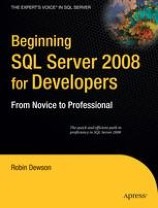
SQL Server 2008 is a first–rate database management system. It offers more capability than any previous release of SQL Server. More than just a classic relational database management system, SQL Server 2008 includes exciting and powerful features that make it useful for everything from large corporate data warehouses to ad hoc departmental databases. You'll find enhanced support for XML, new support for spatial data, transparent data encryption, a policy–based management system, and more.
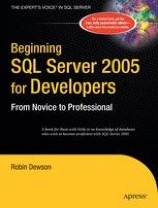
SQL Server 2005 will increase your programming options, productivity, analysis, and database management. If you have some basic knowledge of relational databases and want to start a career as a developer using SQL Server, then this book is your ideal first step. It explains the core jobs and roles for developing a database in both SQL Server 2000 and 2005. This book features practical steps to help you overcome issues youre likely to encounter. You'll learn to use SQL for querying, inserting, updating, and deleting data. You'll also learn how to back up and restore databases for basic administration in SQL Server.
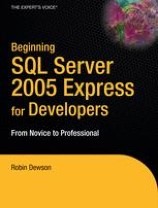
This book is a comprehensive guide that covers installing and configuring SQL Server 2005 Express, creating, backing up, and restoring databases, creating tables, then querying and manipulating them with T-SQL, coding stored procedures and triggers, and using Reporting Services to deliver information to end users.
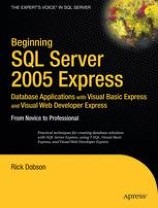
SQL Server 2005 Express is the database component of Microsoft's Express Suite of products. It is free of charge, inherits many (non-enterprise) features from SQL Server 2005, and comes complete with development and administration tools. As such, it is an ideal database for developers and administrators to use in prototype/evaluation projects. It is also a powerful development platform for database applications on nonprofit websites, e-commerce sites, and in small offices and departments.
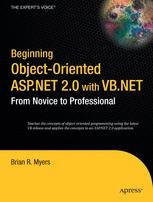
Beginning Object-Oriented ASP.NET 2.0 with VB .NET covers all of the basics, from definition to inheritance. This book even includes a chapter on Visual Studio 2005 and Microsoft .NET Framework 2.0, enabling you to create ASP.NET 2.0 applications. Also included are chapters on creating web forms, web controls, and web services. Code samples illustrate the usage of each concept.
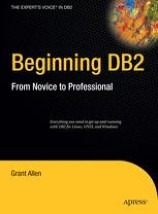
IBM’s DB2 Express Edition is one of the most capable of the free database platforms available in today’s marketplace. In Beginning DB2, author Grant Allen gets you started using DB2 Express Edition for web sites, desktop applications, and more. The author covers the basics of DB2 for developers and database administrators, shows you how to manage data in both XML and relational form, and includes numerous code examples so that you are never in doubt as to how things work.
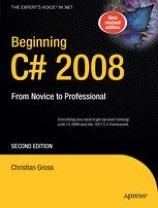
This book is for anyone who wants to write good C# code—even if you have never programmed before. Writing good code can be a challenge—there are so many options, especially in a .NET language like C#. If you want to really get the best from a programming language, you need to know which features work best in which situations, and understand their strengths and weaknesses. It is this understanding that makes the difference between coding and coding well. Beginning C# 2008: From Novice to Professional, Second Edition has been written to teach you how to use the C# programming language to solve problems. From the earliest chapters and the first introductory concepts, you'll be looking at real–world programming challenges and learning how C# can be used to overcome them.
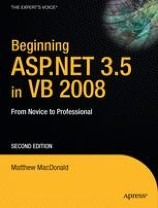
The most up–to–date and comprehensive introductory ASP.NET book you'll find on any shelf, Beginning ASP.NET 3.5 in VB 2008 guides you through Microsoft's latest technology for building dynamic web sites. This book will enable you to build dynamic web pages on the fly, and it assumes only the most basic knowledge of Visual Basic 2008.
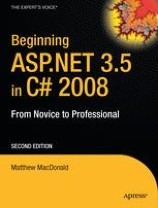
The most up–to–date and comprehensive introductory ASP.NET book you'll find on any shelf, Beginning ASP.NET 3.5 in C# 2008 guides you through Microsoft's technology for building dynamic web sites. This book will enable you to build dynamic web pages on the fly, and it assumes only the most basic knowledge of C#.
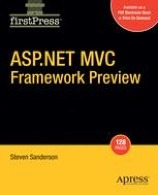
The ASP.NET MVC framework is the latest evolution of Microsoft's ASP.NET web platform. It introduces a radical high–productivity programming model, promotes cleaner code architecture, supports test–driven development, and provides powerful extensibility, combined with all the benefits of ASP.NET 3.5. ASP.NET MVC Framework Preview is a first look at this technology's main features, designed to give you a head start getting to grips with this powerful new technology.

The sustainable management of water cycles is crucial in the context of climate change and global warming. It involves managing global, regional, and local water cycles, as well as urban, agricultural, and industrial water cycles, to conserve water resources and their relationships with energy, food, microclimates, biodiversity, ecosystem functioning, and anthropogenic activities. Hydrological modeling is indispensable for achieving this goal, as it is essential for water resources management and the mitigation of natural disasters. In recent decades, the application of artificial intelligence (AI) techniques in hydrology and water resources management has led to notable advances. In the face of hydro-geo-meteorological uncertainty, AI approaches have proven to be powerful tools for accurately modeling complex, nonlinear hydrological processes and effectively utilizing various digital and imaging data sources, such as ground gauges, remote sensing tools, and in situ Internet of Things (IoT) devices.

Learn foundational and advanced topics in Neural Processing Unit design with real-world examples from leading voices in the field. A thorough introduction to neural networks and neural network development history, as well as Convolutional Neural Network (CNN) models Explorations of various parallel architectures, including the Intel CPU, Nvidia GPU, Google TPU, and Microsoft NPU, emphasizing hardware and software integration for performance improvement Discussions of streaming graph for massive parallel computation with the Blaize GSP and Graphcore IPU An examination of how to optimize convolution with UCLA Deep Convolutional Neural Network accelerator filter decomposition
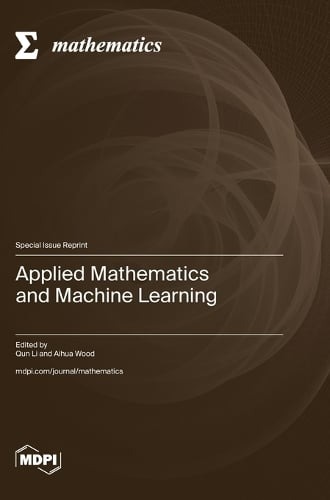
The simultaneous availability of large datasets and high-performance computing capability in recent years has enabled the rapid development of powerful machine learning algorithms. On the one hand, state-of-the-art machine learning techniques have transformed many areas of science and engineering; on the other hand, theoretical discoveries in mathematical algorithms, differential equations, and statistical inferences, to name a few, have provided the foundation for the exploration of new multidisciplinary models for solving practical problems. This Special Issue endeavors to continue the journey that started in our previous Special Issue (Applied Mathematics and Computational Physics) by providing a platform for researchers from both academia and industry, as well as government, to present their new computational methods that have engineering and physics applications.
Building effective and user-friendly transportation systems is one of the big challenges for engineers in the 21st century. There is an increasing need to understand, model, and govern such systems at both the individual (micro) and the society (macro) level. Still, this raises significant technical problems, as transportation systems may contain thousands of autonomous, "intelligent" entities that need to be simulated and/or controlled. Therefore, traffic and transportation scenarios are extraordinarily appealing for Distributed Artificial Intelligence, and (multi-) agent technology in particular. This book gives an overview of recent advances in agent-based transportation systems. It includes both a state-of-the-art survey and reports on cutting-edge research in the field.
Introduces the latest developments in electromagnetic computing and artificial intelligence technology. Artificial intelligence technology can be applied to the modeling, analysis, and optimization design of microwave equipment, solving the routing problem of self-organizing networks in small unmanned aerial vehicle systems, calculating the radiation characteristics of antenna arrays on large electrical platforms, analyzing the impact of electromagnetic wave coupling on electronic devices, simulating the field distribution characteristics of electronic devices, and so on. With the help of artificial intelligence, designers can more conveniently, quickly, and accurately solve engineering problems.
Introduces a novel approach to the design and operation of large ICT systems. It views the technical solutions and their stakeholders as complex adaptive systems and argues that traditional risk analyses cannot predict all future incidents with major impacts. To avoid unacceptable events, it is necessary to establish and operate anti-fragile ICT systems that limit the impact of all incidents, and which learn from small-impact incidents how to function increasingly well in changing environments. The book applies four design principles and one operational principle to achieve anti-fragility for different classes of incidents. It discusses how systems can achieve high availability, prevent malware epidemics, and detect anomalies. Analyses of Netflix’s media streaming solution, Norwegian telecom infrastructures, e-government platforms, and Numenta’s anomaly detection software show that cloud computing is essential to achieving anti-fragility for classes of events with negative impacts.
Ambient Intelligence is one of the new paradigms in the development of information and communication technology, which has attracted much attention over the past years. The aim is the to integrate technology into people environment in such a way that it improves their daily lives in terms of well-being, creativity, and productivity. Ambient Intelligence is a multidisciplinary concept, which heavily builds on a number of fundamental breakthroughs that have been achieved in the development of new hardware concepts over the past years. New insights in nano and micro electronics, packaging and interconnection technology, large-area electronics, energy scavenging devices, wireless sensors, low power electronics and computing platforms enable the realization of the heaven of ambient intelligence by overcoming the hell of physics.
Medical imaging has been transformed over the past 30 years by the advent of computerized tomography (CT), magnetic resonance imaging (MRI), and various advances in x-ray and ultrasonic techniques. An enabling force behind this progress has been the (so far) exponentially increasing power of computers, which has made it practical to explore fundamentally new approaches. In particular, what our group terms "model-based" modalities-which produce tissue property images from data using nonlinear, iterative numerical modeling techniques-have become increasingly feasible. Alternative Breast Imaging: Four Model-Based Approaches explores our research on four such modalities, particularly with regard to imaging of the breast: (1) MR elastography (MRE), (2) electrical impedance spectroscopy (EIS), (3) microwave imaging spectroscopy (MIS), and (4) near infrared spectroscopic imaging (NIS).
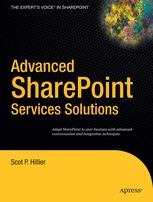
Whether or not youve already benefited from Scot P. Hillier's first renowned Apress book, Microsoft SharePoint: Building Office 2003 Solutions, this fantastic follow-up is sure to please! This book will cover advanced techniques for programming web parts and SharePoint Services. Hillier also covers advanced integration techniques with related products like BizTalk Server 2004 and Content Server. Intended for advanced developers who already know all of the basic SharePoint Services, this book will steer you in solving ultra-specific, advanced problems.

Advanced manufacturing technology and systems cover a broad scope involving manufacturing processes, machine tool design, system optimization, smart and flexible manufacturing, theoretical study and metrology. This reprint comprises 19 original papers concerning recent advances in the research and development of AMTSs. Specifically, there are many research fields that are covered: machining processes (six papers), micro-/nano-precision fabrication (four papers), and system optimization (eight papers), in addition to one review.

Daraa Highway - Ghabagheb - Syria
+963-15 2050 - 15 860 380 /1/2/3 - 11 662 3900