



Page 74
Page 74

Making a Difference in Teacher Education Through Self-Study : Studies of Personal, Professional and Program Renewal
The book presents research on 15 different teacher education programs and describes individual renewal efforts. The stories -- including both the successes and challenges -- are inspiring and informative. In this age of accountability these teacher educators have used a range of research methods to gather data on their work and in turn used it to guide future decisions. The text includes examples of both large scale research and individual efforts. The common thread among the authors is a commitment to "walking the talk."

Magnetic Nanostructures
Addresses the exciting and rapidly developing topic of nanostructured magnetic materials. It combines modern topics in nanoscale magnetism with issues relating to the fabrication and characterization of magnetic nanostructures. The chapters describe a wide range of physical aspects, together with theoretical and experimental methods. "Magnetic Nanostructures" will be of interest to researchers and specialists both in academic and industrial research. Graduate students will also find in this book an accessible introduction to the essential issues.
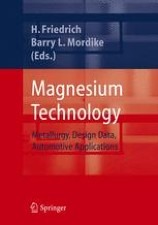
Magnesium Technology : Metallurgy, Design Data, Applications
Magnesium, with a density of 1.74 g/cm², is the lightest structural metal and magnesium are increasingly chosen for weight-critical applications such as in land-based transport systems. "Magnesium Technology" substantially updates and complements existing reference sources on this key material. It assembles international contributions from seven countries covering a wide range of research programs into new alloys with the requisite property profiles, i.e., the current state of both research and technological applications of magnesium. In particular, the international team of authors covers key topics, such as: casting and wrought alloys; fabrication methods; corrosion and protection; engineering requirements and strategies, with examples from the automobile, aerospace, and consumer-goods industries, and recycling.
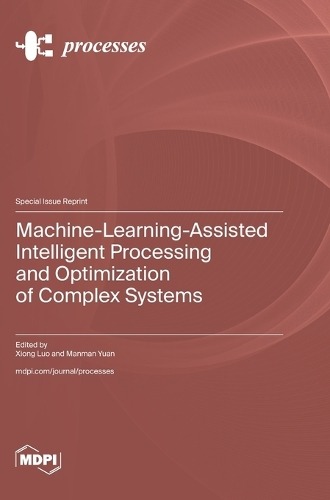
Machine-learning-assisted intelligent processing and optimization of complex systems
Focuses on the most recent developments in intelligent optimization methods and their applications in various test cases. The reprint covers various topics, including distributed multiagent modeling, metaheuristic algorithms, multisource data fusion, mobile computing and mobile sensing, machine learning-based intelligent processing for modeling complex manufacturing systems, and data-driven intelligent modeling

Machine Learning: ECML 2007 ; 18th European Conference on Machine Learning, Warsaw, Poland, September 17-21, 2007, Proceedings
The two premier annual European conferences in the areas of machine learning and data mining have been collocated ever since the ?rst joint conference in Freiburg, 2001. The European Conference on Machine Learning (ECML) traces its origins to 1986, when the ?rst European Working Session on Learning was held in Orsay, France. The European Conference on Principles and Practice of KnowledgeDiscoveryinDatabases(PKDD) was?rstheldin1997inTrondheim, Norway.
Machine Learning, Image Processing, Network Security and Data Sciences ; 2nd International conference, MIND 2020, Silchar, India, July 30 - 31, 2020, Proceedings, Part II
This two-volume set (CCIS 1240-1241) constitutes the refereed proceedings of the Second International Conference on Machine Learning, Image Processing, Network Security and Data Sciences, MIND 2020, held in Silchar, India. Due to the COVID-19 pandemic the conference has been postponed to July 2020. The 79 full papers and 4 short papers were thoroughly reviewed and selected from 219 submissions. The papers are organized according to the following topical sections: data science and big data; image processing and computer vision; machine learning and computational intelligence; network and cyber security.

Machine learning, image processing, network security and data sciences ; 2nd International conference, MIND 2020, Silchar, India, July 30 - 31, 2020, Proceedings, Part I
This two-volume set (CCIS 1240-1241) constitutes the refereed proceedings of the Second International Conference on Machine Learning, Image Processing, Network Security and Data Sciences, MIND 2020, held in Silchar, India. Due to the COVID-19 pandemic the conference has been postponed to July 2020. The 79 full papers and 4 short papers were thoroughly reviewed and selected from 219 submissions. The papers are organized according to the following topical sections: data science and big data; image processing and computer vision; machine learning and computational intelligence; network and cyber security.

Machine Learning Techniques for Multimedia : Case Studies on Organization and Retrieval
This book provides a comprehensive coverage of the most important machine learning techniques used and their application in this domain. Arising from the EU MUSCLE network, a program that drew together multidisciplinary teams with expertise in machine learning, pattern recognition, artificial intelligence, and image, video, text and crossmedia processing, the book first introduces the machine learning principles and techniques that are applied in multimedia data processing and analysis. The second part focuses on multimedia data processing applications, with chapters examining specific machine learning issues in domains .

Machine Learning Techniques and Analytics for Cloud Security
covers new methods, surveys, case studies, and policy with almost all machine learning techniques and analytics for cloud security solutions

Machine Learning Refined : Foundations, Algorithms, and Applications
Provides students with the fundamental knowledge and practical tools needed to conduct research and build data-driven products. The authors prioritize geometric intuition and algorithmic thinking, and include detail on all the essential mathematical prerequisites, to offer a fresh and accessible way to learn. Practical applications are emphasized, with examples from disciplines including computer vision, natural language processing, economics, neuroscience, recommender systems, physics, and biology.
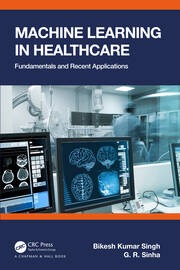
Machine learning in healthcare : Fundamentals and recent applications
Discusses how to build various ML algorithms and how they can be applied to improve healthcare systems. Healthcare applications of AI are innumerable: medical data analysis, early detection and diagnosis of disease, providing objective-based evidence to reduce human errors, curtailing inter- and intra-observer errors, risk identification and interventions for healthcare management, real-time health monitoring, assisting clinicians and patients for selecting appropriate medications, and evaluating drug responses. Extensive demonstrations and discussion on the various principles of machine learning and its application in healthcare is provided, along with solved examples and exercises.

Machine Learning in Dentistry
This book reviews all aspects of the use of machine learning in contemporary dentistry, clearly explaining its significance for dental imaging, oral diagnosis and treatment, dental designs, and dental research. In this book, readers will find up-to-date information on different machine learning tools and their applicability in various dental specialties.
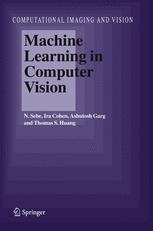
Machine Learning in Computer Vision
The goal of this book is to address the use of several important machine learning techniques into computer vision applications. An innovative combination of computer vision and machine learning techniques has the promise of advancing the field of computer vision, which contributes to better understanding of complex real-world applications. The effective usage of machine learning technology in real-world computer vision problems requires understanding the domain of application, abstraction of a learning problem from a given computer vision task, and the selection of appropriate representations for the learnable (input) and learned (internal) entities of the system. In this book, we address all these important aspects from a new perspective: that the key element in the current computer revolution is the use of machine learning to capture the variations in visual appearance, rather than having the designer of the model accomplish this. As a bonus, models learned from large datasets are likely to be more robust and more realistic than the brittle all-design models.
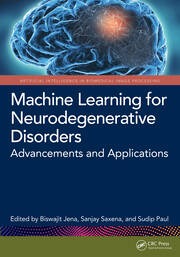
Machine learning for neurodegenerative disorders : advancements and applications
Explores the application of machine learning to the understanding, early diagnosis, and management of neurodegenerative disorders. With a specific focus on its role in ongoing clinical trials, the book covers essential topics such as data collection, pre-processing, feature extraction, model development, and validation techniques. It delves into the applications of neuroimaging techniques like magnetic resonance imaging (MRI), computed tomography (CT), and positron emission tomography (PET) in the diagnosis and understanding of neurodegenerative disorders. Additionally, the book examines various machine-learning algorithms employed for biomarker discovery in neurodegenerative disorders. It highlights the role of neuroinformatics and big data analysis in advancing the understanding and management of neurodegenerative disorders. Furthermore, the book reviews future prospects and presents the ethical considerations and regulatory challenges associated with implementing machine learning approaches in the diagnosis, treatment, and prevention of neurodegenerative disorders.
Machine Learning for Multimedia Content Analysis
Challenges in complexity and variability of multimedia data have led to revolutions in machine learning techniques. Multimedia data, such as digital images, audio streams and motion video programs, exhibit richer structures than simple, isolated data items. A number of pixels in a digital image collectively conveys certain visual content to viewers. A TV video program consists of both audio and image streams that unfold the underlying story. To recognize the visual content of a digital image, or to understand the underlying story of a video program, we may need to label sets of pixels or groups of image and audio frames jointly.

Machine learning for data streams : With practical examples in MOA
The book first offers a brief introduction to the topic, covering big data mining, basic methodologies for mining data streams, and a simple example of MOA. More detailed discussions follow, with chapters on sketching techniques, change, classification, ensemble methods, regression, clustering, and frequent pattern mining. Most of these chapters include exercises, an MOA-based lab session, or both. Finally, the book discusses the MOA software, covering the MOA graphical user interface, the command line, use of its API, and the development of new methods within MOA.

Machine learning for cyber security ; 3rd International Conference, ML4CS 2020, Guangzhou, China, October 8–10, 2020, Proceedings, Part III
Constitutes the proceedings of the Third International Conference on Machine Learning for Cyber Security, ML4CS 2020, held in Xi’an, China in October 2020. The 118 full papers and 40 short papers presented were carefully reviewed and selected from 360 submissions. The papers offer a wide range of the following subjects: Machine learning, security, privacy-preserving, cyber security, Adversarial machine Learning, Malware detection and analysis, Data mining, and Artificial Intelligence.

Machine Learning for Cyber Security ; 3rd International Conference, ML4CS 2020, Guangzhou, China, October 8–10, 2020, Proceedings, Part II
Constitutes the proceedings of the Third International Conference on Machine Learning for Cyber Security, ML4CS 2020, held in Xi’an, China in October 2020. The 118 full papers and 40 short papers presented were carefully reviewed and selected from 360 submissions. The papers offer a wide range of the following subjects: Machine learning, security, privacy-preserving, cyber security, Adversarial machine Learning, Malware detection and analysis, Data mining, and Artificial Intelligence.

Machine Learning for Cyber Security ; 3rd International Conference, ML4CS 2020, Guangzhou, China, October 8–10, 2020, Proceedings, Part I
Constitutes the proceedings of the Third International Conference on Machine Learning for Cyber Security, ML4CS 2020, held in Xi’an, China in October 2020. The 118 full papers and 40 short papers presented were carefully reviewed and selected from 360 submissions. The papers offer a wide range of the following subjects: Machine learning, security, privacy-preserving, cyber security, Adversarial machine Learning, Malware detection and analysis, Data mining, and Artificial Intelligence.

Machine Learning for Cyber Physical Systems : Selected papers from the International Conference ML4CPS 2018
Presents new approaches to Machine Learning for Cyber Physical Systems, experiences and visions. Cyber Physical Systems are characterized by their ability to adapt and to learn: They analyze their environment and, based on observations, they learn patterns, correlations and predictive models. Typical applications are condition monitoring, predictive maintenance, image processing and diagnosis. Machine Learning is the key technology for these developments.
