


Refine Results
Sort By
From
To

Without light, interior architecture cannot be fully designed and experienced. It is one of the key tools for an interior designer, but can be a dauntingly technical subject for students. This book takes a detailed, practical look at lighting in interior design, giving students all the key information and skills they need to be able to tackle lighting successfully in their designs
Exploring a broad range of design styles and movements, this revised and expanded edition includes coverage of non-Western design and vernacular interior architecture and features 665 photographs and drawings (color and black-and-white). The companion image bank includes an interactive presentation of periods and styles, incorporating more than 100 illustrations.
Connects the study of design with care, and explores how concepts of care may have relevance for the ways in which urban environments are designed. It explores how practices and spaces of care are sustained specifically in urban settings, thereby throwing light on an important arena of care that current work has rarely discussed in detail.
A trusted guide for both students and professionals for nearly 40 years, evolving to address the challenges and responsibilities of the building surveying role. It covers everything needed for initial inspections such as equipment, know-how and procedures to writing an accurate report. This updated edition features new material on modern methods of construction, new sustainable materials, new surveying technologies, and industry developments in the wake of the Grenfell Fire. Essential reading for building construction students, professional surveyors, and others who may be required to inspect and report on buildings
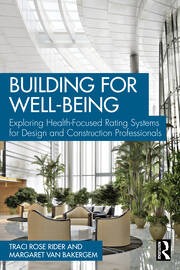
The first introduction to health-focused building standards for design and construction professionals. More than a summary of the state of the field, this practical resource guides designers, builders, developers, and owners through considerations for incorporating WELL®, Fitwel®, and other systems from the planning phase to ground-breaking and beyond.Drawing on the authors’ backgrounds in sustainable design and public health, chapters on the evolution of the green building movement and the relationship between health and the built environment provide vital context for understanding health-focused standards and certifications. The final chapter looks toward the future of health and the built environment.
Provides invaluable guidance to all those with an interest in placemaking and the built environment, from those with no experience to those who have worked for many years in industry, illustrating key principles that will secure higher quality, more sustainable design in accessible, jargon-free language. Explains the design process in a straightforward way, exploring the different roles and highlighting the opportunities and limitations different agencies have to influence design over the various stages of the process. Examples from the UK and worldwide look at how the system operates and how best practice can make a real difference on the ground. Case studies examine situations where quality or sustainability fell short – and how this could have been avoided. This book also showcases a variety of evaluation tools, explaining how they operate, and giving guidance on how to create project-specific tools to drive schemes forward. With community empowerment at its core, the book explains technical language and shares bountiful knowledge to broaden place democracy and make influencing design accessible to many, not just a few.

This is an ultimate resource for creating the ideal remote retreat. Discover 150 cottages and cabins from around the world that feature the luxury of modern home construction while preserving the surrounding landscape and utilizing local natural resources. These enviable dwelling showcase inspirations for homeowners, designers, and architects - from exposed-beam ceilings and built-in furnishings to large open-floor plans and floor-to-ceiling windows that accentuate picturesque views of the great outdoors. This volume highlights hidden sanctuaries that offer spacious, comfortable, and, most important, more natural living environments with a range of stunning full-colour photographs and detailed design plans.
These proceedings are reporting on the conference ''Math Everywhere", a successful event celebrating a leading scientist, promoting ideas he pursued and sharing the open atmosphere he is known for. The areas of the contributions are the following , Deterministic and Stochastic Systems. Mathematical Problems in Biology, Medicine and Ecology, Mathematical Problems in Industry and Economics.
This book is a groundbreaking attempt to address questions of non-human and material agency from a wide range of perspectives and disciplines: archaeology, anthropology, sociology, cognitive science, philosophy, and economics. The editors and authors demostrate that a distributed, relational approach to agency, incorporating both humans and artifacts, has important ramifications for how we understand material culture.

The book has six chapters that have been arranged according to the sequence used when creating and operating a manufacturing system. Thus, the subjects emphasised are: the decision framework for manufacturing, the manufacturing processes, the manufacturing equipment and machine tools, the design for manufacturing and the operation of manufacturing systems. The book attempts a compromise between theory and practice in all addressed manufacturing systems issues, covering a long spectrum of issues from traditional manufacturing processes to innovative technologies such as Virtual Reality, Nanotechnology and Rapid Prototyping.
As it circulates in the atmosphere, in the rivers, lakes, soil, rock, and in the oceans, it is the major conveyer of va- ous chemical substances and of energy, and it can also be called as the blood of the ecosystems of this planet. But at the same time water is interwoven in the va- ous functions of the nature and the human society in countless ways which makes water one of the most complicated challenges of the mankind today.Human beings are exploiting and enjoying, but at the same time polluting and deteriorating, the waters in various ways and water is equally important to the - man socio-economic system as it is to the nature. It may sound a bit anecdotal to say that water obeys no borders, but that is true; the hydrologic cycle with its r- ers, river basins, lakes, aquifers, rainfalls, oceans, etc., cross administrational b- ders without any passport control. River and lake basins are in most cases very different from the administrational borders that the human beings have set up.
Modern logic has been intimately connected with algebra since its origins in figures such as Boole, De Morgan, and Peirce. But while universal algebra is a long recognized field, universal logic has only recently been named as such. This is perhaps because classical logic was until relatively recently taken by many as the "one true logic". But with the proliferation of special purpose non-classical logics in recent years, universal logic is clearly a field whose time has come. This book contains many excellent papers demonstrating the value of this approach.

This book, designed for advanced graduate students and post-graduate researchers, provides an introduction to Lie algebras and some of their applications to the spectroscopy of molecules, atoms, nuclei and hadrons. In the first part, a concise exposition is given of the basic concepts of Lie algebras, their representations and their invariants. The second part contains a description of how Lie algebras are used in practice in the treatment of bosonic and fermionic systems. Physical applications considered include rotations and vibrations of molecules (vibron model), collective modes in nuclei (interacting boson model), the atomic shell model, the nuclear shell model, and the quark model of hadrons. One of the key concepts in the application of Lie algebraic methods in physics, that of spectrum generating algebras and their associated dynamic symmetries, is also discussed. The book contains many examples that help to elucidate the abstract algebraic definitions. It provides a summary of many formulas of practical interest, such as the eigenvalues of Casimir operators and the dimensions of the representations of all classical Lie algebras.
Just over thirty years after Holland first presented the outline for Learning Classifier System paradigm, the ability of LCS to solve complex real-world problems is becoming clear. In particular, their capability for rule induction in data mining has sparked renewed interest in LCS. This book brings together work by a number of individuals who are demonstrating their good performance in a variety of domains.
This volume presents the construction of canonical modular compactifications of moduli spaces for polarized Abelian varieties (possibly with level structure), building on the earlier work of Alexeev, Nakamura, and Namikawa. This provides a different approach to compactifying these spaces than the more classical approach using toroical embeddings, which are not canonical. There are two main new contributions in this monograph: (1) The introduction of logarithmic geometry as understood by Fontaine, Illusie, and Kato to the study of degenerating Abelian varieties; and (2) the construction of canonical compactifications for moduli spaces with higher degree polarizations based on stack-theoretic techniques and a study of the theta group.
Offers critical insights into the thriving international field of community indicators, incorporating the experiences of government leaders, philanthropic professionals, community planners and a wide range of academic disciplines. It illuminates the important role of community indicators in diverse settings and the rationale for the development and implementation of these innovative projects. details many of the practical “how to” aspects of the field as well as lessons learned from implementing indicators in practice. The case studies included here also demonstrate how, using a variety of data applications, leaders of today are monitoring and measuring progress and communities are empowered to make sustainable improvements in their wellbeing.

This book explores how young people engage with chemical substances in their everyday lives. It builds upon and supplements a large body of literature on young people’s use of drugs and alcohol to highlight the subjectivities and socialities that chemical use enables across diverse socio-cultural settings, illustrating how young people seek to avoid harm, while harnessing the beneficial effects of chemical use.

The purpose of this book is to facilitate a better understanding of the characteristics of superchargers in respect to their physical operating principles, as well as their interaction with piston engines. This applies both to the displacement compressor and toexhaustgas turbocharging systems,whichoftenareverycomplex.

This book looks at new ways of tackling the problem of separating reaction products from homogeneous catalytic solutions. The new processes involve low leaching supported catalysts, soluble supports such as polymers and dendrimers and unusual solvents such as water, fluorinated organics, ionic liquids and supercritical fluids. The advantages of the different possibilities are discussed alongside suggestions for further research that will be required for commercialisation.
Calibrating the Cosmos describes hard science, but is gently written. It explains in clear, non-mathematical language the measurements and the interpretation of the resulting data that have led to the current understanding of the origin, evolution and properties of our expanding Big Bang universe. Many people have a sketchy idea of the work of cosmologists, but Professor Levin’s experience in teaching both scientific and liberal arts students has enabled him to impart much of our current thinking without resorting to difficult mathematics. Theoretical concepts are emphasized, in particular the symmetries of homogeneity and isotropy enjoyed by our universe on the largest scales, how these symmetries lead to only one quantity being needed to describe the growth of the universe from its infancy to the present time, and how the so-called parameters of the universe are the ingredients used to construct the model universes to which ours – the real thing – is compared.

Daraa Highway - Ghabagheb - Syria
+963-15 2050 - 15 860 380 /1/2/3 - 11 662 3900