



Page 60
Page 60
Managing Sustainability : Perspectives From Retailing and Services
Companies and policy makers are prioritizing environmental, social, and governance goals as part of their strategies. Academic research has started to focus on these issues, but many important matters require deeper investigation and reflection, especially in specific sectors. This book focuses on the sustainability issues within the retailing and services sectors.

Managing Socio-ecological Production Landscapes and Seascapes for Sustainable Communities in Asia : Mapping and Navigating Stakeholders, Policy and Action
This book presents up-to-date analyses of community-based approaches to sustainable resource management of SEPLS (socio-ecological production landscapes and seascapes) in areas where a harmonious relationship between the natural environment and the people who inhabit it is essential to ensure community and environmental well-being as well as to build resilience in the ecosystems that support this well-being.
Managing Risk and Information Security : Protect to Enable
Examine the evolving enterprise security landscape and discover how to manage and survive risk. While based primarily on the author’s experience and insights at major companies where he has served as CISO and CSPO, the book also includes many examples from other well-known companies and provides guidance for a management-level audience. Managing Risk and Information Security provides thought leadership in the increasingly important area of enterprise information risk and security. It describes the changing risk environment and why a fresh approach to information security is needed. Because almost every aspect of an enterprise is now dependent on technology not only for internal operations but increasing as a part of product or service creation, the focus of IT security must shift from locking down assets to enabling the business while managing and surviving risk. This edition discusses business risk from a broader perspective, including privacy and regulatory considerations. It describes the increasing number of threats and vulnerabilities and offers strategies for developing solutions. These include discussions of how enterprises can take advantage of new and emerging technologies—such as social media and the huge proliferation of Internet-enabled devices—while minimizing risk.
Managing public services : Making informed choices
Chapters provide a valuable frame of reference for the 21st-century manager of public services by assessing the renewal of existing practices such as strategic costing, performance management, digitization and procurement and innovations in management practices, including branding, Lean Management, resilience and risk management. The book suggests that, as the management of public services is imbued with financial, social, economic and political uncertainties, management needs to be flexible and responsive to new ideas and practices to fulfil its purpose. This book ultimately supports the reflective manager, those who think about their job and are open to new ideas on how their job can be done better, by revisiting existing practices and examining innovations in public management.

Managing Protected Areas in Central and Eastern Europe Under Climate Change
Addresses the need for sharing knowledge and experience in the field of biodiversity conservation and climate change. There is an urgent need to build capacity in protected areas to monitor, assess, manage and report the effects of climate change and their interaction with other pressures. The contributors identify barriers to the adaptation of conservation management, such as the mismatch between planning reality and the decision context at site level. Short and vivid descriptions of case studies, drawn from investigation areas all over Central and Eastern Europe, illustrate both the local impacts of climate change and their consequences for future management.

Managing Next Generation Networks and Services ; 10th Asia-Pacific Network Operations and Management Symposium, APNOMS 2007, Sapporo, Japan, October 10-12, 2007, Proceedings
The 48 revised full papers and 30 revised short papers cover management of distributed networks, network configuration and planning, network security management, sensor and ad-hoc networks, network monitoring, routing and traffic engineering, management of wireless networks and security on wireless networks.

Managing logistics systems : Planning and analysis for a successful supply chain
Introduces logistics from a broad perspective to include all activities throughout the product and service life cycle pertaining to supply chain and logistics management, the physical supply and distribution of products, and the corresponding maintenance and support. It recognizes the mutual interdependence of the major functional areas of the organization including marketing, production, and finance. The emphasis throughout the text is on logistics in the context of a total business system design process. It views the business as a "system", managing logistics within that system, and thus transforming their Supply Chain. Pedagogy to aid learning is incorporated throughout every chapter, with chapter objectives, case studies, and concept checks. This text is intended for both upper-level undergraduate and lower-level graduate students in both Business and Engineering on logistics and supply chain tracks. It can also serve as a reference for practitioners actively engaged in day-to-day management of logistics and supply chain activities.

Managing Large-Scale Service Deployment ; 19th IFIP/IEEE International Workshop on Distributed Systems : Operations and Management, DSOM 2008, Samos Island, Greece, September 22-26, 2008. Proceedings
Contains all papers accepted for presentation at the 19th IFIP/IEEE International Workshop on Distributed Systems: Operations and Management (DSOM 2008),which was held September 25-26, 2008 on the island of Samos, Greece. DSOM 2008 was the 19th event in a series of annual workshops. It followed in the footsteps of previous s- cessful meetings, the most recent of which were held in San Jos´ e, California, USA (DSOM 2007), Dublin, Ireland (DSOM 2006), Barcelona, Spain (DSOM 2005), Davis, California, USA (DSOM 2004), Heidelberg, Germany (DSOM 2003), and Montreal, Canada (DSOM 2002).
Managing Dynamic Networks : Organizational Perspectives of Technology Enabled Inter-firm Collaboration
Collaboration of organizations reshapes traditional managerial practices and creates new inter-organizational contexts for strategy, coordination and control, information and knowledge management. Heralded as organizational forms of the future, networks are at the same time fragile and precarious organizational arrangements, which regularly fail. In order to investigate the new realities created by technology-enabled forms of network organizations and to address the emerging managerial challenges, this book introduces an integrative view on inter-firm network management. Centred on a network life cycle perspective, strategic, economic and relational facets of business networking are explored.

Managing Development and Application of Digital Technologies : Research Insights in the Munich Center for Digital Technology & Management (CDTM)
Digital technology determines today’s world and will be one of the key technologies of the future. Successful technology development, introduction and management are not only a question of technical issues; due to their complexity a close cooperation between different scientific disciplines is required to discuss various consequences, chances and risks from manifold points of view as a starting point for the design of adequate solutions. The ability to integrate business and technology decisions will become a crucial core competence.
Managing Complexity : Insights, Concepts, Applications
Each chapter in Managing Complexity focuses on analyzing real-world complex systems and transferring knowledge from the complex-systems sciences to applications in business, industry and society. The interdisciplinary contributions range from markets and production through logistics, traffic control, and critical infrastructures, up to network design, information systems, social conflicts and building consensus. They serve to raise readers' awareness concerning the often counter-intuitive behavior of complex systems and to help them integrate insights gained in complexity research into everyday planning, decision making, strategic optimization, and policy.
Managing Agile Business Technology : The Business and Technology Relationship Model in Practice
Describes in detail how the BTRM, combined with a focus on value creation and value delivery, will enable continuous change, in the context of current, emerging and future technologies. It illustrates the potential for real-time insight and control not previously considered and provides a wide range of information to plan an implementation, understand where AI can be applied, and its importance in the world of self-managing systems.

Management Planning for Nature Conservation : A Theoretical Basis & Practical Guide
The book provides historical and rational background which helps to explain what makes a really effective management plan, and it presents a detailed practical guide to developing such a plan. It concludes with a series of case studies which clearly illustrate the underlying principles drawn out in the text, while highlighting the different approaches demanded by very different sites. Drawing on the expertise of leaders in both conservation research and wildlife management, and with a combined experience from around the world, this book is essential reading for professional conservation managers and any student studying management planning for conservation within a range of degree and postgraduate courses.
Management of Transboundary Rivers and Lakes
As it circulates in the atmosphere, in the rivers, lakes, soil, rock, and in the oceans, it is the major conveyer of va- ous chemical substances and of energy, and it can also be called as the blood of the ecosystems of this planet. But at the same time water is interwoven in the va- ous functions of the nature and the human society in countless ways which makes water one of the most complicated challenges of the mankind today.Human beings are exploiting and enjoying, but at the same time polluting and deteriorating, the waters in various ways and water is equally important to the - man socio-economic system as it is to the nature. It may sound a bit anecdotal to say that water obeys no borders, but that is true; the hydrologic cycle with its r- ers, river basins, lakes, aquifers, rainfalls, oceans, etc., cross administrational b- ders without any passport control. River and lake basins are in most cases very different from the administrational borders that the human beings have set up.
Management of Research Infrastructures : A South African Funding Perspective
This book provides an overview of the building blocks necessary for managing, steering and guiding the establishment of a research infrastructure (RI). It offers valuable insights into RI investment, access and management at the academic, grants management, agency and policy level, and serves as a useful guide for the research community, students, and those in the private sector wishing to understand the approaches and opportunities involved in the establishment, maintenance and management of research infrastructure platforms.

Management of Multimedia Networks and Services ; 8th International Conference on Management of Multimedia Networks and Services, MMNS 2005, Barcelona, Spain, October 24-26, 2005, Proceedings
We are delighted to present the proceedings of the 8th IFIP/IEEE International Conference on Management of Multimedia Networks and Services (MMNS 2005). The MMNS 2005 conference was held in Barcelona, Spain on October 24–26, 2005. As in previous years, the conference brought together an international audience of researchers and scientists from industry and academia who are researching and developing state-of-the-art management systems, while creating a public venue for results dissemination and intellectual collaboration. This year marked a challenging chapter in the advancement of management systems for the wider management research community, with the growing complexities of the “so-called” multimedia over Internet, the proliferation of alternative wireless networks (WLL, WiFi and WiMAX) and 3G mobile services, intelligent and high-speed networks scalable multimedia services and the convergence of computing and communications for data, voice and video delivery. Contributions from the research community met this challenge with 65 paper submissions; 33 high-quality papers were subsequently selected to form the MMNS 2005 technical program. The diverse topics in this year’s program included wireless networking technologies, wireless network applications, quality of services, multimedia, Web applications, overlay network management, and bandwidth management.
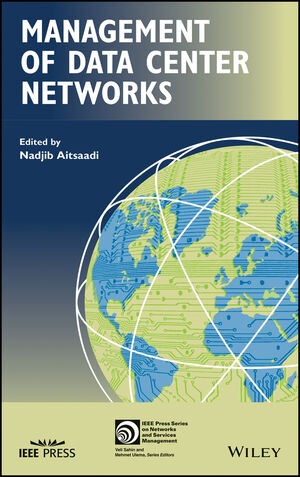
Management of Data Center Networks
Delivers a rigorous and insightful exploration of the network management challenges that present within intra- and inter-data center networks, including reliability, routing, and security. The book also discusses new architectures found in data center networks that aim to minimize the complexity of network management while maximizing Quality of Service, like Wireless/Wired DCNs, server-only DCNs, and more. offers: A thorough overview of the architectures of data center networks, including the classification of switch-centric, server-centric, enhanced, optical, and wireless DCN architectures An exploration of resource management in wired and wireless data center networks, including routing and wireless channel allocation and assignment challenges and criteria Practical discussions of inter-data center networks, including an overview of basic virtual network embedding Examinations of energy and security management in data center networks

Management of Convergence Networks and Services ; 9th Asia-Pacific Network Operations and Management Symposium, APNOMS 2006, Busan, Korea, September 27-29, 2006, Proceedings
Constitutes the refereed proceedings of the 9th Asia-Pacific Network Operations and Management Symposium, APNOMS 2006. This book presents 50 revised full papers and 25 revised short papers, organized in topical sections on management of ad hoc and sensor networks, network measurements and monitoring, mobility management, QoS management, and more

Management of Converged Multimedia Networks and Services ; 11th IFIP/IEEE International Conference on Management of Multimedia and Mobile Networks and Services, MMNS 2008, Samos Island, Greece, September 22-26, 2008. Proceedings
This volume presents the proceedings of the 11th IFIP/IEEE International Conference on Management of Multimedia and Mobile Networks and Services (MMNS 2008), which was held on Samos, Greece during September 22–26 as part of the 4th International Week on Management of Networks and Services (Manweek 2008). As in the previous three years, the Manweek umbrella - lowed an international audience of researchers and scientists from industry and academia – who are researching and developing management systems – to share views and ideas and present their state-of-the-art results. The other events co-located with Manweek 2008 were the 19th IFIP/IEEE International Workshop on Distributed Systems.
Management models of digital transformation : Analysis and definition of success factors for the development of a management framework
Analyses and integrates existing approaches to managing and coordinating a digital transformation in order to identify relevant success factors of a digital transformation, serving as a basis for the development of a systematic framework for a management model of digital transformation. The analysis reveals ten success-critical focus areas of a digital transformation, which comprise numerous success factors: ‘Vision, goals, and strategies’, ‘Leadership’, ‘Communication’, ‘Digital culture and mindset’, ‘Digital platform’, ‘Partnership network’, ‘Capabilities, talents, and skills’, ‘Organization, coordination, and roles’, ‘Management methodologies’, and ‘Governance’.
