


Refine Results
Sort By
From
To

Discusses the innovative approaches and investigation strategies, as well as provides a broad spectrum of the cutting-edge research on the processing, properties and technological developments of microbial products and their applications. Microbes finds very important applications in our lives including industries and food processing. They are widely used in the fermentation of beverages, processing of dairy products, production of pharmaceuticals, chemicals, enzymes, proteins and biomaterials / conversion of biomass into fuel, fuel cell technology, health and environmental sectors. Some of these products are produced commercially, while others are potentially valuable in biotechnology. Microorganisms are considered invaluable in research as model organisms. This is a useful compilation for students and researchers in microbiology, biotechnology and chemical industries.
Covers general concepts of anti-viral metabolites, classifications, ethnopharmacology, chemistry, clinical and preclinical studies focusing on different medicinal plants against various types of viral infections. Various plants have been used in medicine since ancient times and are known for their strong therapeutic effects. The book will describe potential antiviral properties of medicinal plants against a diverse group of viruses, and provide an insight to the potential plants possess for broad-spectrum antiviral effects against emerging viral infections.The book aims to target a broad audience including virologists, molecular biologist, microbiologist and scientists working with natural products as well as researchers, students, healthcare experts involved in pharmaceutical and medical field.
Microbes are in our midst soon after birth. Thankfully, the number of harmless (and often beneficial) microbes far outnumber those that would do us harm. Our ability to ward-off pathogens in our environment, including those that can colonize our exterior and/or interior surfaces, depends on the integrative action of the innate and adaptive immunity systems. This volume of CTMI, entitled Antimicrobial Peptides and Human Disease, is dedicated to the role of antimicrobial peptides (AMPs) in the innate host defense system of homo sapiens.
Provides unique insights into the issues that drive modified dosing regimens for antibiotics in the critically ill. Leading international authors provide their commentary alongside a summary of existing evidence on how to effectively dose antibiotics. Severe infection frequently necessitates admission to the intensive care unit (ICU). Equally, nosocomial sepsis often complicates the clinical course in ICU. Early, appropriate application of antibiotic therapy remains a cornerstone of effective management. However, this is challenging in the critical care environment, given the significant changes in patient physiology and organ function frequently encountered. Being cognisant of these factors, prescribers need to consider modified dosing regimens, not only to ensure adequate drug exposure, and therefore the greatest chance of clinical cure, but also to avoid encouraging drug resistance.
Antiangiogenesis remains a dynamic and evolving field in oncology. New therapeutic targets continue to emerge followed by the rapid development of new therapeutic agents to be investigated in clinical trials. Optimizing the therapeutic potential of antiangiogenic agents in combination with the other therapies in the armamentarium to fight cancer will be an on-going challenge. Antiangiogenic Agents in Cancer Therapy, Second Edition provides a current, up-dated perspective on the state of the art of angiogenesis and therapy with a compendium of scientific findings and approaches to the study of angiogenesis in cancer. Leaders in the field present chapters on such topics as the environmental influences and the genetic and physiologic abnormalities that mediate angiogenesis and its role in the progression of malignant disease, working models of tumor angiogenesis, and the role of angiogenesis inhibition in the therapy of malignant disease in humans. Comprehensive and cutting-edge, Antiangiogenic Agents in Cancer Therapy, Second Edition is an ideal, valuable guide to the most recent advances in the field, and a collection that will be useful for many years to come.
This volume provides an overview of climate change data, its effects on the structure and functioning of Antarctic ecosystems, and the occurrence and cycling of persistent contaminants. It discusses the unique physico-chemical characteristics of the Antarctic environment, ecophysiological adaptations of terrestrial and marine organisms, the transfer of contaminants in pelagic and neritic food chains and the possible consequences for animals at higher trophic levels.
The book discusses the conventional analyses for oil and natural gas feeds, along with their limitations. It offers detailed descriptions of advanced analytical techniques that are commercially available, plus explanations of gas and oil industry equipment and instrumentation. You’ll find technique descriptions supplemented with a list of references as well as with real-life application examples. With this book as a reference, you can prepare to apply specific analytical methods in your organization’s lab environment. Analytical Techniques can also serve as your comprehensive resource on key techniques in the characterization of oil and gas samples, within both refinery and environmental contexts.
Explains task management concepts and outlines practical knowledge to help pharmaceutical analytical scientists become productive and enhance their career. •Presents broad topics such as product development process, regulatory requirement, task and project management, innovation mindset, molecular recognition, separation science, degradation chemistry, and statistics. •Provokes thinking through figures, tables, and case studies to help understand how the various functions integrate and how analytical development can work efficiently and effectively by applying science and creativity in their work. •Discusses how to efficiently develop a fit-for-purpose HPLC method without screening dozens of columns, gradients, or mobile phase combinations each time, since the extra effort may not provide enough of a benefit to justify the cost and time in a fast-paced product development environment.
This book reflects the rich personal experience of a German allergist with international training and reputation, who is active in immunology and allergy research and practice for almost 30 years. In this book, not only IgE-mediated allergic reactions are covered but all other kinds of allergies such as atopic eczema, contact dermatitis, drug eruptions, anaphylaxis and food allergies are equally represented as well as psychosomatic aspects and problems of environmental intolerances.
This book reports on the latest advances in allelopathy through the contributions of leading scientists in the field. The book addresses the history of allelopathy, the science of allelochemicals, and the application of allelopathy in agriculture and forestry. An emphasis on both methodology and application makes Allelopathy a truly practical reference for scientists, researchers and students of plant science, agriculture, forestry, terrestrial ecology and environmental science.
This book provides the reader relevant information about actual knowledge about the process of allelopathy, covering all aspects from the molecular to the ecological level. Special relevance is given to the physiological and ecophysiological aspects of allelopathy. Several ecosystems are studied and methodological considerations are taken into account in several different chapters. The book has been written to be useful both for Ph.D. students and for senior researchers, so the chapters include all necessary information to be read by beginners, but they also include a lot of useful information and discussion for the initiated.
This volume contains the lectures and seminars given at the NATO Advanced Study Institute on “Sensor Systems for Biological Threads: The Algal Toxins Case”, held in Pisa, Italy in October, 2007. Algae can form heavy growths in ponds, lakes, reservoirs and sl- moving rivers throughout the world; algae can house toxins which are - ually released into water when the cells rupture or die. Hundreds of toxins have been identified so far. Detection methods, including rapid screening, have been developed to help us learning more about them, especially to find out which toxins are a real threat for people and what conditions encourage their production and accumulation. Early detection of algal toxins is an - portant aspect for public safety and natural environment, and significant efforts are underway to develop effective and reliable tools that can be used for this purpose.
This volume contains the lectures and seminars given at the NATO Advanced Study Institute on “Sensor Systems for Biological Threads: The Algal Toxins Case”, held in Pisa, Italy in October, 2007. Algae can form heavy growths in ponds, lakes, reservoirs and sl- moving rivers throughout the world; algae can house toxins which are - ually released into water when the cells rupture or die. Hundreds of toxins have been identified so far. Detection methods, including rapid screening, have been developed to help us learning more about them, especially to find out which toxins are a real threat for people and what conditions encourage their production and accumulation. Early detection of algal toxins is an - portant aspect for public safety and natural environment, and significant efforts are underway to develop effective and reliable tools that can be used for this purpose.
ALGAE AND CYANOBACTRIA IN EXTREME ENVIRONMENTS is a unique collection of essays, contributed by leading scientists from around the world, devoted to algae – and some related microbes – observed in unexpected harsh habits, which it seems are an oasis or Garden of Eden for these organisms. This timely book on Extremophilic alga, including its especially impressive micrographs, may provide clues about the edges of life on Earth and possibly elsewhere in the universe. This volume is a must for students of the field of biodiversity, as well as those in Phycology, ecology and general biological research.
AIDS-associated viral oncology is a significant healthcare problem. Since the identification of human immunodeficiency virus (HIV)-associated acquired immune disease syndrome (AIDS), the role of viruses in human cancers has become acutely apparent over the past twenty years. The understanding and treatment of AIDS-associated cancers has become a major concern among healthcare organizations. Human cancers that were once rare in the population have now become common within the HIV infected population.
Brings together some of the most important current research in European agroforestry, and evaluates the current scope and future potential of agroforestry across the EU.While the majority of Europe’s agroforestry practices are currently focused in the Mediterranean, this volume draws together examples from a wide range of countries – including Greece, Spain, the UK, Hungary, Germany, Italy, the Netherlands, Switzerland, France and Slovenia. The book also covers a range of agroforestry types, including silvopastoralism – Europe’s predominant form of agroforestry – as well as alley cropping, forest farming, silvoarable systems and the use of trees for shelter. Through these examples the book also discusses the potential roles for these traditional land management systems in addressing both environmental issues such as water quality, biodiversity conservation, desertification, ecosystem services and socioeconomic issues such as rural population stabilization.
There is wide agreement on the need to change the prevalent agricultural models, given their negative impacts and their incompatibility with current societal issues. Agroecological transition has been promoted as a potential solution to the ecological, social and economic problems generated by these models. It however involves a systemic, multi-scale and transdisciplinary process. Due to this complexity, the overall picture of what farms and food systems “actually are” and “might be” may not be apparent at the individual level. Yet individuals’ knowledge and values provide complementary insights on how to proceed in deepening ecological modernisation. Expertise can also provide landmarks to be considered in that process. Because local stakeholders’ experience and skills are key resources in the adaptation and adoption of agroecological transition, new conceptual and methodological frameworks and tools have to be developed to support them in the design process of such a complex transition. This book presents feedback from the ‘Territorial Agroecological Transition in Action’- TATA-BOX research project, which was devoted to these specific issues.
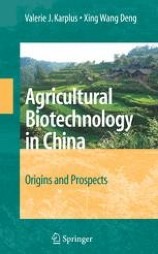
Building on a long tradition of agricultural advances, Chinese scientists have applied biotechnology techniques to develop hundreds of novel crop varieties suited to local farming conditions and challenges.Agricultural Biotechnology in China: Origins and Prospects is a comprehensive examination of how the origins of biotechnology research agendas, along with the effectiveness of the seed delivery system and biosafety oversight, help to explain current patterns of crop development and adoption in China. Based on firsthand insights from China’s laboratories and farms, Valerie Karplus and Dr. Xing Wang Deng explore the implications of China’s investment for the nation’s rural development, environmental footprint, as well as its global scientific and economic competitiveness.
This book gives an overview of the sessions, panel discussions, and outcomes of the Advancing the Science of Cancer in Latinos conference, held in February 2018 in San Antonio, Texas, USA, and hosted by the Mays Cancer Center and the Institute for Health Promotion Research at UT Health San Antonio.
Food insecurity is a central concern and a fundamental challenge for human welfare and economic growth in Africa. Low agricultural production, results in low incomes, poor nutrition, vulnerability to risks and lack of empowerment. Land degradation and soil fertility depletion are considered the major threats to food security and natural resource conservation in sub-Saharan Africa (SSA). Investments in technology, policy and institutional reforms are needed to increase agricultural productivity to ensure food security and sustained national economies. Past research has generated numerous soil fertility management technologies which if adopted could propel the African continent out of the poverty trap. However, these technologies have had little, if any, impact due to low adoption by the smallholder farmers.

Daraa Highway - Ghabagheb - Syria
+963-15 2050 - 15 860 380 /1/2/3 - 11 662 3900