



Page 5
Page 5

Finite element methods : Parallel-sparse statics and Eigen-Solutions
FEM, and the associated computer software are widely recognized as some of the most effective tools for solutions of large-scale engineering applications. Efficient equation and eigen-solvers play critical roles in solving these problems. Sparse matrix technologies have evolved and are now mature enough that all popular and commercialized FEM codes have inserted sparse solvers into their software. So far, however, few books include detailed discussion and explanation of sparse equation-solvers and Lanczos domain decomposition (DD) or finite element formulation for parallel computing purposes. The material in Finite Element Methods: Parallel-Sparse Statics and Eigen-Solutions has evolved over the past several years from the author's research work and his graduate courses.

Finite Element Mathematics
Is a comprehensive guide that explores the versatility and affordability of the finite element method (FEM) as a powerful tool for solving engineering problems across various industries. This book provides a practical introduction to FEM analysis, covering applications in mechanical engineering, civil engineering, electrical engineering, and physics. It presents a balanced blend of theory and applications, catering to both beginners and those seeking to enhance their FEM skills.

Finite element design of concrete structures : Practical problems and their solutions
In Finite Element Design of Concrete Structures: practical problems and their solutions the author addresses this 'blind belief' in computer results by offering a useful critique that 'important details are overlooked due to the flood of information' from the output of computer calculations. Indeed, errors in the numerical model may lead in extreme cases to structural failures as the collapse of the so-called Sleipner platform has demonstrated.

Finite element analysis in geotechnical engineering ; Vol.1 : Theory
Provides the reader with a detailed insight into the use of the finite element method in geotechnical engineering. As specialist knowledge required to perform geotechnical finite element analysis is not normally part of a single engineering degree course, this lucid work will prove invaluable. It brings together essential information presented in a manner understandable to most engineers. Volume 1 presents the theory, assumptions and approximations involved in finite element analysis

Finite element analysis in geotechnical engineering : Vol.2 : Application
Provides the reader with a detailed insight into the use of the finite element method in geotechnical engineering. As specialist knowledge required to perform geotechnical finite element analysis is not normally part of a single engineering degree course, this lucid work will prove invaluable. It brings together essential information presented in a manner understandable to most engineers. Volume 2 concentrates on its practical applications.

Finite element analysis for design engineers
Finite Element Analysis (FEA) has been widely implemented by the automotive industry as a productivity tool for design engineers to reduce both development time and cost. This essential work serves as a guide for FEA as a design tool and addresses the specific needs of design engineers to improve productivity.

Finite Element Analysis for Civil Engineering with DIANA Software
Introduces readers to the finite element analysis software DIANA (DIsplacement ANAlyzer) and its applications in civil engineering. Developed by TNO Corporation in the 1970s, DIANA is frequently used in civil engineering and engineering mechanics. This book presents a simplified overview of the basic background theory to help beginners master the software quickly. It also discusses GUI operation and the command console in Python language, and includes examples involving classical modeling operations to help readers review each section.
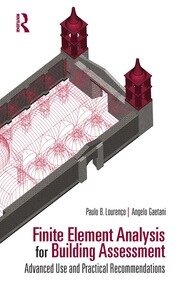
Finite element analysis for building assessment : Advanced use and practical recommendations
Existing structures represent a heterogeneous category in the global built environment as often characterized by the presence of archaic materials, damage and disconnections, uncommon construction techniques and subsequent interventions throughout the building history. In this scenario, the common linear elastic analysis approach adopted for new buildings is incapable of an accurate estimation of structural capacity, leading to overconservative results, invasive structural strengthening, added intervention costs, excessive interference to building users and possible losses in terms of aesthetics or heritage values. For a rational and sustainable use of the resources, this book deals with advanced numerical simulations, adopting a practical approach to introduce the fundamentals of Finite Element Method, nonlinear solution procedures and constitutive material models.

Finite element analysis and design of steel and steel–concrete composite bridges
The book’s eight chapters begin with an overview of the various forms of modern steel and steel-concrete composite bridges, current design codes (American, British, and Eurocodes), nonlinear material behavior of the bridge components, and applied loads and stability of steel and steel-concrete composite bridges. This is followed by self-contained chapters concerning design examples of steel and steel-concrete composite bridge components as well as finite element modeling of the bridges and their components. The final chapter focuses on finite element analysis and the design of composite highway bridges with profiled steel sheeting.

Field Models in Electricity and Magnetism
Covering the development of field computation in the past forty years, Field Models in Electricity and Magnetism intends to be a concise, comprehensive and up-to-date introduction to field models in electricity and magnetism, ranging from basic theory to numerical applications. The approach assumed throughout the whole book is to solve field problems directly from partial differential equations in terms of vector quantities. Theoretical issues are illustrated by practical examples. In particular, a single example is solved by different methods so that, by comparison of results, limitations and advantages of the various methods are made clear.

Explosion-Resistant Buildings : Design, Analysis, and Case Studies
This excellent book highlights all aspects of the analysis and design of buildings subject to impact, explosion and fire. It is a definitive reference book and contains 10 chapters from a wide international prospective. Three-dimensional finite element and discrete element techniques are included. They are applied to buildings such as the World Trade Center (WTC Twin Towers) and the Federal Building in Oklahoma on the basis of the designers drawings, data and other information. Many small case studies are also included. The book has a comprehensive bibliography and a large appendix providing background analysis and computer subroutines of recently developed programs.

Excavations and Foundations in Soft Soils
The book is about soft soil engineering and is intended to serve the practicing as well as the research engineers. The planning, design and construction of exca- tions and foundations in soft to very soft soils is always a difficult and challanging assignment to engineers. The authors have tried to address some of these problems and challenges in this book. Beside the state of the art of soft soils, authors own research results and expe- ences from practical projects are presented in the book. Special emphasis is also given among others on the presentation of several case studies coresponding to each topic treated in the book as well as a summary of the experiences in the - termination of soil parameters for finite element analysis of geotechnical pr- lems. The book is illustrated by a wealth of photographs and diagrams.

Environmental Modeling : Using MATLAB®
“Environmental Modeling using MATLAB R ” by Ekkehard Holzbecher is an excellent publication and a novel approach covering the intersection of two important, growing worlds – the world of environmental modeling and of mathematical software. Environmental modeling is a science that uses mathematics and comp- ers to simulate physical and chemical phenomena in the environment (e.g., environmental pollution).

Energy methods in structural mechanics : A comprehencive introduction to matrix and finite element methods of analysis
Provides a basic and clear introduction to the principles underlying finite elements and the computer based methods of the analysis of structures commonly used in industry. There can be a danger that, without such an understanding, engineers will use these computer based analysis tools as black boxes and accept results without being aware of the real significance of the information obtained.

Elasto-Plastic and Damage Analysis of Plates and Shells
This book presents a finite element model for the elasto-plastic and damage analysis of thin and thick shells. Linear elastic, inelastic and softening behaviors caused by damage in structural shells, as well as large rotations are investigated.

Dynamics of Rotating Systems
This book is structured in two parts: the first introduces classical or basic rotordynamics. The basic assumptions are linearity, steady state operation, and at least some degree of axial symmetry. The second part discusses advanced rotordynamics. More detailed models are covered for rotors departing from the classic configurations studied in rotordynamics. The contents of the second part are more research topics than consolidated applications.

Dynamics of Flexible Multibody Systems : Rigid Finite Element Method
A new approach is presented for modelling multi-body systems, which constitutes a substantial enhancement of the Rigid Finite Element method. The new approach is based on homogeneous transformations and joint coordinates, and it yields the advantage that equations of motion are automatically generated for systems consisting of alternate rigid and flexible links. Apart from its simple physical interpretation and easy computer implementation, the method is also valuable for educational purposes since it impressively illustrates the impact of mechanical features on the mathematical model. This novel modelling approach is then applied to systems such as offshore-cranes and telescopic rapiers.

Dynamic Analysis of Structures
Reflects the latest application of structural dynamics theory to produce more optimal and economical structural designs. The author includes carefully worked-out examples which are solved utilizing more recent numerical methods. These examples pave the way to more accurately simulate the behavior of various types of structures. The essential topics covered include principles of structural dynamics applied to particles, rigid and deformable bodies, thus enabling the formulation of equations for the motion of any structure.

Domain Decomposition Methods in Science and Engineering
Domain decomposition is an active, interdisciplinary research area that is devoted to the development, analysis and implementation of coupling and decoupling strategies in mathematics, computational science, engineering and industry.This book special focus has been on numerical analysis, computational issues,complex heterogeneous problems, industrial problems, and software development.

Domain Decomposition Methods for the Numerical Solution of Partial Differential Equations
Domain decomposition methods are divide and conquer methods for the parallel and computational solution of partial differential equations of elliptic or parabolic type. They include iterative algorithms for solving the discretized equations, techniques for non-matching grid discretizations and techniques for heterogeneous approximations. This book serves as an introduction to this subject, with emphasis on matrix formulations. The topics studied include Schwarz, substructuring, Lagrange multiplier and least squares-control hybrid formulations, multilevel methods, non-self adjoint problems, parabolic equations, saddle point problems (Stokes, porous media and optimal control), non-matching grid discretizations, heterogeneous models, fictitious domain methods, variational inequalities, maximum norm theory, eigenvalue problems, optimization problems and the Helmholtz scattering problem. Selected convergence theory is included.
