



Page 45
Page 45

Geometrical Geodesy : Using Information and Computer Technology
This book reviews developments in geodesy and hydrography, using a wide variety of electronic and acoustic instruments. The aim is to take stock of the latest fundamental geodetic constants for the 2000s, to focus on dissimilar ellipsoidal areas, distances, and conversion of applications, referenced to an abundant bibliography. It presents a mixture of issues, dealing with reference and time systems, datums, and s-transformations, elucidate multi-dimensional aspects of the information, communication, and computation technology, including the use of parallel computers. Stressing the hands-on methodology, the handbook is of interest to geodetic engineers, consultants, hydrographers, and engineers with an interest in the field of earth sciences.

Geometrical dynamics of complex systems : A unified modelling approach to physics, control, biomechanics, neurodynamics and psycho-socio-economical dynamics
This volume presents a comprehensive introduction into rigorous geometrical dynamics of complex systems of various natures. By "complex systems", in this book are meant high-dimensional nonlinear systems, which can be (but not necessarily are) adaptive. This monograph proposes a unified geometrical approach to dynamics of complex systems of various kinds: engineering, physical, biophysical, psychophysical, sociophysical, econophysical, etc. The main objective of this book is to show that high-dimensional nonlinear systems in "real life" can be modeled and analyzed using rigorous mathematics, which enables their complete predictability and controllability, as if they were linear systems.

Geometric Properties for Incomplete Data
Computer vision and image analysis require interdisciplinary collaboration between mathematics and engineering. This book addresses the area of high-accuracy measurements of length, curvature, motion parameters and other geometrical quantities from acquired image data. It is a common problem that these measurements are incomplete or noisy, such that considerable efforts are necessary to regularise the data, to fill in missing information, and to judge the accuracy and reliability of these results. This monograph brings together contributions from researchers in computer vision, engineering and mathematics who are working in this area.

Geometric Problems on Maxima and Minima
Questions of maxima and minima have great practical significance, with applications to physics, engineering, and economics; they have also given rise to theoretical advances, notably in calculus and optimization. Indeed, while most texts view the study of extrema within the context of calculus, this carefully constructed problem book takes a uniquely intuitive approach to the subject: it presents hundreds of extreme-value problems, examples, and solutions primarily through Euclidean geometry.

Geometric Modeling and Processing - GMP 2006 ; 4th International Conference, GMP 2006, Pittsburgh, PA, USA, July 26-28, 2006, Proceedings
This book constitutes the refereed proceedings of the 4th International Conference on Geometric Modeling and Processing, GMP 2006, held in Pittsburgh, PA, USA in July 2006. The 36 revised full papers and 21 revised short papers presented were carefully reviewed and selected from a total of 84 submissions. All current issues in the area of geometric modeling and processing are addressed and the impact in such areas as computer graphics, computer vision, machining, robotics, and scientific visualization is shown. The papers are organized in topical sections on shape reconstruction, curves and surfaces, geometric processing, shape deformation, shape description, shape recognition, geometric modeling, subdivision surfaces, and engineering applications.

Geometric Fundamentals of Robotics
Geometric Fundamentals of Robotics provides an elegant introduction to the geometric concepts that are important to applications in robotics. This second edition is still unique in providing a deep understanding of the subject: rather than focusing on computational results in kinematics and robotics, it includes significant state-of-the art material that reflects important advances in the field, connecting robotics back to mathematical fundamentals in group theory and geometry.

Geometric and Engineering Drawing
Descriptive geometry and contemporary drafting guides the student through the essential principles to create engineering drawings that comply with international standards of technical product specification. This heavily updated new edition now applies to CAD as well as conventional drawing.

Geology and Ecosystems
This book includes an analysis of the relationship between the different geological, hydrochemical, hydrogeological and engineering-geological processes and the processes within surface ecosystems. The analysis of specific interactions between the lithosphere and biosphere provides an integrated concept of the role of the geological environment in the evolution of the biosphere. The practical significance of the book is reflected by the analysis of modern engineering activity associated with the mining of minerals, excessive groundwater withdrawal, disposal of industrial and domestic wastes (including radioactive wastes) and their impacts on all components of the environment. Geology and Ecosystems includes a scientific approach to the complex monitoring of the environment under different natural and anthropogenic conditions, including the monitoring of permafrost regions. An important part of the book is the analysis of the "water factor" impact on ecosystems and sustainable development. Influences of intensive groundwater extraction on river flow, vegetation and land subsidence are also considered.

Geological atlas of Africa : With notes on stratigraphy, tectonics, economic geology, geohazards, geosites and geoscientific education of each country
T is atlas is intended primarily for anybody who is in-some background for the arrangement of how the terested in basic geology of Africa. Its originality lies atlas was done. T e second chapter is devoted to the in the fact that the regional geology of each African history of geological mapping in Africa, necessary nation or territory is reviewed country-wise by maps for a fuller appreciation of why this work in Africa is and text, a view normally not presented in textbooks worth doing. Chapter 3 provides an executive s- of regional geology. It is my belief, that there has long mary on the stratigraphy and tectonics of Africa as a been a need in universities and geological surveys, whole, i. e. in the context of no political boundaries.
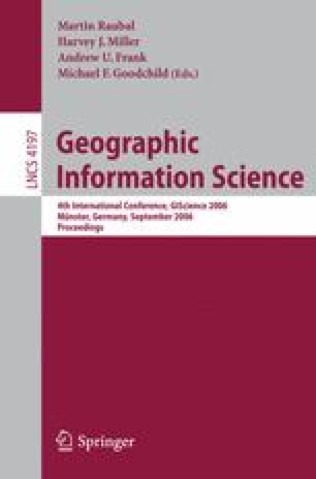
Geographic Information Science ; 4th International Conference, GIScience 2006, Münster, Germany, September 20-23, 2006, Proceedings
The GIScience conference series (www. giscience. org) was created as a forum for all researchers who are interested in advancing research in the fundam- tal aspects of geographic information science.The conferences focus on emerging topics and basic research ?ndings across all s- tors of geographic information science. After three highly successful conferences in the United States, this year’s GIScience conference was held in Europe for the ?rst time. The GIScience conferences have been a meeting point for researchers coming from various disciplines, including cognitive science, computer science, engine- ing, geography,information science, mathematics, philosophy, psychology,social science, and statistics. The advancement of geographic information science - quiressuchinterdisciplinarybreadth,andthisisalsowhatmakestheconferences so exciting. In order to account for the di?erent needs of the involved scienti?c disciplines with regard to publishing their research results.

Geoenvironmental Engineering : Integrated management of groundwater and contaminated land
Contains the proceedings of the 4th Geoenvironmental Engineering Conference, organised by the British Geotechnical Association and Cardiff University's School of Engineering, held in Stratford-Upon-Avon in June 2004. The theme of the conference was Integrated Management of Groundwater and Contaminated Land. This book is a compilation of peer-reviewed papers; grouped according to the sessions under which they were presented at the conference.

Geoenvironmental Engineering : Geoenvironmental impact management ; Proceedings of the third conference organized by the British Geotechnical Association and Cardiff School of Engineering, Cardiff University, and held in Edinburgh on 17–19 September 2001
Geoenvironmental engineering contains the collected papers from the third Geoenvironmental Engineering Conference, organised by the British Geotechnical Association and Cardiff School of Engineering, Cardiff University. Authors from around the world have submitted the papers in this volume. They aim to share knowledge and experience to the international geoenvironmental engineering community. The main theme of this third conference is Geoenvironmental Impact Management.

geoENV VI - Geostatistics for Environmental Applications : Proceedings of the Sixth European Conference on Geostatistics for Environmental Applications
This volume contains how geostatistics is applied within the environmental sciences. A few selected theoretical contributions are also included.

Geodetic Deformation Monitoring : From Geophysical to Engineering Roles ; IAG Symposium Jaén, Spain, March 7-19,2005
Geodesy is the science dealing with the determination of the position of points in space, the shape and gravity field of the Earth and with their time variations. A consequence is that geodesists feel as a permanent subject of research, the detection, analysis and interpretation of spatial deformation as well as gravity field variation. This book collects 36 selected papers from the International Symposium on Geodetic Deformation Monitoring held in Jaén (Spain) from 17th to 19th March 2005. The main topics covered in the symposium were: mathematical and statistical models for crustal deformation analysis, deformation monitoring from GPS and InSAR data: analysis and geophysical interpretation, geodetic monitoring of movements in civil engineering, integration of spatial and terrestrial techniques in deformation studies, geodynamical applications of gravimetric observations and present-day geodetic instrumentation for deformation monitoring. This volume is a good overview of theoretical matters, models and results.

Geodetic and geophysical observations in Antarctica : An overview in the IPY perspective
This book is a collection of papers on various aspects of the scientific investigation and observation techniques of the polar regions at both temporary and permanent observatories. Most papers focus on regional models based on data acquired in polar regions. Geodetic satellite positions systems (GNSS: GPS, GLONASS, GALILEO) will also be discussed as well as other space techniques (DORIS, VLBI). Gravimetry, absolute gravimetry, and tidal gravimetry are also discussed, as well as seismology and meteorology.

Gentamicin : Biosynthesis, medicinal applications and potential side effects
Discusses the biosynthesis, medicinal applications and potential side effects of Gentamicin. Topics include Gentamicin used in combination therapy and applied to medicinal materials for clinical applications; use of natural products to enhance the antibiotic activity of Gentamicin and other aminoglycosides; regiospecific Gentamicin functionalization; Gentamicin and particle engineering; and the indications and adverse effects of Gentamicin.

Genome Mapping and Genomics in Fishes and Aquatic Animals
The series Genome Mapping and Genomics in Animals provides comprehensive and up-to-date reviews on genomic research on a large variety of selected animal systems, contributed by leading scientists from around the world.This volume summarizes the first era of genomic studies of aquaculture species, in which the tools and resources necessary to support whole-genome sequencing were developed. These tools will enhance efforts toward selective breeding of aquaculture species. Included in this volume are summaries of work on salmonids, cyprinids, catfish, tilapias, European sea bass, Japanese flounder, shrimps and oysters.

Genome editing in neurosciences
Innovations in molecular biology are allowing neuroscientists to study the brain with unprecedented resolution, from the level of single molecules to integrated gene circuits. Chief among these innovations is the CRISPR-Cas genome editing technology, which has the precision and scalability to tackle the complexity of the brain. This Colloque Médecine et Recherche has brought together experts from around the world that are applying genome editing to address important challenges in neuroscience, including basic biology in model organisms that has the power to reveal systems-level insight into how the nervous system develops and functions as well as research focused on understanding and treating human neurological disorders.

Genetic Systems Programming : Theory and Experiences
This book is devoted to reporting innovative and significant progress about the contribution of genetic programming in systems programming. The contributions of this book clearly demonstrate that genetic programming is very effective in solving hard and yet-open problems in systems programming. Followed by an introductory chapter, in the remaining contributed chapters, the reader can easily learn about systems where genetic programming can be applied successfully. These include but are not limited to, information security systems, compilers, data mining systems, stock market prediction systems, robots and automatic programming.

Genetic surgery : from genes to solutions
As a tool for modifying the genome, gene editing technologies has developed rapidly in recent years, the application of these technologies in basic biomedical research has yielded significant advances in identifying and studying key molecular targets relevant to human diseases and their treatment. The clinical translation of genome editing techniques offers unprecedented biomedical engineering capabilities in the diagnosis, prevention, and treatment of disease or disability...
