



Page 4
Page 4

Grippers in Motion : The Fascination of Automated Handling Tasks
This book shows you how to ensure process reliability on the basis of combining the right components with advanced application know-how. By explaining basic preconditions of the gripping process and highlighting the milestones of automation history, we guide you all the way through to the center of the handling process – the workpiece. Its ambient conditions and setup are clearly defined as well as the process of setting grippers in motion. Starting with simple linear movements up to multi-axis kinematics, you are provided with the details for practical solutions.

Good laboratory practice : The why and the how
The GLP regulations have developed from rules on how to exactly document the planning, conduct and reporting of toxicity studies to a quality system for the management of a multitude of study types, from the simple determination of a physical/chemical parameter to the most complex field studies or ecotoxicology studies. At the same time the term “Good Laboratory Practice” has become somewhat of a slogan with the aim to characterise any reliably conducted laboratory work.

Global Risk Governance : Concept and Practice Using the IRGC Framework
This book innovative risk governance framework, the careful reviews it received from internationally recognized scientists, and the results of several case studies in which the framework has been applied to a number of significant but different risks.

Geometric Properties for Incomplete Data
Computer vision and image analysis require interdisciplinary collaboration between mathematics and engineering. This book addresses the area of high-accuracy measurements of length, curvature, motion parameters and other geometrical quantities from acquired image data. It is a common problem that these measurements are incomplete or noisy, such that considerable efforts are necessary to regularise the data, to fill in missing information, and to judge the accuracy and reliability of these results. This monograph brings together contributions from researchers in computer vision, engineering and mathematics who are working in this area.

Geomagnetics for aeronautical safety : A case study in and around the Balkans
Flying safely in aircraft implies the use of navigation instruments. Among them, the magnetic compass is still a first choice for orientation and it is compulsory in all aircraft. In our increasingly sophisticated but fragile world of global navigation systems and gyroscopic sensors, the compass is especially useful as a back-up: it is highly reliable and likely to survive in harsh electromagnetic aggressions or when all power supplies fail. This book examines in detail how the science of geomagnetism is able to promote correct use of the magnetic compass for navigation. A selected group of specialists met in Ohrid, Macedonia to expose their approaches to the question. Using techniques from Geology, Instrument science, Magnetism, Chaos theory and Potential Fields applied to the Balkan region and surroundings, they put together a roadmap to fully tackle the issue of measurement, analysis, mapping and forecasting the magnetic declination in support of aeronautical safety.

Gallium Nitride Electronics
Gallium Nitride Electronics covers developments in III-N semiconductor-based electronics with a focus on high-power and high-speed RF applications. Material properties of III-N semiconductors and substrates; the state-of-the-art of devices and circuits, epitaxial growth, device technology, modelling and characterization; and circuit examples are discussed. The book concludes with device reliability aspects and an overview of integration and packaging. This comprehensive monograph and tutorial is based on more than a decade of research on materials, devices, and circuits.

Fuzzy Quantifiers : A Computational Theory
Almost all", "many", "some": fuzzy quantifiers are vital for effective communication in natural language (NL). This monograph pursues an axiomatic method to achieve a reliable interpretation of these quantifiers in technical applications of fuzzy quantification. Unlike existing work in this area, it targets a much broader class of quantificational phenomena which includes all cases usually considered in linguistics. The topics addressed in the monograph run the gamut from the introduction of the theoretical framework for analysing fuzzy quantification, the formalization of semantical requirements on models of fuzzy quantification, the construction and detailed study of prototypical models which conform to the linguistic desiderata, the development of algorithms for implementing the main types of quantifiers in these models, and finally a preview to fuzzy branching quantifications which might be necessary for modelling NL sentences involving more than one quantifier.

Fuzzy probabilities : New approach and applications
In probability and statistics we often have to estimate probabilities and parameters in probability distributions using a random sample. Instead of using a point estimate calculated from the data we propose using fuzzy numbers which are constructed from a set of confidence intervals. In probability calculations we apply constrained fuzzy arithmetic because probabilities must add to one. Fuzzy random variables have fuzzy distributions. A fuzzy normal random variable has the normal distribution with fuzzy number mean and variance. Applications are to queuing theory, Markov chains, inventory control, decision theory and reliability theory.

Fuzzy Modeling with Spatial Information for Geographic Problems
This book focuses on research advances in approaches for incorporating explicit handling of uncertainty, especially by fuzzy sets, to address geographic problems. It has two aims: to stimulate research in the theory and application of fuzzy sets to spatial information management and geographic problem solving; and to highlight advances that have matured so much that geoscientists, computer scientists, geographers, et al. use fuzzy modeling. The book includes examples of the use of fuzzy sets in representational issues such as terrain features, landscape morphology, spatial extents and approaches for spatial interpolation, plus applications using fuzzy sets covering data mining, spatial decision making, ecological simulation, and reliability in GIS.

Fuzzy Logic Applications in Engineering Science
Fuzzy logic is a relatively new concept in science applications. Hitherto, fuzzy logic has been a conceptual process applied in the field of risk management. Its potential applicability is much wider than that, however, and its particular suitability for expanding our understanding of processes and information in science and engineering in our post-modern world is only just beginning to be appreciated.

Fuzzy Applications in Industrial Engineering
After an introductory chapter explaining the recent status of fuzzy sets in IE, this volume involves application chapters on the major seven areas of IE to which fuzzy set theory can contribute. These major application areas are Control and Reliability, Engineering Economics and Investment Analysis, Group and Multi-criteria Decision-making, Human Factors Engineering and Ergonomics, Manufacturing Systems and Technology Management, Optimization Techniques, and Statistical Decision-making. Under these major areas, every chapter includes didactic numerical applications.

Fracture Mechanics of Ceramics ; Active Materials, Nanoscale Materials, Composites, Glass, and Fundamentals
The 8th International Symposium on fracture mechanics of ceramics was held in on the campus of the University of Houston, Houston, TX, USA, on February 25-28, 2003. With the natural maturing of the fields of structural ceramics, this symposium focused on nano-scale materials, composites, thin films and coatings as well as glass. The symposium also addressed new issues on fundamentals of fracture mechanics and contact mechanics, and a session on reliability and standardization.

Foundations and applications of MIS : A model theory approach
Foundations and Applications of MIS presents a unique systems theory approach to management information system (MIS) development. The development is driven by the need to eliminate ambiguity in specification, design and construction of the application software. Further, the authors show that the considerable effort being expanded nowadays on validation, verification and testing, as required in current software engineering practices, will be reduced. The approach also reinforces the belief that MIS development is independent of software development. The work presents an approach that provides a theoretical foundation for MIS development from the systems theoretic viewpoint along with practical applications ranging from a transaction processing system to a solver system. Both formal systems theory and automatic system generation based on the authors' newly extended Prolog offer a significant increase in the efficiency of specification, design and production of the application software, as well as an increase in the functional reliability of the software produced. The book assumes a working knowledge of elementary set theory, logic, and familiarity with some systems concepts, such as the automaton model.

Foundation PHP for Dreamweaver 8
In this book, we look specifically at using Dreamweaver's built-in server behaviors to build dynamic web sites using PHP and MySQL, the world's most popular open source server-side language and database server combination, which are both reliable, powerful, and open source (and therefore free to use). This version of Dreamweaver includes more powerful support for PHP and MySQL than ever before, and we'll show you how to make this work for you. No previous experience of PHP or MySQL is necessary to use this book. Examples built throughout the book include a content management system, and an online image gallery. All examples are designed to meet modern usability requirements and be web standards-compliant.

Formal Models of Operating System Kernels
The purpose of this book is to show that the formal specification of kernels is not only possible but also necessary if operating systems are to achieve the levels of reliability and security that is demanded of them today. Specifications of a sequence of kernels of increasing complexity are included, acting as models to enable the designer to identify and reason about the properties of the design – thus making explicit that which is too often left implicit or even unknown.

Formal methods applications and technology ; 11th International workshop on formal methods for industrial critical systems, FMICS 2006, and 5th International Workshop on parallel and distributed methods in verification, PDMC 2006, Bonn, Germany, August 26-27, and August 31, 2006, Revised Selected
The workshop program included two invited talks, by Anna Slobodova from Intel on “Challenges for Formal Veri?cation in an Industrial Setting” and by Edward A. Lee from the University of California at Berkeley on “Making C- currency Mainstream.” The former full paper can be found in this volume.
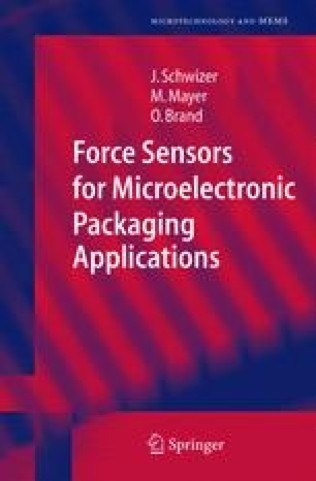
Force Sensors for Microelectronic Packaging Applications
This monograph is intended for wire bonding and flip-chip packaging professionals and for scientists and engineers working in the field of mechanical microsensors. New measurement technologies are introduced that allow in situ and real-time examination of physical processes during the packaging process or during subsequent reliability tests. The measurement system presented here enables measurements at formerly inaccessible packaging interconnects. For the first time it becomes possible to describe the wire bonding process window in terms of the physical forces at the contact zone instead of the applied machine settings. This is significant for a deeper understanding of these packaging processes. Applications of the sensor in the field of wire bonding and flip-chip characterization are illustrated. The reader will gain much insight into the important field of interconnection technology in semiconductor packaging.

Fire Safety for Very Tall Buildings : Engineering Guide
Provides information on special topics that affect the fire safety performance of very tall buildings, their occupants and first responders during a fire. This Guide addresses these topics as part of the overall building design process using performance-based fire protection engineering concepts as described in the SFPE Engineering Guide to Performance Based Fire Protection. This Guide is not intended to be a recommended practice or a document that is suitable for adoption as a code. The Guide pertains to “super tall,” “very tall” and “tall” buildings. Throughout this Guide, all such buildings are called “very tall buildings.” These buildings are characterized by heights that impose fire protection challenges; they require special attention beyond the protection features typically provided by traditional fire protection methods. This Guide does not establish a definition of buildings that fall within the scope of this document.

Field and Service Robotics ; Vol. 24 : Recent Advances in Research and Applications
This unique collection is the post-conference proceedings of the 4th FSR in Lake Yamanaka, Japan at July 2003. This book edited by Shin’ichi Yuta, Hajime Asama, Sebastian Thrun, Erwin Prassler and Takashi Tsubouchi is rich by topics and authoritative contributors and presents the current developments and new directions in field and service robotics. The contents of these contributions represent a cross-section of the current state of robotics research from one particular aspect: field and service applications, and how they reflect on the theoretical basis of subsequent developments. Pursuing technologies aimed at realizing skilful, smart, reliable, robust field and service robots is the big challenge running throughout this focused collection.

Fault-Tolerance Techniques for SRAM-Based FPGAs
This book discusses fault-tolerance techniques for SRAM-based Field Programmable Gate Arrays (FPGAs). It starts by showing the model of the problem and the upset effects in the programmable architecture. In the sequence, it shows the main fault tolerance techniques used nowadays to protect integrated circuits against errors. A large set of methods for designing fault tolerance systems in SRAM-based FPGAs is described. Some presented techniques are based on developing a new fault-tolerant architecture with new robustness FPGA elements. Other techniques are based on protecting the high-level hardware description before the synthesis in the FPGA.
