


Refine Results
Sort By
From
To

Clare Churcher's Beginning SQL Queries is your guide to mastering the lingua franca of the database industry: the SQL language. Good knowledge of SQL is crucial to anyone working with databases, because it is with SQL that you retrieve data, manipulate data, and generate business results. Knowing how to write good queries is the foundation for all work done in SQL, and it is a foundation that Clare lays well in her book.
Beginning Spring 2 is the first Spring–authorized book that takes you through the first steps of using Spring, and requires no prior J2EE experience. It discusses relevant integrated technologies that you should be aware of, and illustrates how Spring makes using them easier.
Introduces you to the Scala programming language, its object-oriented and functional programming characteristics, and then guides you through Scala constructs and libraries that allow you to assemble small components into high-performance, scalable systems. You will understand why Scala is judiciously used for critical business applications by leading companies such as Twitter, LinkedIn, Foursquare, the Guardian, Morgan Stanley, Credit Suisse, UBS, and HSBC – and you will be able to use it in your own projects. You will: Get started with Scala 3 or Scala language programming in general / Understand how to utilitze OOP in Scala / Perform functional programming in Scala / Master the use of Scala collections, traits and implicits / Leverage Java and Scala interopability / Employ Scala for DSL programming / Use patterns and best practices in Scala
Beginning Ruby on Rails E-Commerce: From Novice to Professional is the first book of its kind to guide you through producing e-commerce applications with Rails, the stacked web framework taking the world by storm. The book dives right into the process of creating a production-level web application using agile methodologies and test-driven development combined with Rails best practices.
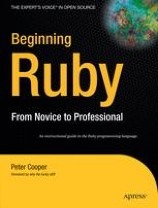
Beginning Ruby is a thoroughly contemporary guide for every type of reader who wants to learn Ruby, from novice programmers to web developers to Ruby newcomers. It starts by explaining the principles behind object-oriented programming and within a few chapters builds toward creating a genuine Ruby application.
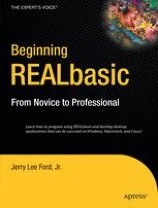
REALbasic is an easy-to-learn, powerful, cross-platform programming language, allowing you to write powerful applications that can be distributed across Windows, Mac, and Linux. REALbasic’s success is proven - there are already over 100,000 users, and this number is steadily growing. In a recent promotional effort, 35,000 Visual Basic developers downloaded a free copy of the Windows version of REALbasic, and REAL software has had many requests for decent beginning title on the subject. As far as we know, this is the only up-to-date book planned for the current version, REALbasic 2005, which matches that description. REAL software are enthusiastic about helping us sell the book.
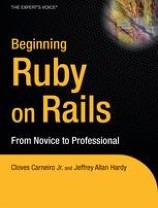
Beginning Rails is the practical starting point for anyone wanting to learn how to build dynamic web applications using the Rails framework for Ruby. You'll learn how all of the components of Rails fit together and how you can leverage them to create sophisticated web applications with less code and more joy.
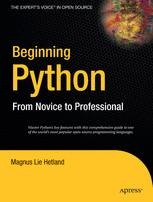
Ten different projects illustrate the concepts introduced in the book. You will learn how to create a P2P file-sharing application and a web-based bulletin board, and how to remotely edit web-based documents and create games. Author Magnus Lie Hetland is an authority on Python and previously authored Practical Python. He also authored the popular online guide, Instant Python Hacking, on which both books are base
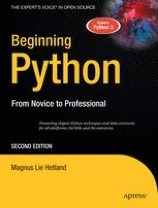
Gain a fundamental understanding of Python's syntax and features with the second edition of Beginning Python, an up–to–date introduction and practical reference. Covering a wide array of Python–related programming topics, including addressing language internals, database integration, network programming, and web services, you'll be guided by sound development principles. Ten accompanying projects will ensure you can get your hands dirty in no time. Updated to reflect the latest in Python programming paradigms and several of the most crucial features found in Python 3.0 (otherwise known as Python 3000), advanced topics, such as extending Python and packaging/distributing Python applications, are also covered
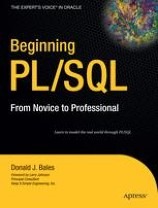
Get started with PL/SQL, the built-in language that every Oracle developer and database administrator must know, in Beginning PL/SQL, a fast-paced and example-filled tutorial. The book that covers all the key features of PL/SQL without wasting your time discussing esoteric and obsolete parts of the language.
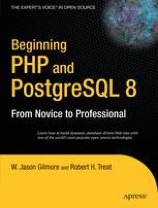
Beginning PHP and PostgreSQL 8 delves into some of the most popular open-source web development technologies, the PostgreSQL 8 database server and PHP 5 scripting language. You'll learn to reap the benefits of these core technologies by using them in unison to create dynamic, data-driven web applications. This is an ideal read if you are a web designer, programmer, hobbyist, or novice who wants to create applications with PHP 5 and PostgreSQL 8.
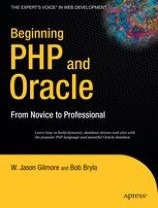
Beginning PHP and Oracle: From Novice to Professional offers comprehensive information on using the PHP scripting language in conjunction with Oracles database platform. PHP is one of the most prominent open source technologies in the area of web development, while Oracle is one of the most widely deployed and used database products.
Written for the budding web developer searching for a powerful, low-cost solution for building flexible, dynamic web sites. Essentially three books in one: provides thorough introductions to the PHP language and the MySQL database, and shows you how these two technologies can be effectively integrated to build powerful websites. Provides over 500 code examples, including real-world tasks such as creating an auto-login feature, sending HTML-formatted e-mail, testing password guessability, and uploading files via a web interface. Updated for MySQL 5, includes new chapters introducing triggers, stored procedures, and views.
Beginning PHP and MySQL: From Novice to Professional, Third Edition offers a comprehensive introduction to two of the most prominent open-source technologies on the planet: the PHP scripting language and the MySQL database server. Updated to introduce the features found in MySQL's most significant release to date, readers will learn how to take advantage of the features of both technologies to build powerful, manageable, and stable web applications. Essentially three books in one, readers will not only profit from extensive introductions to the core features of each technology, but also learn how to effectively integrate the two in order to build robust data-driven applications.
Beginning Object-Oriented Programming with VB 2005 is a comprehensive resource of correct coding procedures. Author Daniel Clark takes you through all the stages of a programming project, including analysis, modeling, and development, all using object-oriented programming techniques and Visual Basic .NET. Clark explores the structure of classes and their hierarchies, as well as inheritance and interfaces. He also introduces the .NET Framework and the Visual Studio integrated development environment, or IDE. A real-world case study walks you through the design of a solution. You can then transform the design into a functional VB .NET application. The application includes a graphical user interface (GUI), a business logic class library, and integration with a back-end database. Throughout the book, you'll explore the fundamentals of software design, object-oriented programming, Visual Basic .NET 2.0, and the Unified Modeling Language (UML).
Beginning MapServer: Open Source GIS Development is the first book of its kind. It offers a comprehensive introduction to MapServer, the development platform for integrating mapping technology into Internet applications. You'll learn how to build and extend dynamic applications using popular languages like PHP, Perl, and Python. After a thorough introduction to installation and configuration, you'll uncover basic MapServer topics and examples. You'll also learn about advanced MapServer features, and how to query and incorporate dynamic data into your application. The book culminates with the creation of an actual mapping application.
Learn to use the jOOQ library to manage SQL database operations in Java and JVM applications. This book walks you through what JOOQ is, how to install and get started with it, and then gets you working with it. You will: Comparing equivalent features between Hibernate, JPA and jOOQ. Unlock the power of your SQL database with high performing, flexible and typesafe SQL queries. Seamlessly work with many different SQL database vendors without changing your code. Effortlessly generate Java code based on the content of your database. Write reactive SQL database access code with R2DBC. Integrating jOOQ into popular frameworks and platforms like Hibernate, Spring boot and Quarkus tools like IDEs. Testing jOOQ-based code with modern integration testing frameworks like TestContainers and Docker. Learn how to safely handle data access code within frameworks like the Java Persistence API (JPA)
Learning to design objects effectively with Java is the goal of Beginning Java Objects: From Concepts to Code, Second Edition. Plenty of titles dig into the Java language in massive detail, but this one takes the unique approach of stepping back and looking at fundamental object concepts first. Mastery of Java—from understanding the basic language features to building complete industrial-strength Java applications—emerges only after a thorough tour of thinking in objects. The first edition of Beginning Java Objects has been a bestseller; this second edition includes material on the key features of J2SE 5, conceptual introductions to JDBC and J2EE, and an in-depth treatment of the critical design principles of model-data layer separation and model-view separation.
Teaches you tools that you can use to build efficient applications. It starts with an introduction to algorithms and big O notation, later explains bubble, merge, quicksort, and other popular programming patterns. You’ll also learn about data structures such as binary trees, hash tables, and graphs. The book progresses to advanced concepts, such as algorithm design paradigms and graph theory. By the end of the book, you will know how to correctly implement common algorithms and data structures within your applications.
Learn the fundamentals of the Java 17 LTS or Java Standard Edition version 17 Long Term Support release, including basic programming concepts and the object-oriented fundamentals necessary at all levels of Java development. You will: Write your first Java programs with emphasis on learning object-oriented programming / How to work with switch expressions, value types (records), local variable type inference, pattern matching switch and more from Java 17 / Handle exceptions, assertions, strings and dates, and object formatting / Learn about how to define and use modules / Dive in depth into classes, interfaces, and inheritance in Java / Use regular expressions / Take advantage of the JShell REPL tool

Daraa Highway - Ghabagheb - Syria
+963-15 2050 - 15 860 380 /1/2/3 - 11 662 3900