


Refine Results
Sort By
From
To

In development scenarios where things can't be run in a debugger, or when you run the risk of masking the problem, logs are the greatest source of information about running a program. Pro Apache Log4j, Second Edition provides best practices guidelines and comprehensive coverage of the most recent release. Step by step, the book explains core concepts, from basic to advanced. Code samples are in Java and include guidelines for different application-specific needs. You'll also learn how to extend the API to write custom components and best practices for using the feature-rich log4j API. This book concludes with enterprise Java applications using log4j with JSP and J2EE.

Laser-based additive manufacturing (LAM) is a revolutionary advanced digital manufacturing technology developed in recent decades, which is also a key strategic technology for technological innovation and industrial sustainability. This technology unlocks the design and constraints of traditional manufacturing and meets the needs of complex geometry fabrication and high-performance part fabrication. A deeper understanding of the design, materials, processes, structures, properties and applications is desired to produce novel functional devices, as well as defect-free structurally sound and reliable LAM parts.The topics in this Special Issue reprint include macro- and micro-scale additive manufacturing with lasers, such as structure/material design, fabrication, modeling and simulation, in situ characterization of additive manufacturing processes and ex situ materials characterization and performance, with an overview that covers various applications in aerospace, biomedicine, optics and energy.
The LNCS Journal on Data Semantics is devoted to the presentation of notable work that, in one way or another, addresses research and development on issues related to data semantics. The scope of the journal ranges from theories supporting the formal definition of semantic content to innovative domain-specific applications of semantic knowledge. The journal addresses researchers and advanced practitioners working on the semantic web, interoperability, mobile information services, data warehousing, knowledge representation and reasoning, conceptual database modeling, ontologies, and artificial intelligence.
Springer's LNCS Journal on Data Semantics aims at providing a highly visible dissemination channel for most remarkable work that in one way or another addresses research and development on issues related to the semantics of data. The target domain ranges from theories supporting the formal definition of semantic content to innovative domain-specific application of semantic knowledge. This publication channel should be of the highest interest to researchers and advanced practitioners working on the Semantic Web, interoperability, mobile information services, data warehousing, knowledge representation and reasoning, conceptual database modeling, ontologies, and artificial intelligence.
The LNCS Journal on Data Semantics is devoted to the presentation of notable work that, in one way or another, addresses research and development on issues related to data semantics. Based on the highly visible publication platform Lecture Notes in Computer Science, this new journal is widely disseminated and available worldwide. The scope of the journal ranges from theories supporting the formal definition of semantic content to innovative domain-specific applications of semantic knowledge. The journal addresses researchers and advanced practitioners working on the semantic web, interoperability, mobile information services, data warehousing, knowledge representation and reasoning, conceptual database modeling, ontologies, and artificial intelligence.
The LNCS Journal on Data Semantics is devoted to the presentation of notable work that, in one way or another, addresses research and development on issues related to data semantics. Based on the highly visible publication platform Lecture Notes in Computer Science, this new journal is widely disseminated and available worldwide. The scope of the journal ranges from theories supporting the formal definition of semantic content to innovative domain-specific applications of semantic knowledge. The journal addresses researchers and advanced practitioners working on the semantic web, interoperability, mobile information services, data warehousing, knowledge representation and reasoning, conceptual database modeling, ontologies, and artificial intelligence.
The LNCS Journal on Data Semantics is devoted to the presentation of notable work that, in one way or another, addresses research and development on issues related to data semantics. Based on the highly visible publication platform Lecture Notes in Computer Science, this new journal is widely disseminated and available worldwide. The scope of the journal ranges from theories supporting the formal definition of semantic content to innovative domain-specific applications of semantic knowledge. The journal addresses researchers and advanced practitioners working on the semantic web, interoperability, mobile information services, data warehousing, knowledge representation and reasoning, conceptual database modeling, ontologies, and artificial intelligence.
Expand your knowledge of Java with this entertaining learning guide, which features 100+ exercises and programming challenges. Java Challenges will prepare you for your next exam or job interview, and covers many practical topics, such as strings, arrays, data structures, recursion, and date and time. The APIs and other material included in this book are Java 17 compatible. You will: Improve your Java knowledge by solving enjoyable but challenging programming puzzles / Solve mathematical problems, recursions, strings, arrays and more / Manage data processing and data structures like lists, sets, maps / Handle advanced recursion as well as binary trees, sorting and searching / Gamify key fundamentals for fun and easier reinforcement
Iterating Infusion presents comprehensive tools for you to best manage and work with object orientation. These include simplified fundamental concepts, popular language comparisons, advanced designing strategies, a broad usage progression, thorough design notations (interaction algebra), and data-oriented (fundamentally-OO) languages. The title, Iterating Infusion, alludes to the fact that any system has multiple, coexisting functional levels and that new levels—both lower and higher—are continually added to the same functional area. The practical effect is to bring processes into focus, always clarifying the vague. The extreme form of this is when separate but compatible technologies are brought together to create advancements; these can be baby-steps or great leaps, with varying amounts of effort. In more general terms, the same thing in a different context can take on much more power. And actually, this phenomenon is at the heart of object-oriented software.
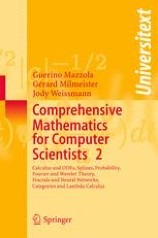
This second volume of a comprehensive tour through mathematical core subjects for computer scientists completes the ?rst volume in two - gards: Part III ?rst adds topology, di?erential, and integral calculus to the t- ics of sets, graphs, algebra, formal logic, machines, and linear geometry, of volume 1. With this spectrum of fundamentals in mathematical e- cation, young professionals should be able to successfully attack more involved subjects, which may be relevant to the computational sciences. In a second regard, the end of part III and part IV add a selection of more advanced topics. In view of the overwhelming variety of mathematical approaches in the computational sciences, any selection, even the most empirical, requires a methodological justi?cation. Our primary criterion has been the search for harmonization and optimization of thematic - versity and logical coherence. This is why we have, for instance, bundled such seemingly distant subjects as recursive constructions, ordinary d- ferential equations, and fractals under the unifying perspective of c- traction theory.
Many approaches have already been proposed for classification and modeling in the literature. These approaches are usually based on mathematical mod els. Computer systems can easily handle mathematical models even when they are complicated and nonlinear (e.g., neural networks). On the other hand, it is not always easy for human users to intuitively understand mathe matical models even when they are simple and linear. This is because human information processing is based mainly on linguistic knowledge while com puter systems are designed to handle symbolic and numerical information. A large part of our daily communication is based on words. We learn from various media such as books, newspapers, magazines, TV, and the Inter net through words. We also communicate with others through words. While words play a central role in human information processing, linguistic models are not often used in the fields of classification and modeling. If there is no goal other than the maximization of accuracy in classification and modeling, mathematical models may always be preferred to linguistic models. On the other hand, linguistic models may be chosen if emphasis is placed on interpretability.
This book provides a gentle, software engineering oriented introduction to category theory. Assuming only a minimum of mathematical preparation, this book explores the use of categorical constructions from the point of view of the methods and techniques that have been proposed for the engineering of complex software systems: object-oriented development, software architectures, logical and algebraic specification techniques, models of concurrency, inter alia. After two parts in which basic and more advanced categorical concepts and techniques are introduced, the book illustrates their application to the semantics of CommUnity – a language for the architectural design of interactive systems. "For computer scientists, this unique book presents Category Theory in a manner tailored to their interests and with examples to which they can relate." Ira Forman, IBM "This book applies little-known yet quite powerful formal tools from category theory to software structures: designs, architectures, patterns, and styles. Rather than focus on issues at the level of computational models and semantics, it instead applies these tools to some of the problems facing the sophisticated software architect.
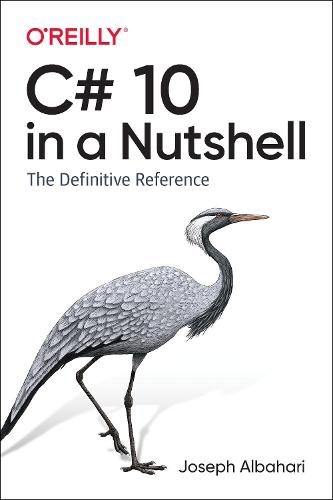
When you have questions about C# 10.0 or .NET 6, this guide has the answers you need. C# is a language of unusual flexibility and breadth, but with its continual growth, there's so much more to learn. In the tradition of O'Reilly's Nutshell guides, this thoroughly updated edition is simply the best one-volume reference to the C# language available today. Organized around concepts and use cases, this comprehensive and complete reference provides intermediate and advanced programmers with a concise map of C# and .NET that also plumbs significant depths
This book provides foundational knowledge for designing autonomous, asynchronous systems and explains aspects of users relevant to designing for these systems, introduces principles for user-centered design, and prepares readers for more advanced and specific readings.
Solving modern biological problems requires advanced computational methods. Bioinformatics evolved from the active interaction of two fast-developing disciplines, biology and information technology. The central issue of this emerging field is the transformation of often distributed and unstructured biological data into meaningful information. This book describes the application of well-established concepts and techniques from areas like data mining, machine learning, database technologies, and visualization techniques to problems like protein data analysis, genome analysis and sequence databases. Chen has collected contributions from leading researchers in each area. The chapters can be read independently, as each offers a complete overview of its specific area, or, combined, this monograph is a comprehensive treatment that will appeal to students, researchers, and R&D professionals in industry who need a state-of-the-art introduction into this challenging and exciting young field.
Gain a fundamental understanding of Python's syntax and features with the second edition of Beginning Python, an up–to–date introduction and practical reference. Covering a wide array of Python–related programming topics, including addressing language internals, database integration, network programming, and web services, you'll be guided by sound development principles. Ten accompanying projects will ensure you can get your hands dirty in no time. Updated to reflect the latest in Python programming paradigms and several of the most crucial features found in Python 3.0 (otherwise known as Python 3000), advanced topics, such as extending Python and packaging/distributing Python applications, are also covered
Beginning PHP and MySQL E-Commerce: From Novice to Professional, Second Edition covers every step of the design and building process involved in creating powerful, extendable e–commerce web sites. Based around a real–world example involving a web site selling t–shirts, you'll learn how to create and manage a product catalog, build and integrate a shopping cart, and process customer accounts and PayPal/credit card transactions. With the e–commerce framework in place, authors Emilian Balanescu and Cristian Darie show you how to integrate advanced features sure to set your web site apart from the competition. You'll learn how to expand your catalog using Amazon Web Services, optimize the web site for the search engines, and take advantage of Ajax to build an even more user–friendly shopping cart.
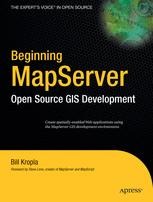
Beginning MapServer: Open Source GIS Development is the first book of its kind. It offers a comprehensive introduction to MapServer, the development platform for integrating mapping technology into Internet applications. You'll learn how to build and extend dynamic applications using popular languages like PHP, Perl, and Python. After a thorough introduction to installation and configuration, you'll uncover basic MapServer topics and examples. You'll also learn about advanced MapServer features, and how to query and incorporate dynamic data into your application. The book culminates with the creation of an actual mapping application.
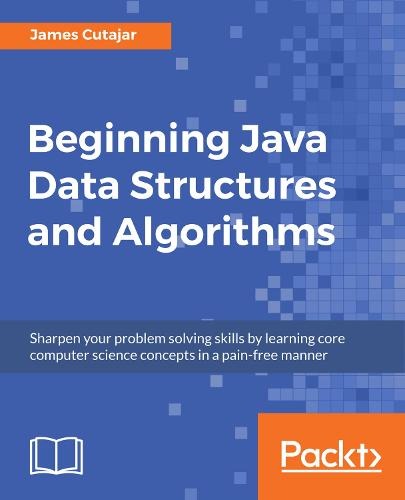
Teaches you tools that you can use to build efficient applications. It starts with an introduction to algorithms and big O notation, later explains bubble, merge, quicksort, and other popular programming patterns. You’ll also learn about data structures such as binary trees, hash tables, and graphs. The book progresses to advanced concepts, such as algorithm design paradigms and graph theory. By the end of the book, you will know how to correctly implement common algorithms and data structures within your applications.
Stats with an introduction to AI, where you’ll learn the history of neural networks and what sets deep learning apart from other varieties of machine learning. Discovery the variety of deep learning frameworks and set-up a deep learning development environment. Next, you’ll jump into simple classification programs for hand-writing analysis. Once you’ve tackled the basics of deep learning, you move on to TensorFlow 2 specifically. Find out what exactly a Tensor is and how to work with MNIST datasets. Finally, you’ll get into the heavy lifting of programming neural networks and working with a wide variety of neural network types such as GANs and RNNs. Deep Learning is a new area of Machine Learning research widely used in popular applications, such as voice assistant and self-driving cars. Work through the hands-on material in this book and become a TensorFlow programmer! You will: Develop using deep learning algorithms Build deep learning models using TensorFlow 2 Create classification systems and other, practical deep learning applications

Daraa Highway - Ghabagheb - Syria
+963-15 2050 - 15 860 380 /1/2/3 - 11 662 3900