



Page 25
Page 25

Artificial neural networks – ICANN 2007 ; 17th International Conference, Porto, Portugal, September 9-13, 2007, Proceedings, Part I
This book contains learning theory, advances in neural network learning methods, ensemble learning, spiking neural networks, advances in neural network architectures neural network technologies, neural dynamics and complex systems, data analysis, estimation, spatial and spatio-temporal learning, evolutionary computing, meta learning, agents learning, complex-valued neural networks, as well as temporal synchronization and nonlinear dynamics in neural networks.
Artificial markets modeling : Methods and applications
Agent-based computational modeling with its intrinsic multidisciplinary approach is gaining increasing recognition in the social sciences, particularly in economics, business and finance. This volume is devoted to recent contributions to the field from both the social sciences and computer sciences.
Artificial Market Experiments with the U-Mart System
Economics went through great development in the 20th century. This development, which was based mainly on mathematical methods, is not an appropriate method of analyzing markets that change every hour and every day. In a stock market, prices constantly change depending on speculation. U-Mart, a manmade market, has been proposed in order to study such instantly moving markets. Although the U-Mart system is internationally acclaimed for being at the forefront of market research, its use is by no means limited to a small number of researchers on the fringe. The whole system, including its source code, is open and is distributed without charge, testifying to a philosophy of creating and providing a common testbed for research into financial markets.
Artificial life models in software
Artificial Life Models in Software presents software tools, environments and realities dealing with creation, imitation and analysis of artefactual, virtual and living forms, written by those who personally design and produce software, hardware and art installations in artificial life, simulated complex systems and virtual worlds. This timely volume offers a nearly exhaustive overview and original analysis of major non-profit artificial life software packages. The carefully selected topics include: · simulation of real and imaginary life forms and their evolution · self-organization · emergent behaviours · swarm intelligence · evolutionary robotics · agent-based simulations · adaptive, complex and biologically inspired ecosystems · creative computer art There has long been a need within the academic and research community for an informal introduction and guidance to modern software tools for modelling and simulation of life-like phenomena – Artificial Life Models in Software fills this gap and provides invaluable information to both professional and amateur readers, offering detailed reviews of contemporary software for artificial life.

Artificial Intelligence. IJCAI 2019 International Workshops ; Macao, China, August 10–12, 2019, Revised Selected Best Papers
This book presents selected papers of 12 Workshops held in conjunction with the 28th International Joint Conference on Artificial Intelligence, IJCAI 2019, in Macao, China, in August 2019.
Artificial intelligence in the design process : The impact on creativity and team collaboration
Discusses how to include artificial intelligence (AI) systems in the early stages of the design process. Today designers need new tools capable of supporting them in dealing with the increasing project's complexity and empowering their performances and capabilities. AI systems appear to be powerful means to enhance designers' creativity. This assumption was tested in a workshop where sixteen participants collaborated with three AI systems throughout the creative phases of research, sketching, and color selection. Results show that designers can access a broader level of variance and inspiration while reducing the risk of fossilization by triggering lateral thinking through AI-generated data. Therefore, AI could significantly impact the creative phases of the design process if applied consciously. Being AI systems intelligent agents, the book treats the Human-AI collaboration as a collaboration between human agents, proposing a set of guidelines helpful to achieving an efficient partnership with the machine.
Artificial intelligence for customer relationship management : Solving customer problems
This book describes a number of applications of Artificial Intelligence in the field of Customer Relationship Management with the focus of solving customer problems. We design a system that tries to understand the customer complaint, his mood, and what can be done to resolve an issue with the product or service. To solve a customer problem efficiently, we maintain a dialogue with the customer so that the problem can be clarified and multiple ways to fix it can be sought. We introduce dialogue management based on discourse analysis: a systematic linguistic way to handle the thought process of the author of the content to be delivered. We analyze user sentiments and personal traits to tailor dialogue management to individual customers. We also design a number of dialogue scenarios for CRM with replies following certain patterns and propose virtual and social dialogues for various modalities of communication with a customer.

Artificial intelligence applications and innovations II; IFIP TC12 and WG12.5 ; 2nd IFIP conference on artificial intelligence applications and innovations (AIAI-2005), Sept. 7-9, 2005, Beijing, China
Artificial Intelligence is one of the oldest and most exciting subfields of computing, covnering such areas as intelligent robotics, intelligent planning and scheduling, model-based reasoning, fault diagnosis, natural language processing, maching translation, knowledge representation and reasoning, knowledge-based systems, knowledge engineering, intelligent agents, machine learning, neural nets, genetic algorithms and knowledge management. The papers in this volume comprise the refereed proceedings of the Second International Conference on Artificial Intelligence Applications and Innovations,held in Beijing, China in 2005.

Artificial intelligence and soft computing ; 19th International conference, ICAISC 2020, Zakopane, Poland, October 12-14, 2020, Proceedings, Part II
The two-volume set LNCS 12415 and 12416 constitutes the refereed proceedings of of the 19th International Conference on Artificial Intelligence and Soft Computing, ICAISC 2020, held in Zakopane, Poland*, in October 2020. The 112 revised full papers presented were carefully reviewed and selected from 265 submissions. The papers included in the first volume are organized in the following six parts: neural networks and their applications; fuzzy systems and their applications; evolutionary algorithms and their applications; pattern classification; bioinformatics, biometrics and medical applications; artificial intelligence in modeling and simulation. The papers included in the second volume are organized in the following four parts: computer vision, image and speech analysis; data mining; various problems of artificial intelligence; agent systems, robotics and control.

Artificial intelligence and soft computing ; 19th International Conference, ICAISC 2020, Zakopane, Poland, October 12-14, 2020, Proceedings, Part I
The two-volume set LNCS 12415 and 12416 constitutes the refereed proceedings of of the 19th International Conference on Artificial Intelligence and Soft Computing, ICAISC 2020, held in Zakopane, Poland*, in October 2020. The 112 revised full papers presented were carefully reviewed and selected from 265 submissions. The papers included in the first volume are organized in the following six parts: neural networks and their applications; fuzzy systems and their applications; evolutionary algorithms and their applications; pattern classification; bioinformatics, biometrics and medical applications; artificial intelligence in modeling and simulation. The papers included in the second volume are organized in the following four parts: computer vision, image and speech analysis; data mining; various problems of artificial intelligence; agent systems, robotics and control.

Artificial intelligence and simulation ; 13th international conference on AI, simulation, and planning in high autonomy systems, AIS 2004, Jeju Island, Korea, October 4-6, 2004, Revised Selected Papers
This volume is the proceedings of AIS 2004. The AI, Simulation and Planning in High Autonomy Systems (AIS) 2004 C- ference was held on Korea, AIS 2004 was the thirteenth in the series ofbiennial conferences on AI and simulation. The conf- enceprovidedthemajorforumforresearchers ,scientistsandengineerstopresent the state-of-the-art research results in the theory and applications of AI, si- lation and their fusion. This volume includes the invited speakers’ papers, along with thepapers presented in the conference.In addition to the scientific tracks presented.

Artificial intelligence and innovations 2007 : from theory to applications ; Proceedings of the 4th IFIP International Conference on Artificial Intelligence Applications and Innovations (AIAI2007)
This book brings together leading research from engineers and practitioners interested in the technical advances, business and industrial applications of intelligent systems.It is focused on providing insights on how AI can be implemented in real world applications. Intelligent Internet Systems: Emerging Technologies and Applications

Artificial intelligence : Theories, models and applications ; 5th Hellenic Conference on AI, SETN 2008, Syros, Greece, October 2-4, 2008. Proceedings
This book constitutes the refereed proceedings of the 5th Hellenic Conference on Artificial Intelligence, SETN 2008, held at Syros, Greece in October 2008.

Artificial intelligence : Methodology, systems, and applications ; 12th International Conference, AIMSA 2006, Varna, Bulgaria, September 12-15, 2006, Proceedings
This book constitutes the refereed proceedings of the 12th International Conference on Artificial Intelligence: Methodology, Systems, and Applications, AIMSA 2006. The 28 revised full papers presented together with the abstracts of 2 invited lectures were carefully reviewed and selected from 81 submissions. The papers are organized in topical sections on agents, constraints and optimization, user concerns, decision support, models and ontologies, machine learning, ontology manipulation, natural language processing, and applications.

Artificial intelligence : Methodology, systems, and applications ; 10th International Conference, AIMSA 2002, Varna, Bulgaria, September 4-6, 2002. Proceedings
The AIMSA conference series was frst conceived in 1984 as a gathering of AI researchers and students from Eastern and Central Europe.Sincethenthecon- rence has followed a biennial schedule of meetings in Bulgaria, attracting parti- pantsfrom awidergeographicalarea.The AIMSA organizers are delighted to present you with another exciting program, coveringmostareasof Artifcial Intelligence.Inkeepingwithitsm- sion to inform the research community and excite the commercial sector, AIMSA presents this year two invited contributions from world-leading European rese- chersworkingoncutting-edgeAIresearch: Prof.CaroleGoble, ontheSemantic Web.
Artificial Intelligence : Applications and innovations
It's about the science of artificial intelligence (AI). AI is the study of the design of intelligent computational agents. This book provides a valuable resource for researchers, scientists, professionals, academicians and students dealing with the new challenges and advances in the areas of AI and innovations. This book also covers a wide range of applications of machine learning such as fire detection, structural health and pollution monitoring and control. Provides insight into prospective research and application areas related to industry and technology / Discusses industry- based inputs on success stories of technology adoption / Discusses technology applications from a research perspective in the field of AI / Provides a hands- on approach and case studies for readers of the book to practice and assimilate learning
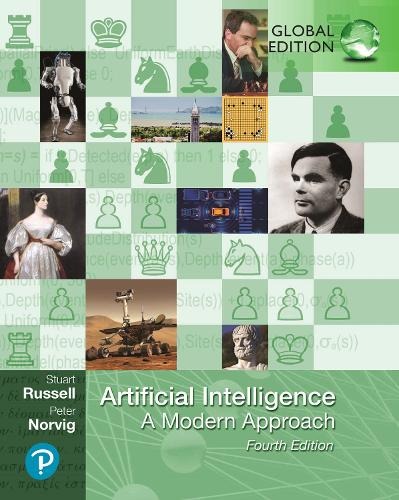
Artificial intelligence : A modern approach ; global ed.
Explores the full breadth and depth of the field of artificial intelligence (AI). The 4th edition brings readers up to date on the latest technologies, presents concepts in a more unified manner, and offers new or expanded coverage of machine learning, deep learning, transfer learning, multi agent systems, robotics, natural language processing, causality, probabilistic programming, privacy, fairness, and safe AI
Artificial economics : Agent-based methods in finance, game theory and their applications
The purpose of this book is to give an up-to date view of the scientific production in the fields of Agent-based Computational Economics (mainly in Market Finance and Game Theory). Based on communications given at AE'2005 (Lille, USTL, France), this book offers a wide panorama of recent advances in ACE (both theoretical and methodological) that will interest academics as well as practitioners.

Artifical intelligence for human computing ; ICMI 2006 and IJCAI 2007 International Workshops, Banff, Canada, November 3, 2006 Hyderabad, India, January 6, 2007 Revised Selceted Papers
This book contains the thoroughly refereed post-proceedings of two events discussing AI for Human Computing.It presented a vision of the future of computing technology in which AI, in particular machine learning and agent technology, plays an essential role.

Aromatase Inhibitors
Many breast tumours are dependent upon oestrogen for their development and continued growth. Over the last 25 years hormone therapy has progressed from the irreversible destruction of endocrine glands to the use of drugs that reversibly suppress oestrogen synthesis or action. The inhibition of oestrogen synthesis is most readily achieved by inhibiting the final step in the pathway of oestrogen biosynthesis, the reaction which transforms androgens into oestrogens by creating an aromatic ring in the steroid molecule (hence the enzyme's trivial name, aromatase). Whereas the first aromatase inhibitors to be used therapeutically could be shown to produce drug-induced inhibition of the enzyme and therapeutic benefits in patients with breast cancer, they were not particularly potent and lacked specificity. However, second-generation drugs were developed and most recently third-generation inhibitors have evolved which possess remarkable specificity and potency. Initial results from clinical trials suggest that these agents will become the cornerstones of future endocrine therapy.
