



Page 220
Page 220

A Guide to Lead-free Solders : Physical Metallurgy and Reliability
While tin/lead solders have dominated the electronics industry for many years, environmental considerations and new legislation are forcing change. Backed by more than ten years of research in Pb-free solders, many electronics manufacturers are poised for conversion. A Guide to Lead-free Solders is intended as a tool to help industry as it moves into a new era in the production and use of solders. An overview of the principles of soldering technology is provided beginning with the theory underlying each concept. Focusing on the most up-to-date methods for testing and characterization, these theories are then reinforced by experimental examples and industrial applications.
A Guide to Graph Algorithms
Offers high-quality content in the research area of graph algorithms and explores the latest developments in graph algorithmics. The reader will gain a comprehensive understanding of how to use algorithms to explore graphs. It is a collection of texts that have proved to be trend setters and good examples of that. The book aims at providing the reader with a deep understanding of the structural properties of graphs that are useful for the design of efficient algorithms. These algorithms have applications in finite state machine modelling, social network theory, biology, and mathematics. The book contains many exercises, some up at present-day research-level. The exercises encourage the reader to discover new techniques by putting things in a clear perspective.

A Guide to Fluid Mechanics
The theory is explained using ordinary and accessible language, where fluid mechanics is presented in analogy to solid mechanics to emphasize that they are all the application of Newtonian mechanics and thermodynamics. All the informative and helpful illustrations are drawn by the author, uniting the science and the art with figures that complement the text and provide clear understanding.

A guide to dental sedation
This concise guide bridges the gap between classroom instruction and the actual application of various methods of sedation. The considerations for each dental specialty are covered, with special focus on pediatric and special needs patients. Chapters summarize the medications used in sedation, including dosages, warnings, and reversal agents, and sections on nitrous oxide discuss how to administer it without harm to the provider.
A Graph-Theoretic Approach to Enterprise Network Dynamics
This monograph treats the application of numerous graph-theoretic algorithms to a comprehensive analysis of dynamic enterprise networks. Network dynamics analysis yields valuable information about network performance, efficiency, fault prediction, cost optimization, indicators and warnings.
A Geometric Approach to Differential Forms
The modern subject of differential forms subsumes classical vector calculus. This text presents differential forms from a geometric perspective accessible at the undergraduate level. The book begins with basic concepts such as partial differentiation and multiple integration and gently develops the entire machinery of differential forms. Each new concept is presented with a natural picture that students can easily grasp. Algebraic properties then follow. This facilitates the development of differential forms without assuming a background in linear algebra. Throughout the text, emphasis is placed on applications in 3 dimensions, but all definitions are given so as to be easily generalized to higher dimensions. A centerpiece of the text is the generalized Stokes' theorem. Although this theorem implies all of the classical integral theorems of vector calculus, it is far easier for students to both comprehend and remember.
A First Course in Modular Forms
This book introduces the theory of modular forms with an eye toward the Modularity Theorem: All rational elliptic curves arise from modular forms. The topics covered include: • elliptic curves as complex tori and as algebraic curves, • modular curves as Riemann surfaces and as algebraic curves, • Hecke operators and Atkin–Lehner theory, • Hecke eigenforms and their arithmetic properties, • the Jacobians of modular curves and the Abelian varieties associated to Hecke eigenforms, • elliptic and modular curves modulo p and the Eichler–Shimura Relation, • the Galois representations associated to elliptic curves and to Hecke eigenforms. As it presents these ideas, the book states the Modularity Theorem in various forms, relating them to each other and touching on their applications to number theory.
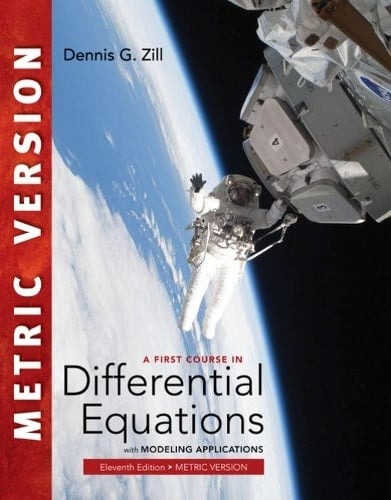
A first course in differential equations with modeling applications
A comprehensive treatment of ordinary differential equations, concisely presenting basic and essential results in a rigorous manner. Including various examples from physics, mechanics, natural sciences, engineering and automatic theory, Differential Equations is a bridge between the abstract theory of differential equations and applied systems theory.
A First Course in Differential Equations
This text is designed for the standard post-calculus course in elementary differential equations. It is a brief, one-semester treatment of the basic ideas, models, and solution methods. The book, which serves as an alternative to existing texts for instructors who want more concise coverage, emphasizes graphical, analytical, and numerical approaches, and is written with clear language in a user-friendly format. It provides students with the tools to continue on to the next level in applying differential equations to problems in engineering, science, and applied mathematics.
A Dictionary of Electronics and Electrical Engineering
This popular dictionary, formerly published as the Penguin Dictionary of Electronics, has been extensively revised and updated, providing clear, concise, and jargon-free A-Z entries on key terms, theories, and practices in the areas of electronics and electrical science. Topics covered include circuits, power, systems, magnetic devices, control theory, communications, signal processing, and telecommunications, together with coverage of applications areas such as image processing, storage, and electronic materials.
A Course in Credibility Theory and its Applications
It covers the subject of Credibility Theory extensively and includes most aspects of this topic from the simplest case to the most general dynamic model. The first four chapters contain plenty of material The book therefore treats explicitly the tasks which the actuary encounters in his daily work such as estimation of loss ratios, claim frequencies and claim sizes. The models are worked out in detail (including the estimation of structural parameters) so that they can immediately be applied in practice. Most exercises are based on real insurance data and real situations from practice and many of them have the characteristics of a case study. The extension to practical problems arising from the general area of finance is often quite straightforward. This book deserves a place on the bookshelf of every actuary and mathematician who works, teaches or does research in the area of insurance and finance.for a first course on Credibility.
A Course in Calculus and Real Analysis
Provides a self-contained and rigorous introduction to calculus of functions of one variable. The presentation and sequencing of topics emphasizes the structural development of calculus. At the same time, due importance is given to computational techniques and applications. The authors have strived to make a distinction between the intrinsic definition of a geometric notion and its analytic characterization. It highlight the fact that calculus provides a firm foundation to several concepts and results that are generally encountered in high school and accepted on faith. For example, one can find here a proof of the classical result that the ratio of the circumference of a circle to its diameter is the same for all circles. Also, this book helps get a clear understanding of the concept of an angle and the definitions of the logarithmic, exponential and trigonometric functions together with a proof of the fact that these are not algebraic functions. A number of topics that may have been inadequately covered in calculus courses and glossed over in real analysis courses are treated here in considerable detail. As such, this book provides a unified exposition of calculus and real analysis.

A concise introduction to traffic engineering : theoretical fundamentals and case studies
Covers a selection of fundamental topics of traffic engineering useful for highways facilities design and control. The treatment is concise but it does not neglect to examine the most recent and crucial theoretical aspects which are at the root of numerous highway engineering applications, like, for instance, the essential aspects of highways traffic stream reliability calculation and automated highway systems control.
A Concise Introduction to Mathematical Logic
This book is unique in that it is more concise than most others; the material is treated in a streamlined fashion. This allows the lecturer to select the material for a one-semester course on a topic more easily. These initial chapters cover just the material for an introductory course on mathematical logic combined with the necessary material from set theory. Chapter 3 is partly of a descriptive nature, providing a view towards decision problems, automated theorem proving, non-standard models and related subjects. The other chapters contain material on logic programming for computer scientists, model theory, recursion theory, Gödel's Incompleteness Theorems, and applications of mathematical logic. Philosophical and foundational problems of mathematics are discussed where appropriate.
A Computational Differential Geometry Approach to Grid Generation
This monograph gives a detailed treatment of applications of geometric methods to advanced grid technology. It focuses on and describes a comprehensive approach based on the numerical solution of inverted Beltramian and diffusion equations with respect to monitor metrics for generating both structured and unstructured grids in domains and on surfaces.

A compendium of principles and practice of laser biophotonics in oral medicine
The application of photonics technologies and principles to medicine and life sciences is known as biophotonics. Laser is one of the most important inventions of the twentieth century in biophotonic technology. This book a concise but comprehensive body of information, written in a simple tone, attempting to cruise the readers' vision through every perspective, to seek objective information on all aspects of the instrument and its uses, fostering a preliminary step towards efficient laser diagnosis and therapy.

A Comparison of the Dynamical Evolution of Planetary Systems ; Proceedings of the Sixth Alexander von Humboldt Colloquium on Celestial Mechanics Bad Hofgastein (Austria), 21-27 March 2004
The papers in this volume cover a wide range of subjects covering the most recent developments in Celestial Mechanics from the theoretical point of nonlinear dynamical systems to the application to real problems. We emphasize the papers on the formation of planetary systems, their stability and also the problem of habitable zones in extrasolar planetary systems. A special topic is the stability of Trojans in our planetary system, where more and more realistic dynamical models are used to explain their complex motions: besides the important contribution from the theoretical point of view, the results of several numerical experiments unraveled the structure of the stable zone around the librations points. This volume will be of interest to astronomers and mathematicians interested in Hamiltonian mechanics and in the dynamics of planetary systems.
A Classical Introduction to Cryptography Exercise Book
A Classical Introduction to Cryptography Exercise Book for A Classical Introduction to Cryptography: Applications for Communications Security covers a majority of the subjects that make up today's cryptology, such as symmetric or public-key cryptography, cryptographic protocols, design, cryptanalysis, and implementation of cryptosystems. Exercises do not require a large background in mathematics, since the most important notions are introduced and discussed in many of the exercises.
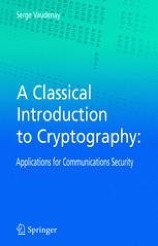
A Classical Introduction to Cryptography : Applications for Communications Security
This advanced-level textbook covers conventional cryptographic primitives and cryptanalysis of these primitives; basic algebra and number theory for cryptologists; public key cryptography and cryptanalysis of these schemes; and other cryptographic protocols, e.g. secret sharing, zero-knowledge proofs and undeniable signature schemes.
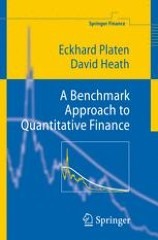
A Benchmark Approach to Quantitative Finance
The general framework is used to provide an understanding of the nature of stochastic volatility. The book is intended for a wide audience that includes quantitative analysts, postgraduate students and practitioners in finance, economics and insurance. It aims to be a self-contained, accessible but mathematically rigorous introduction to quantitative finance for readers that have a reasonable mathematical or quantitative background. Finally, the book should stimulate interest in the benchmark approach by describing some of its power and wide applicability.
