



Page 15
Page 15
Advances in Evolutionary Algorithms : Theory, Design and Practice
The goal of this book is to provide effective optimization algorithms for solving a broad class of problems quickly, accurately, and reliably by employing evolutionary mechanisms. In this regard, five significant issues have been investigated: Bridging the gap between theory and practice of GEAs, thereby providing practical design guidelines. Demonstrating the practical use of the suggested road map. Offering a useful tool to significantly enhance the exploratory power in time-constrained and memory-limited applications. Providing a class of promising procedures that are capable of scalably solving hard problems in the continuous domain. Opening an important track for multiobjective GEA research that relies on decomposition principle.
Advances in Computational Intelligence in Transport, Logistics, and Supply Chain Management
Presents a careful selection of relevant applications of CI methods for transport, logistics, and supply chain management problems. The chapters illustrate the current state-of-the-art in the application of CI methods in these fields and should help and inspire researchers and practitioners to apply and develop efficient methods.
Advances in computation and intelligence ; 3rd International symposium, ISICA 2008 Wuhan, China, December 19-21, 2008 Proceedings
Constitutes the refereed proceedings of the Third International Symposium on Intelligence Computation and Applications, ISICA 2008, held in Wuhan, China, in December 2008.

Advances in computation and intelligence ; 2nd International symposium, ISICA 2007, Wuhan, China, September 21-23, 2007, Proceedings
Constitutes the refereed proceedings of the Second International Symposium on Intelligence Computation and Applications, cover such topics as evolutionary computation, evolutionary learning, neural networks, swarms, pattern recognition, and data mining.
Advances in Artificial Life ; 9th European Conference, ECAL 2007, Lisbon, Portugal, September 10-14, 2007, Proceedings
This book is organized in topical sections on conceptual articles, morphogenesis and development, robotics and autonomous agents, evolutionary computation and theory, cellular automata, models of biological systems and their applications, ant colony and swarm systems, evolution of communication, simulation of social interactions, self-replication, artificial chemistry, and posters.
Advances in artificial life ; 8th European Conference, ECAL 2005 , Canterbury, UK, September 5-9, 2005, Proceedings
The Artificial Life term appeared more than 20 years ago . Since then the area has developed dramatically, many researchersjoining enthusiastically and research groups sprouting everywhere.a conceptual track, where papers were judged on criteria like importance and/or novelty of the concepts proposed rather than the experimental / theoretical results, has been introduced this year. A conference on a theme as broad as Artificial Life is bound to be very di-verse, but a few tendencies emerged. First, fields like ‘Robotics and Autonomous Agents’ or ‘Evolutionary Computation’are still extremely active and keep onbringing a wealth of results to the A-Life community. Even there, however, new tendencies appear, like collective robotics, and more specifically self-assembling robotics, which represent now a large subsection. Second, new areas appear.‘Morphogenesis and Development’ which used to be the subject of only a fewpapers, is now one of the largest subsections, and seems to be on the brinkof becoming a field of its own. Finally, most classical themes of A-Life re-search like ‘Artificial Chemistry’, ‘Ant-Inspired Systems’, ‘Cellular Automata’,‘Self-Replication’, ‘Social Simulations’ or ‘Bio-realist Simulations’ are still goingstrong and are well represented within this volume.

Advances in Artificial Intelligence - IBERAMIA-SBIA 2006 ; 2nd International Joint Conference, 10th Ibero-American Conference on AI, 18th Brazilian AI Symposium, Ribeirao Preto, Brazil, October 23-27, 2006
This decision was a consequence of the successful event organized in 2000, when the First International Joint Conference IBERAMIA/ SBIA 2000 (7th Ibero- American Artifcial Intelligence Conference and 15th Brazilian Artifcial Intel- gence Symposium) occurred in Brazil. Moreover, in 2006 the artifcial intelligence community celebrated the golden anniversary of the 1956 Dartmouth Conference that marked the beginning of artifcial intelligence as a research feld. th SBIA 2006 was the 18 conference of the SBIA conference series, which is the leading Brazilian conference for the presentation of AI research and applications.
Advanced Techniques in Knowledge Discovery and Data Mining
This explosion is a result of the growing use of electronic media. But what is data mining (DM)? A Web search using the Google search engine retrieves many (really many) definitions of data mining. We include here a few interesting ones. One of the simpler definitions is: “As the term suggests, data mining is the analysis of data to establish relationships and identify patterns” [1]. It focuses on identifying relations in data. Our next example is more elaborate: An information extraction activity whose goal is to discover hidden facts contained in databases. Using a combination of machine learning, statistical analysis, modeling techniques and database technology, data mining finds patterns and subtle relationships in data and infers rules that allow the prediction of future results. Typical applications include market segmentation, customer profiling, fraud detection, evaluation of retail promotions, and credit risk analysis .
Advanced robust and nonparametric methods in efficiency analysis : Methodology and applications
This readable book makes available an intuitive yet rigorous presentation of advanced nonparametric and robust methods. This flexible toolbox can be used in theories based on the neoclassical theory of production and its alternatives, including evolutionary theories.
Advanced Intelligent Paradigms in Computer Games
This book presents a sample of the most recent research concerning the application of computational intelligence techniques and internet technology in computer games. The contents include: - COMMONS GAME in intelligent environment - Adaptive generation of dilemma-based interactive narratives - Computational intelligence in racing games - Evolutionary algorithms for board game players with domain knowledge - The ChessBrain project - Electronic market games - EVE’s entropy - Capturing player enjoyment in computer games This book is directed to researchers, practicing engineers/scientists and students.
Advanced Intelligent Computing Theories and Applications. With Aspects of Theoretical and Methodological Issues ; 4th International Conference on Intelligent Computing, ICIC 2008 Shanghai, China, September 15-18, 2008 Proceedings
This book - in conjunction with the two volumes CCIS 0015 and LNAI 5226 - constitutes the refereed proceedings of the 4th International Conference on Intelligent Computing, ICIC 2008, held in Shanghai, China, in September 2008.
Advanced Intelligent Computing Theories and Applications. With Aspects of Contemporary Intelligent Computing Techniques ; 4th International Conference on Intelligent Computing, ICIC 2008 Shanghai, China, September 15-18, 2008 Proceedings
Constitutes the refereed proceedings of the Fourth International Conference on Intelligent Computing, ICIC 2008, held in Shanghai, China in September 2008.
Advanced Intelligent Computing Theories and Applications : With Aspects of Contemporary Intelligent Computing Techniques ; 3rd International Conference on Intelligent Computing, ICIC 2007 Qingdao, China, August 21-24, 2007 Proceedings
The International Conference on Intelligent Computing (ICIC) was formed to provide an annual forum dedicated to the emerging and challenging topics in artificial intelligence, machine learning, bioinformatics, and computational biology, etc. It aims to bring - gether researchers and practitioners from both academia and industry to share ideas, problems and solutions related to the multifaceted aspects of intelligent computing.This year, the conference concentrated mainly on the theories and methodologies as well as the emerging applications of intelligent computing. Its aim was to unify the picture of contemporary intelligent computing techniques as an integral concept that highlights the trends in advanced computational intelligence and bridges theoretical research with applications.
Advanced Intelligent Computing Theories and Applications : With Aspects of Artificial Intelligence ; 3rd International Conference on Intelligent Computing, ICIC 2007, Qingdao, China, August 21-24, 2007, Proceedings
The International Conference on Intelligent Computing (ICIC) was formed to provide an annual forum dedicated to the emerging and challenging topics in artificial intelligence, machine learning, bioinformatics, and computational biology, etc. It aims to bring gether researchers and practitioners from both academia and industry to share ideas, problems and solutions related to the multifaceted aspects of intelligent computing.This year, the conference concentrated mainly on the theories and methodologies as well as the emerging applications of intelligent computing. Its aim was to unify the picture of contemporary intelligent computing techniques as an integral concept that highlights the trends in advanced computational intelligence and bridges theoretical research with applications.
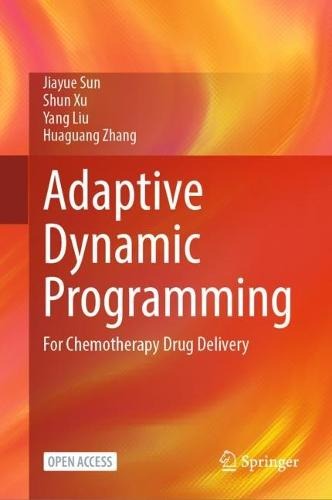
Adaptive dynamic programming for chemotherapy drug delivery
Focuses on the practical application of Adaptive Dynamic Programming (ADP) in chemotherapy drug delivery, taking into account clinical variables and real-time data. ADP's ability to adapt to changing conditions and make optimal decisions in complex and uncertain situations makes it a valuable tool in addressing pressing challenges in healthcare and other fields. As optimization technology evolves, we can expect to see even more sophisticated and powerful solutions emerge.
Adaptive and natural computing algorithms ; Proceedings of the International Conference in Coimbra, Portugal, 2005
The ICANNGA series of Conferences has been organised since 1993 and has a long history of promoting the principles and understanding of computational intelligence paradigms within the scientific community and is a reference for established workers in this area.and this book about Proceedings of the International Conference in Coimbra, Portugal, 2005 including Topics Artificial Intelligence Simulation and Modeling / Mathematics of Computing / Computer Applications

Adaptive and Natural Computing Algorithms ; 8th International Conference, ICANNGA 2007, Warsaw, Poland, April 11-14, 2007, Proceedings, Part II
The ICANNGA series of conferences has been organized since 1993 and has a long history of promoting the principles and understanding of computational intelligence paradigms within the scientifc community. the ICANNGA series has established itself as a reference for scientists and practitioners in this area. The series has also been of value to young researchers wishing both to extend their knowledge and experience and to meet experienced professionals in their ?elds. In a rapidly advancing world, where technology and engineering change d- matically, new challenges in computer science compel us to broaden the c- ference scope in order to take into account new developments.
Adaptive and Natural Computing Algorithms ; 8th International Conference, ICANNGA 2007, Warsaw, Poland, April 11-14, 2007, Proceedings, Part I
Constitutes the refereed proceedings of the 8th International Conference on Adaptive and Natural Computing Algorithms, ICANNGA 2007, held in Warsaw, Poland, in April 2007. The 178 revised full papers presented were carefully reviewed and selected from a total of 474 submissions. The 94 papers of the first volume are organized in topical sections on evolutionary computation, genetic algorithms, particle swarm optimization, learning, optimization and games, fuzzy and rough systems, just as classification and clustering. The second volume contains 84 contributions related to neural networks, support vector machines, biomedical signal and image processing, biometrics, computer vision, as well as to control and robotics.
Adaptive and Multilevel Metaheuristics
Presents recent advances in the area of adaptativeness in metaheuristic optimization, including up-to-date reviews of hyperheuristics and self-adaptation in evolutionary algorithms, as well as cutting edge works on adaptive, self-adaptive and multilevel metaheuristics, with application to both combinatorial and continuous optimization.
A Matrix Algebra Approach to Artificial Intelligence
The book consists of two parts: the first discusses the fundamentals of matrix algebra in detail, while the second focuses on the applications of matrix algebra approaches in AI. Highlighting matrix algebra in graph-based learning and embedding, network embedding, convolutional neural networks and Pareto optimization theory, and discussing recent topics and advances, the book offers a valuable resource for scientists, engineers, and graduate students in various disciplines
