



Page 13
Page 13

Handbook of healthcare in the Arab World
Examines health and medical care in the Arab world from a systems biology approach. It features comprehensive coverage that includes details of key social, environmental, and cultural determinants. In addition, the contributors also investigate the developed infrastructure that manages and delivers health care and medical solutions throughout the region. More than 25 sections consider all aspects of health, from cancer to hormone replacement therapy, from the use of medications to vitamin deficiency in emergency medical care. Chapters highlight essential areas in the wellbeing and care of this population. These topics include women’s health care, displaced and refugee women’s health needs, childhood health, social and environmental causes of disease, health systems and health management, and a wide range of diseases of various body systems. This resource also explores issues related to access and barriers to health delivery throughout the region.

Handbook of Evidence-Based Therapies for Children and Adolescents : Bridging Science and Practice
Growing numbers of young people—some 10% to 20% of school-age populations—have mental health problems requiring intervention, and current policy initiatives identify evidence-based therapies as the most effective and relevant forms of treatment. By reviewing evidence-based treatments (EBTs) across a wide spectrum of conditions, the Handbook of Evidence-Based Therapies for Children and Adolescents: Bridging Science and Practice closes the gaps between children’s needs and services as well as those between research, training, and practice, Several EBT options, both proved and promising, are offered for each covered disorder and are bolstered by case examples, tables, and reference lists. Features include chapters on implementation issues such as diversity, family treatment, assessment strategies, and community settings, and step-by-step guidance for the researcher looking to gather empirical support for therapies.

Handbook of Consultation-Liaison Psychiatry
This book takes a practical biopsychosocial approach to helping readers navigate this complex terrain.Early chapters trace the roots of psychosomatic medicine and consultation-liaison psychiatry, the nature of psychiatric diagnosis, and explain the clinical, educational, administrative, and research functions of CL psychiatry, and walk the reader through the basics of psychiatric consultation. They discuss common reasons for psychiatric consultation and the immediate management of urgent conditions such as agitation and suicidal behavior. From there, chapters feature case vignettes, practice guidelines, and specific information on topics as varied as postpartum depression, withdrawal symptoms, and chronic pain. And in keeping with this real-world orientation, contributors identify cultural issues, analyze ethical concerns, and flag the potential conflicts of interest that practitioners must recognize and prevent for successful practice.

Handbook of clinical techniques in pediatric dentistry
Features updated and expanded information on pediatric clinical dentistry, including eight new chapters written by educators with special interest in each topic. Since publication of the first edition, non-invasive treatment is at the forefront of pediatric dental care, and the new edition reflects this, with multiple options and techniques for non-invasive treatment. The book is filled with photographs for improved understanding and guidance through the procedures described.

Handbook of cardiac anatomy, physiology, and devices
Because of rapid growth in the medical device industry-which today enjoys revenues as large as those of the automobile industry-as well as in our understanding of cardiac disease processes, biomedical engineers must cope with a rising tide of highly complex information. In Handbook of Cardiac Anatomy, Physiology, and Devices, leading experts from the University of Minnesota's renowned Lillehei Heart Institute and scientists from Medtronic, Inc. have compiled a concise-yet detailed and comprehensive-reference source on the anatomic features, underlying physiologic mechanisms, and treatments for diseases of the heart. Here, active bioengineers working on cardiac devices will find the complete critical background they need to understand cardiac pacing, defibrillation, cardiac repair using stem cell therapy, robotics, less invasive cardiac surgery, biventricular pacing, cardiac bioenergetics, and more. Insightful chapters address animal models for cardiac research, cardiac mapping systems, heart valve disease, ventricular assist devices, and genomics-based tools and technology.

Handbook of Bioentrepreneurship
Providing an important and timely overview of research in the field of entrepreneurship in biotechnology, The Handbook of Bioentrepreneurship examines one of the most promising industries of the 21st century. While genetically engineered foods and biopharmaceuticals have made biotechnology part of our everyday lives, launching a bioventure is among the most complex and risky entrepreneurial undertakings, given long development cycles, high levels of technological and market uncertainty, and extraordinary capital requirements. Featuring unparalleled, in-depth analysis from experts around the world, the Handbook sheds light on emerging business models and strategies, geographical and regional networks, cooperation between firms and universities, legal frameworks, and policy issues that influence the context in which biotech ventures are established and the conditions under which they may flourish. biotechnology.

Handbook of Behavioral and Cognitive Therapies with Older Adults
The book enhances the professional’s understanding of the learning and self regulating capacities of older adults. Its consistent and easy-access format features empirical reviews, recommended cognitive and behavioral interventions specific to the problem, instructive case studies, and salient diversity issues. In their choice of topics, the editors have assembled the Handbook to fit the unique challenges of both older individuals and the practitioners working with them.

Hand Bone Age : A Digital Atlas of Skeletal Maturity
For decades, the determination of bone maturity has relied on a visual evaluation of skeletal development in the hand and wrist, most commonly using the Greulich and Pyle atlas. The Gilsanz and Ratib digital atlas takes advantage of the advent of digital imaging and provides a more effective and objective approach to skeletal maturity assessment. This atlas integrates the key morphological features of ossification in the bones of the hand and wrist and provides idealized, sex- and age-specific images of skeletal development. This computer-generated set of images should serve as a reasonable alternative to the reference books currently available.

Hamiltonian Reduction by Stages
In this volume readers will find for the first time a detailed account of the theory of symplectic reduction by stages, along with numerous illustrations of the theory. Special emphasis is given to group extensions, including a detailed discussion of the Euclidean group, the oscillator group, the Bott-Virasoro group and other groups of matrices. Ample background theory on symplectic reduction and cotangent bundle reduction in particular is provided. Novel features of the book are the inclusion of a systematic treatment of the cotangent bundle case, including the identification of cocycles with magnetic terms, as well as the general theory of singular reduction by stages.

Half-metallic Alloys : Fundamentals and Applications
Half-metals are particular ferromagnetic materials which can be considered as hybrids between metals and semiconductors. A particular feature of these materials is that electrons at the Fermi level show complete spin polarization making them prime targets for research into suitable divices for spin electronics. This book is both an introduction and state-of-art survey of the latest advances in the understanding and applications of Heusler alloys and related compounds.

Guyton and Hall textbook of medical physiology
Employs a distinctive format to ensure maximum learning and retention of complex concepts. A larger font size emphasizes core information, while supporting information, including clinical examples, are detailed in smaller font and highlighted in pale blue - making it easy to quickly skim the essential text or pursue more in-depth study. This two-tone approach, along with other outstanding features, makes this bestselling text a favorite of students worldwide. Offers a clinically oriented perspective written with the clinical and preclinical student in mind, bridging basic physiology with pathophysiology. Focuses on core material and how the body maintains homeostasis to remain healthy, emphasizing the important principles that will aid in later clinical decision making. Presents information in short chapters using a concise, readable voice that facilitates learning and retention. Contains more than 1,200 full-color drawings and diagrams - all carefully crafted to make physiology easier to understand. Features expanded clinical coverage including obesity, metabolic and cardiovascular disorders, Alzheimer's disease, and other degenerative diseases.

Green techniques for organic synthesis and medicinal chemistry
Presents comprehensive coverage of green chemistry techniques for organic and medicinal chemistry applications, summarizing the available new technologies, analyzing each technique’s features and green chemistry characteristics, and providing examples to demonstrate applications for green organic synthesis and medicinal chemistry.

Green new deal landscapes : Architectural design
Explores the principles behind the Green New Deal and how they apply to the architectural and landscape professions. Whatever form the Green New Deal will take and is taking, it will be materialised through infrastructure, buildings, landscapes and various other constructed forms. The contributors to this AD examine the theoretical frameworks and design practices within which the protocols of the Green New Deal could be integrated. Initially, such a goal requires a survey of the available design tools and methodologies necessary to achieve a transition to a decarbonised economy in an equitable manner. The articles feature design practices who are transforming their existing modes of operation to work in environments were fossil fuels are kept well below ground, and to explore renewable forms of local, regional and planetary urbanisation.

Graph-theoretic concepts in computer science ; 34th International Workshop, WG 2008, Durham, UK, June 30 – July 2, 2008. Revised Papers
This book constitutes the thoroughly refereed post-conference proceedings of the 34th International Workshop on Graph-Theoretic Concepts in Computer Science, WG 2008, held in Durham, UK, in June/July 2008.The 30 revised full papers presented together with 3 invited paper were carefully reviewed and selected from 76 submissions. The papers feature original results on all aspects of graph-theoretic concepts in Computer Science, e.g. structural graph theory, sequential, parallel, and distributed graph and network algorithms and their complexity, graph grammars and graph rewriting systems.

Graphics Recognition. Recent Advances and New Opportunities ; 7th International Workshop, GREC 2007, Curitiba, Brazil, September 20-21, 2007. Selected Papers
This book constitutes the thoroughly refereed post-proceedings of the 7th International Workshop on Graphics Recognition, GREC 2007, held in Curitiba, Brazil in September 2007.The 30 revised full papers presented together with a panel discussion report were carefully selected and improved during two rounds of reviewing and revision. The papers are organized in topical sections on technical documents, maps and diagrams understanding; symbol and shape description and recognition; information retrieval, indexing and spotting; sketching interfaces and on-line processing; feature and primitive analysis and segmentation; performance evaluation and ground truthing.
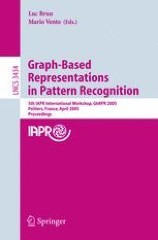
Graph-based representations in pattern recognition ; 5th IAPR International Workshop, GbRPR 2005, Poitiers, France, April 11-13, 2005, Proceedings
Many vision problems have to deal with di?erent entities (regions, lines, line junctions, etc.) and their relationships. These entities together with their re- tionships may be encoded using graphs or hypergraphs. The structural inf- mation encoded by graphs allows computer vision algorithms to address both the features of the di?erent entities and the structural or topological relati- ships between them. Moreover, turning a computer vision problem into a graph problem allows one to access the full arsenal of graph algorithms developed in computer science. The Technical Committee (TC15, http://www.iapr.org/tcs.html) of the IAPR (International Association for Pattern Recognition) has been funded in order to federate and to encourage research work in these ?elds. Among its - tivities, TC15 encourages the organization of special graph sessions at many computer vision conferences and organizes the biennial workshop GbR.

Google Guice : Agile Lightweight Dependency Injection Framework
Guice (pronounced “Juice”) is the Jolt Award-winning, 100% Java icing on the cake of Java dependency injection. Unlike other popular dependency injection frameworks such as Spring, Guice fully embraces modern Java language features and combines simplicity with stunning performance and developer–friendliness. Google Guice: Agile Lightweight Dependency Injection Framework will not only tell you “how,” it will also tell you “why” and “why not,” so that all the knowledge you gain will be as widely applicable as possible. Filled with examples and background information, this book is an invaluable addition to your knowledge of modern agile Java.

Globalization and Sustainable Development : Environmental Agendas
A characteristic of the present global ecological situation is increasing instability or— put another way—a crisis in the civilization system, the global scale of which is expressed through a deterioration of human and animal habitats. The most sub stantial features of global ecodynamics of the late 20th and early 21st centuries include the rapid increase in world population (mainly in developing countries), increase in the size of the urban population (considerable growth in the number of megalopolises), and increase in the scales of such dangerous diseases as HIV/AIDS, hepatitis, tuberculosis, etc.

Globalization and Health : Challenges for health law and bioethics
This timely collection explores ethical and legal dilemmas in healthcare arising from globalization. Conflicts between public interests and individual rights, the challenge of regulating professionals and access to health services, and the effects of a global market all feature prominently in contemporary debates in this area. As a result of globalization, issues in health law and bioethics can no longer be understood solely within political boundaries that define traditional notions of individuals and communities. Rather, solutions for emerging problems require a global conception of rights and obligations, including the re-evaluation of ethical frameworks and legal regimes that currently govern exchanges in healthcare. Leading scholars in bioethics, law, medicine and philosophy from various jurisdictions engage these themes in this volume, and demonstrate the need for transnational solutions in a global age of healthcare.

Global optimization and constraint satisfaction ; 2nd International Workshop, COCOS 2003, Lausanne, Switzerland, Nevember 18-21, 2003, Revised Selected Papers
Theformulationofmanypracticalproblemsnaturallyinvolvesconstraintsonthe variables entering the mathematical model of a real-life situation to be analyzed. It is of great interest to ?nd the possible scenarios satisfying all constraints, and, iftherearemanyofthem,eitherto?ndthebestsolution,ortoobtainacompact, explicit representation of the whole feasible set. The 2nd Workshop on Global Constrained Optimization and Constraint S- isfaction, COCOS 2003, which took place during November 18–21, 2003 in L- sanne, Switzerland, was dedicated to theoretical, algorithmic, and application oriented advances in answering these questions. Here global optimization refers to ?nding the absolutely best feasible point, while constraint satisfaction refers to?ndingallpossiblefeasiblepoints.AsinCOCOS2002,the?rstsuchworkshop (see the proceeedings [1]), the emphasis was on complete solving techniques for problems involving continuous variables that provide all solutions with full rigor, and on applications which, however, were allowed to have relaxed standards of rigor.
