


Refine Results
Sort By
From
To

Communication, awareness and access to information: Given the complexity of the field and the fact that data pertaining to each particular aspects of p53 biology or deregulation are scattered in many different publications, it is extremely difficult to access the full scale of relevant information of any specific p53-related topic. This book may help in this task by putting into perspective both general considerations on the p53 pathway and more specific information on various aspects of p53. In the longer term, however, open access to p53 complexity will require the development of knowledge bases accessible through the web and using simple navigation tools to guide users towards the specific information they need. Several efforts are currently being developed in that direction. They need to be strenghtened and better integrated within the rapidly growing galaxy of web-based information sources on molecular and individual variations in cancer. 2. Reference functional assays and structural analysis: Given the huge diversity of cellular and animal models for wild-type or mutant p53 functions, it will be important to set up standard, universally accepted assays to measure critical p53 protein functions.
Mastering Calculations in Linear and Nonlinear Mechanics is concerned with the management of calculations in linear and nonlinear mechanics. In the last twenty years The accent is on the concept of error in constitutive relation. An important part of this work is also devoted to the utilization of the error estimators involved in a calculation.

Provides a unique approach, combining the fundamentals of concept design and structural analysis of bridges in a single volume. The book provides insights into conceptual design with concrete, steel or composite bridge solutions as alternatives.
Presents an analysis of structures using numerical methods and mathematical modeling. This structural analysis also includes beam, plate, and pipe elements, and examines deflection and frequency or buckling loads. The various engineering theories of beams/plates/shells are comprehensively presented, and the relationships between stress and strain, and the governing equations of the structure are extracted. To solve governing equations with numerical methods, there are two general types, including methods based on derivatives or integrals. Derivative-based methods have the advantage of flexibility in modeling boundary conditions, low analysis time, and a very high degree of accuracy.

Deals with the analysis of engineering structures made of skeletal members and covers the type of structures that are commonly used in practice. It builds up on the subject matter dealing with matrix algebra, analysis of bar elements, special forms of members, stability and vibration of structures, and pin-connected, rigid-plane, and 3D frames. It treats the important step of formulating the overall stiffness matrix of a structure in a systematic and straightforward manner and uses simple mathematical approaches wherever possible.
In recent years an increasing emphasis has been placed on numerically based methods of structural analysis. This has been reflected in the production of structural mechanics texts that are orientated towards particular numerical methodologies, especially the finite element method. Whilst this approach serves the needs of potential research' engineers, a concentration on the numerical analysis aspects of structural mechanics is of less relevance to professional' engineers, who are likely to be concerned with the use and interpretation of numerical analyses, but not in the development of the methodologies.
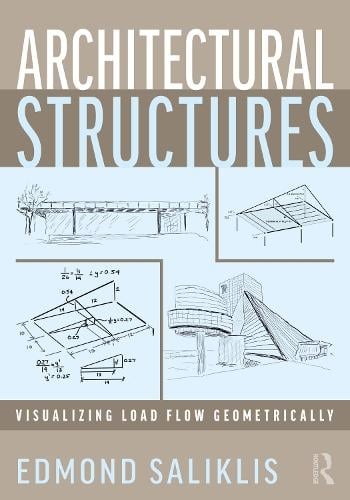
Presents an alternative approach to understanding structural engineering load flow using a visually engaging and three-dimensional format. This book presents a ground-breaking new way of establishing equilibrium in architectural structures using the Modern Müller-Breslau method. Includes approachable coverage of parametric modeling of two-dimensional and three-dimensional structures, as well as more advanced topics such as indeterminate structural analysis and plastic analysis. Hundreds of detailed drawings created by the author are included throughout to aid understanding. Architecture and structural engineering students can employ this novel method by hand sketching, or by programming in parametric design software.
The present monograph deals with new advanced materials, including composites, functionally graded materials, materials for high temperature service, advanced approaches to local and non-local analysis of localized damage, new description of crack deactivation, and many more.

Daraa Highway - Ghabagheb - Syria
+963-15 2050 - 15 860 380 /1/2/3 - 11 662 3900