


Refine Results
Sort By
From
To

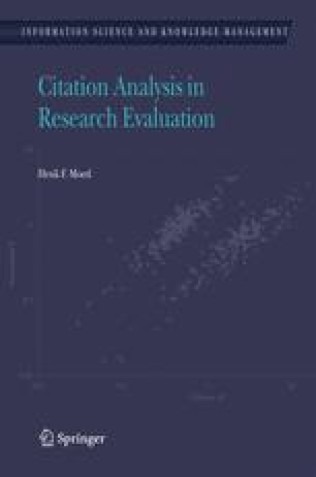
This book is written for members of the scholarly research community, and for persons involved in research evaluation and research policy. More specifically, it is directed towards the following four main groups of readers: – All scientists and scholars who have been or will be subjected to a quantitative assessment of research performance using citation analysis. – Research policy makers and managers who wish to become conversant with the basic features of citation analysis, and about its potentialities and limitations. – Members of peer review committees and other evaluators, who consider the use of citation analysis as a tool in their assessments. – Practitioners and students in the field of quantitative science and technology studies, informetrics, and library and information science. Citation analysis involves the construction and application of a series of indicators of the ‘impact’, ‘influence’ or ‘quality’ of scholarly work, derived from citation data, i.e. data on references cited in footnotes or bibliographies of scholarly research publications. Such indicators are applied both in the study of scholarly communication and in the assessment of research performance. The term ‘scholarly’ comprises all domains of science and scholarship, including not only those fields that are normally denoted as science – the natural and life sciences, mathematical and technical sciences – but also social sciences and humanities.

Manipulating and processing masses of digital data is never a purely technical activity. It requires an interpretative and exploratory outlook - already well known in the social sciences and the humanities - to convey intelligible results from data analysis algorithms and create new knowledge. Big Data is based on an inquiry of several years within Proxem, a software publisher specializing in big data processing. The book examines how data scientists explore, interpret and visualize our digital traces to make sense of them, and to produce new knowledge. Grounded in epistemology and science and technology studies, Big Data offers a reflection on data in general, and on how they help us to better understand reality and decide on our daily actions.
This book provides new thinking on scientific identity formation. It thoroughly interrogates the concepts of community and identity, including both historical and contemporaneous analyses of several scientific fields.
Addresses the engagement between science and society from multiple viewpoints. At a time when trust in experts is being questioned, misinformation is rife and scientific and technological development show growing social impact, the volume examines the challenges in involving the public in scientific debates and decisions. It takes into account societal needs and concerns in research, and analyses the interface between the roles of institutions and individuals. From environmental challenges to science communication, participatory technological design to animal experimentation, and transdisciplinarity to norms and values in science, the volume brings together research on areas in which scientists and citizens interact, across diverse, often understudied, socio-cultural contexts in Europe.

This book explores how young people engage with chemical substances in their everyday lives. It builds upon and supplements a large body of literature on young people’s use of drugs and alcohol to highlight the subjectivities and socialities that chemical use enables across diverse socio-cultural settings, illustrating how young people seek to avoid harm, while harnessing the beneficial effects of chemical use.
This book shines a light on how and why academic work became entwined with air travel, and what can be done to change academia’s flying habit. The starting point of the book is that flying is only one means of scholarly communication among many, and that the state of the planet now obliges us to shift to other means.

Daraa Highway - Ghabagheb - Syria
+963-15 2050 - 15 860 380 /1/2/3 - 11 662 3900