



Page 1
Page 1

National Constitutions in European and Global Governance : Democracy, Rights, the Rule of Law: National Reports
It offers important insights into three areas. First, it explores how constitutions reflect the transfer of powers from domestic to European and global institutions. Secondly, it revisits substantive constitutional values, such as the protection of constitutional rights, the rule of law, democratic participation and constitutional review, along with constitutional court judgments that tackle the protection of these rights and values in the transnational context, e.g. with regard to the Data Retention Directive, the European Arrest Warrant, the ESM Treaty, and EU and IMF austerity measures. The responsiveness of the ECJ regarding the above rights and values, along with the standard of protection, is also assessed. Thirdly, challenges in the context of global governance in relation to judicial review, democratic control and accountability are examined. On a broader level, the contributors were also invited to reflect on what has increasingly been described as the erosion or ‘twilight’ of constitutionalism, or a shift to a thin version of the rule of law, democracy and judicial review in the context of Europeanisation and globalisation processes.

International Actors and the Formation of Laws
This book addresses the discourse that creates, modifies, and reshapes the law, as well as discourse participants. The book focuses on the actors operating in legal regimes and their subtly, bluntly, or even outright aggressive impact on the formation of laws. As the book examines the intersection of domestic, European, international, and even transnational, legal regimes where new law emerges as a product of this discourse, it contributes to the understanding of the mobility of law and contemporary law’s interactive nature. This book provides enlightening examples of diverse legal fields influenced by international, non-domestic actors. It covers a wide range of relevant topics, from financial sanctions to the rights of indigenous peoples, and addresses actors ranging from the European Union and the European Court of Human Rights to disability organizations. By exploring actors, the book stresses their objectives and driving forces behind their efforts to influence law. The book reveals an array of diverging methods used by international actors to influence law. Additionally, the book resonates with Nordic legal tradition and highlights Nordic commitment to rule of law and equality.

Intangible capital and growth : Essays on labor productivity, monetary economics, and political economy ; Vol.1
It is now widely recognized that intangible capital has been a crucial element in the growth performance of these economies and their firms. In the author's view, “intangible capital” serves as the most appropriate umbrella term for capturing several dimensions of capital that are not tangible in nature but are nevertheless fundamentally important for growth. The term encompasses investments in education (human capital) and in informal (social capital) and formal (rule of law) institutions by the public sector and households, as well as investments by businesses aimed at enhancing their knowledge base, such as software, innovative property, and economic competencies.

Institutional Reform for Innovation and Entrepreneurship : An Agenda for Europe
The authors of this book advise the economies of the European Union to become more entrepreneurial in promoting innovation and economic growth. The authors propose a reform strategy with respect to several aspects to achieve this goal. Starting with the rule of law and the protection of property rights; the tax system; the authors deal with regulations governing savings, capital and finance, and the organization of labor markets and social insurance systems. Framework strategies related to the regulations governing goods and service markets, bankruptcy and insolvency are also put forward. A core understanding and future path is also provided towards R&D, commercialization and knowledge spillovers; human capital investments; and informal institutions.

Illiberal Trends and Anti-EU Politics in East Central Europe
This book provides an in-depth look into the background of rule of law problems and the open defiance of EU law in East Central European countries. Current illiberal trends and anti-EU politics have the potential to undermine mutual trust between member states and fundamentally change the EU. It is therefore crucial to understand their domestic causes, context conditions, specific processes and consequences.

Governance of automated decision-making and EU law
Presents a multifaceted exploration of the intersection between technological innovation and democratic governance in Europe. It rigorously examines the profound impact of information technologies on rule-making and decision-making processes, emphasizing the preservation of constitutional values within the European Union (EU). Simultaneously, the book seeks to devise future-proof regulatory strategies to navigate the challenges of rapid technological advancements.

Defending Checks and Balances in EU Member States : Taking Stock of Europe’s Actions
This book deals with Article 7 TEU measures, court proceedings, financial sanctions and the EU Rule of Law Framework to protect EU values with a particular focus on checks and balances in EU Member States.

Courts, politics and constitutional law : judicialization of politics and politicization of the judiciary
Examines how the judicialization of politics, and the politicization of courts, affect representative democracy, rule of law and separation of powers. This volume critically assesses the phenomena of judicialization of politics and politicization of the judiciary. It explores the rising impact of courts on key constitutional principles, such as democracy and separation of powers, which is paralleled by increasing criticism of this influence from both liberal and illiberal perspectives. The book also addresses the challenges to rule of law as a principle, preconditioned on independent and powerful courts, which are triggered by both democratic backsliding and the mushrooming of populist constitutionalism and illiberal constitutional regimes.

Law as Symbolic Form : Ernst Cassirer and the Anthropocentric View of Law
In this book we describe the rule of law as the reign of persuasion rather than the reign of force, and democracy as the reign by persuasion rather than the reign by force.
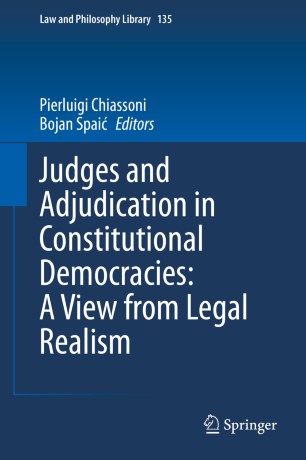
Judges and Adjudication in Constitutional Democracies : A View from Legal Realism
Offers contributions to a philosophical and realistic approach to the place of adjudication in contemporary constitutional democracies. Bringing together scholars from different legal and philosophical backgrounds, purports to cast light on the role(s) of judges and the function of judicial interpretation inside of constitutional states, from the standpoint of legal realism as a revisited and sophisticated jurisprudential outlook. In so doing, also copes with a few major jurisprudential issues, like, e.g., determining the ideas that make up the core of legal realism, exploring the relation between legal realism and legal positivism, identifying the boundaries of judicial interpretation as they appear from a realist standpoint, as well as considering some skeptical outlooks on the very claims of contemporary legal realism.

Buddhism and comparative constitutional law
The first comprehensive account of the entanglements of Buddhism and constitutional law,The authors also highlight the important ways in which Buddhist actors have (re)conceived Western liberal ideals such as constitutionalism, rule of law, and secularism.
Autonomy : In the Law
Autonomy in the Law considers one of the most important benefits of the rule of law. Juxtaposing European and American conceptions of autonomy in the law of families, capital punishment and, criminal trials reveals the common values that justify all legal systems. Law protects the autonomy of individuals and associations by defending the boundaries of their own self-rule. This book illuminates the fundamental purpose of law by examining how European and American lawyers, judges and citizens do and should apply legal autonomy to the practical circumstances of litigation, legislation and the law.

At the crossroads : The world trading system and the Doha Round
Since its foundation in 1995 the legitimacy of the WTO – and herewith the notion of organising global trade on the basis of herewith the notion of organising global trade on the basis of concepts like trade-liberalisation, treaty-based rule of law and concepts like trade-liberalisation, treaty-based rule of law and enforceability – is challenged for very different reasons this volume not only documents the proceedings of this conference but, against the backdrop of the ongoing efforts to revive the Doha Round wants to be understood as some sort of stocktaking: What did really go wrong in Cancún? Where does the WTO stand today? Has there been any progress made since? And, finally: Is there any chance left to reach the ambitions goals postulated by the Doha Development Agenda? These and other, related questions are being discussed in the volume at hand.
