



Page 1
Page 1

Multicriteria Optimization
Decision makers in many areas, from industry to engineering and the social sector, face an increasing need to consider multiple, conflicting objectives in their decision processes. In many cases these real world decision problems can be formulated as multicriteria mathematical optimization models. The solution of such models requires appropriate techniques to compute so called efficient, or Pareto optimal, or compromise solutions that - unlike traditional mathematical programming methods - take the contradictory nature of the criteria into account. This book provides the necessary mathematical foundation of multicriteria optimization to solve nonlinear, linear and combinatorial problems with multiple criteria. Motivational examples illustrate the use of multicriteria optimization in practice. Numerous illustrations and exercises as well as an extensive bibliography are provided.

Motivational profiles in TIMSS mathematics : Exploring student clusters across aountries and time
This open access book presents a person-centered exploration of student profiles, using variables related to motivation to do school mathematics derived from the IEA’s Trends in International Mathematics and Science Study (TIMSS) data. Statistical cluster analysis is used to identify groups of students with similar motivational profiles, across grades and over time, for multiple participating countries. In this book, a person-centered analysis of distinct and meaningful motivational profiles and their differences on sociodemographic variables and mathematics performance broadens understanding about the role that motivation characteristics play in learning and achievement in mathematics.

Motivational Aspects of Prejudice and Racism
Motivational Aspects of Prejudice and Racism examines the cognitive processes as well as the motivational forces that create and sustain social hierarchies based on racial categories. A panel of top scholars analyzes the subtle and explicit manifestations of bias within and across racial groups, while refuting the idea that race has lost its power as a social concept. Chapter authors review the evolution of the psychological understanding of racism and its effects, pinpoint emerging trends in racism research, and illuminate the experience of prejudice from minority group members’ perspectives. Well-known psychosocial phenomena as the cross-race identification effect, social identity, and majority culture members' conflicting attitudes regarding race, are explored, with the underlying ideologies that nurture them. The volume concludes with a realistic assessment of the future, and possible elimination, of racism. Readers are challenged to re-think self and social identities and self-concepts—particularly relevant ideas as America grows more diverse, and potentially more divided.

Motivation and career satisfaction at higher education in Syria: A sample from private university
This research paper examines the effect of motivational factors , extrinsic and intrinsic factors which effect on staff satisfaction at work at universities in Syria. The research methodology employs a quantitative design of questionnaire instrument. The model predicts that if employees develop high levels of motivation in their work and organizations, this will stimulate a good quality in their productivity and develop satisfaction at work. Motivation in general , extrinsic factors, intrinsic factors and job satisfaction are based on prior research measures. Sampling strategy employed non-probability sampling. The size of the sample is 35. The results of the research designate that intrinsic and extrinsic motivation factors are positively associated with employee job satisfaction

Interdisciplinary mathematics education : A state of the art
This book provides an essential introduction to the state-of the-art in interdisciplinary Mathematics Education. First, it begins with an outline of the field’s relevant historical, conceptual and theoretical backgrounds, what “discipline” means and how inter-, trans-, and meta-disciplinary activities can be understood. Relevant theoretical perspectives from Marx, Foucault and Vygotsky are explained, along with key ideas in theory, e.g. boundaries, discourses, identity, and the division of labour in practice. Second, the book reviews research findings of mainly empirical studies on interdisciplinary work involving mathematics in education, in all stages of education that have become disciplined. For example, it reports that a common theme in studies in middle and high schools is assessing the motivational benefits for the learner of subsuming disciplinary motives and even practices to extra-academic problem-solving activities; this is counter-balanced by the effort needed to overcome the disciplinary boundaries in academic institutions, and in professional identities. These disciplinary boundaries are less obviously limitations in middle and primary schools, and in some vocational courses. Third and finally, it explores selected case studies that illustrate these concepts and findings, both in terms of the motivational benefits for learners and the institutional and other boundaries involved.

Group interventions in schools : Promoting mental health for at-risk children and youth
Children who are labeled at-risk often suffer from severe deficiencies in cognitive, affective, and behavioral skills that, if unaddressed, may lead to limited prospects for future success and well-being. Tapping into the therapeutic potential of groups, this volume presents the theory and practice of cognitive-oriented group-centered counseling – combining intrinsic motivation, efficacy retraining, and targeted play therapy and social role-playing – that can be implemented to help children build core social skills and emotional regulation to complement their classroom instruction.

Country-Compatible Incentive Design : A Comparision of Employees' Performance Reward Preferences in Germany and the USA
Based on an empirical study among employees of a multinational corporation (MNC) in Germany and the USA, Marjaana Gunkel shows that the employees in these countries have different preferences regarding incentives and that incentive plans designed for one country are not always effective in others. Money is an important motivator in both countries, but the motivational effects of non-monetary rewards differ greatly. In addition, the author presents an explorative study of employee groups in China and Japan and gives advice for designing appropriate compensation schemes for employees of MNC in different countries.

Corporate Entrepreneurship and Venturing
The common theme in Corporate Entrepreneurship and Venturing is how and why corporate entrepreneurship and corporate venturing can contribute to innovation and strategic renewal in large established companies. In particular it explores ways to balance exploitation and exploration in established companies. The issue is how the locus of entrepreneurship affects the way corporate entrepreneurship addresses the exploitation/exploration challenge. One stream of research focuses on the entrepreneurial culture in large companies and how they can create an environment in which intrapreneurs (entrepreneurs within large companies) can blossom. In this view entrepreneurial initiatives can emerge throughout the organization and this type of entrepreneurship has been labelled as ‘dispersed corporate entrepreneurship’. Two related chapters fit into that stream of research. The other three chapters address the challenge of corporate venture capital programs. These programs have funds to invest in start-ups (external ventures) and the corporate parent want to benefit from the technology, new products or new competences developed in these start-ups. In this case they have separated the locus of entrepreneurship from the main line of business operations, which has been labelled ‘focused corporate entrepreneurship’. In this ‘focused corporate entrepreneurship’ stream the issue is not so much the motivational factors and supportive culture to entrepreneurial initiatives, but the creation and development of linkage mechanisms between the start-ups and the parent company in order to create new combinations based on competences from both the start-up and the parent company. Although the challenges in these two streams of literature are different, they both address the strategic issue of balancing exploitation and exploration.

Management of the Addicted Patient in Primary Care
لThe text is logically organized and key information is easily accessible. The introductory section offers the reader important background and rationale for evaluating and treating addiction in primary care. Following a useful presentation of addiction "basics" (i.e., definitions, neurobiology, genetics, and the disease model), the majority of the book focuses on helping the physician gain insight and develop practical skills that can be readily implemented. A wealth of clinical assessment tools is provided, and the underlying psychosocial processes common to all forms of addiction are discussed. Both pharmacologic interventions and nonpharmalogic modalities are clearly outlined. Of particular note are specific cognitive-behavioral and motivational strategies that can be administered in an office-based setting. The role of community-based recovery support systems is considered as well. Since a complete understanding of why and when to refer is critical to the management of this often life-threatening condition, criteria for referral are detailed. Bulleted clinical "pearls" further aid the reader in gaining insight into treating this difficult patient population.
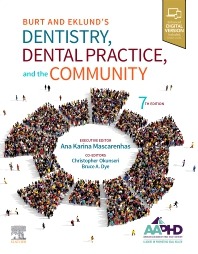
Burt and Eklund’s dentistry, dental practice, and the community
Presents dentistry and dental practice against the ever-changing backdrop of economic, technological, and demographic trends, as well as the distribution of the oral diseases that dental professionals treat and prevent. Readers will learn the latest techniques of research and measurement, and how oral disease may be limited through control and prevention. This updated text also addresses the new educational competencies for predoctoral/ post-doctoral dental students and dental hygiene students with updated and new content on cultural competency, oral health literacy, social responsibility, motivational interviewing, and oral systemic associations.
