


Refine Results
Sort By
From
To

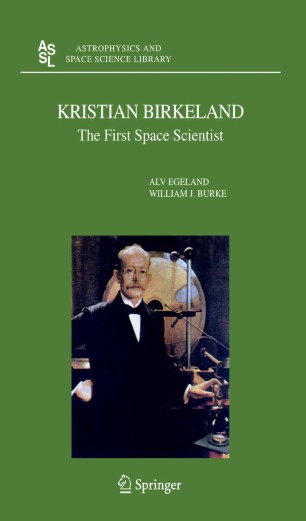
PREFACEThisscientific biography of Kristian Birkeland (1867–1917) was written to bring the story ofa Norwegian national hero to the attention ofthe English-speaking world. Birkeland’sheroic stature was established not on a field of military battle,but in the bitter cold of the Artic wilderness ashe sought to answer basic questions abouthow the Sun controlled northern lights andmag-netic storms. He was also afather of Norsk Hydro one ofNorway’s largest industries. Birkel and died before reaching the age of 50.Because Birkel and never kept adiary, documented information about his family and private life is sparse. Before he died, Olaf Devik, the last of Birke-ffland’s close friends, gave along interview and graciously transferred his personal archive to A.E. Birkeland’s 82 scientific papers and three book-length publications map the progress of his investigations. addressed this book questions that had vexed European scientists for centuries. Why do the northern lights appear overhead when the Earth’s magnetic field is disturbed? How are magnetic storms connected to disturbances on the Sun? To answer these questions Birkeland interpreted his advance laboratory simulations and daring campaigns in the Arctic wilderness in the light of Maxwell’s newly discovered laws of electricity and magnetism. Birkeland’s ideas were dismissed for decades, only to be vindicated when satellites could fly above the Earth’s atmosphere.
Compatible spatial discretizations are those that inherit or mimic fundamental properties of the PDE such as topology, conservation, symmetries, and positivity structures and maximum principles. It offer a snapshot of the current trends and developments in compatible spatial discretizations. The reader will find valuable insights on spatial compatibility from several different perspectives and important examples of applications compatible discretizations in computational electromagnetics, geosciences, linear elasticity, eigenvalue approximations and MHD. The contributions collected in this volume will help to elucidate relations between different methods and concepts and to generally advance our understanding of compatible spatial discretizations for PDEs.
This textbook can be used to teach electromagnetism to a wide range of undergraduate science majors in physics, electrical engineering or materials science. However, by making lesser demands on mathematical knowledge than competing texts, and by emphasizing electromagnetic properties of materials and their applications, this textbook is uniquely suited to students of materials science. Many competing texts focus on the study of propagation waves either in the microwave or optical domain, whereas Basic Electromagnetism and Materials covers the entire electromagnetic domain and the physical response of materials to these waves.

Daraa Highway - Ghabagheb - Syria
+963-15 2050 - 15 860 380 /1/2/3 - 11 662 3900