



Page 1
Page 1

On the path to AI : Law’s prophecies and the conceptual foundations of the machine learning age
This book explores machine learning and its impact on how we make sense of the world. It does so by bringing together two ‘revolutions’ in a surprising analogy: the revolution of machine learning, which has placed computing on the path to artificial intelligence, and the revolution in thinking about the law that was spurred by Oliver Wendell Holmes Jr in the last two decades of the 19th century.

Interpretation, Law and the Construction of Meaning : Collected Papers on Legal Interpretation in Theory, Adjudication and Political Practice
Given the relative indeterminacy of law, it is no surprise that the problem of interpretation has always been one of the focal points of attention for legal semiotics. Who has the power to define words and concepts? Who can successfully assume the power to speak on behalf of the legal community? Which methods are used to justify the power to define? This book discusses the questions mentioned above.

International aviation law for aerodrome planning
The objective of to provide ICAO, States, competent authorities and aerodrome operators with a comprehensive overview of legal challenges related to international aerodrome planning. Answers to derived legal questions as well as recommendations thereafter shall help to enhance regulatory systems and to establish a safer aerodrome environment worldwide. Compliant aerodrome planning has an immense impact on the safety of passengers, personnel, aircraft – and of course the airport.

Constitutional law : Model problems and outstanding answers
Constitutional law is one of the most engaging and yet challenging first year law classes. At the confluence of history, politics, legal theory, and judicial review, it requires students to learn a new framework for legal interpretation and thought unique from other areas of law. For the first time, Oxford University Press equips students with an accessible guide to acing these challenging constitutional law exams.
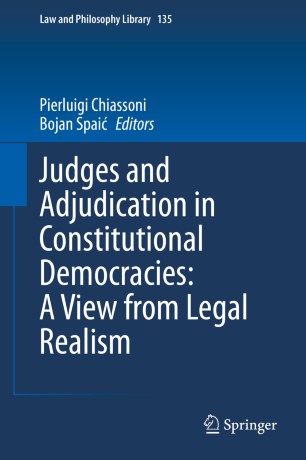
Judges and Adjudication in Constitutional Democracies : A View from Legal Realism
Offers contributions to a philosophical and realistic approach to the place of adjudication in contemporary constitutional democracies. Bringing together scholars from different legal and philosophical backgrounds, purports to cast light on the role(s) of judges and the function of judicial interpretation inside of constitutional states, from the standpoint of legal realism as a revisited and sophisticated jurisprudential outlook. In so doing, also copes with a few major jurisprudential issues, like, e.g., determining the ideas that make up the core of legal realism, exploring the relation between legal realism and legal positivism, identifying the boundaries of judicial interpretation as they appear from a realist standpoint, as well as considering some skeptical outlooks on the very claims of contemporary legal realism.
