



Page 1
Page 1

Understanding Cities : Method in Urban Design
Creates the vital link between urban design theory and praxis and opens the required methodological gateway to a new and unified field of urban design. Using spatial political economy as his most important reference point, Alexander Cuthbert both interrogates and challenges mainstream urban design and provides an alternative and viable comprehensive framework for a new synthesis. He rejects the idea of yet another theory in urban design, and chooses instead to construct the necessary intellectual and conceptual scaffolding for what he terms 'The New Urban Design'. Building both on Michel de Certeau's concept of heterology – 'thinking about thinking' – and on the framework of his previous books Designing Cities and The Form of Cities, Cuthbert uses his prior adopted framework – history, philosophy, politics, culture, gender, environment, aesthetics, typologies and pragmatics – to create three integrated texts.

The Urban Sketching Handbook Techniques for Beginners : How to Build a Practice for Sketching on Location
Learn the basics of value, color mixing, and perspective through helpful studies and exercises, whether at home, in studio, and on location. The Urban Sketching Handbook: Techniques for Beginners is perfect for anyone who's just getting started in this fascinating art form, or who wants to develop their observational and drawing aptitude by reinforcing basic concepts. Offers location artists expert instruction on creative techniques, on-location tips and advice, and an abundance of visual inspiration. These handy references come in a compact, easy-to-carry format-perfect to toss in your backpack or artist's tote.

The urban sketching handbook color first, ink later : A dynamic approach to drawing and painting on Location ; Vol.15
A guide to this exciting method in The Urban Sketching Handbook: Color First, Ink Later. Start with a detailed overview of the process, from optional light pencil sketch to finishing touches. Follow along several step-by-step demonstrations that apply the approach to a range of subjects, from still life to figures to architecture. Get inspired by an extensive gallery of on-location sketches. You'll learn how to let watercolor do the hard work of urban sketching and enjoy the spontaneous effects and delightful surprises you'll see in your artwork.

The Poetics of Arabian Suqs : A Hermeneutic Reading of the Development of Arabian Sūqs from the Pre-Islamic Era to Present
Investigates the history of Arabian sūqs from their pre-Islamic beginnings to the present. Collecting evidence from archaeological ruins, Islamic towns, modern cities, Arabic poetry, philosophical debates, political conflicts, puppet shows and the insights of modern-day market-goers, the book presents new and unforeseen interpretations of the Arabian sūq’s meaning and its transformation through time and place. The finding that such meaning is tied to ancient trade rituals, where temple and market presented a holistic socio-urban unit, re-questions some instrumental assumptions regarding the value of sūq-ness in Arabia’s everyday practices. Such a finding, which locates the fadaā/tareeq duality as a central theme in Arabia’s socio-urban discourse, emphasizes the importance of lived experiences and poetics as key sources for understanding socio-urban phenomena.
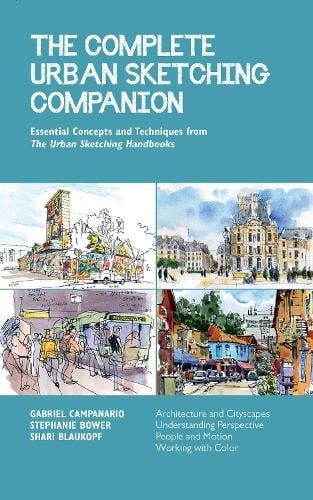
The complete urban sketching companion : essential concepts and techniques from the urban sketching handbooks
Provides instruction and inspiration for sketching architecture, cityscapes, people, and motion, plus lessons on perspective and adding color. This book includes key drawing techniques and strategies from four books in the Urban Sketching Handbook series: Understanding Perspective, Working with Color, Architecture and Cityscapes, and People and Motion. Learn how to draw unique buildings, urban landscapes, and lively street scenes, incorporating interesting elements and striking color and lighting. Get tips on sketching with accurate perspective with easy methods and great examples to guide you along. Discover ways to capture motion, whether it’s a group of dancers or commuters on the move.

Sustainable Urban Planning : Vibrant Neighbourhoods - Smart Cities - Resilience
It addresses the fundamental challenges of urban planning today and offers planners essential knowledge, implementation strategies and ways toward holistic concept development. Examples of international neighbourhood developments clearly show how aspects of sustainable urban planning can be implemented in practice.

Routledge Handbook of Urban Landscape Research
Presents current writing about the pivotal roles that landscape architects play in addressing some of the most pressing problems facing the planet, its environments and its populations through their research, analysis and speculative practice. The book has assembled current writings on recent research structured around five major themes: governance, power and partnership; infrastructure, systems and performance; environment, resilience and climate change; people, place and design; and culture, heritage and identity. As a collection, the chapters demonstrate the diversity of themes and topics that are expanding the scholarly body of knowledge for the discipline and its relevance to the practice of landscape architecture.

Retrofitting Cities for Tomorrow's World
A groundbreaking exploration of the most promising new ideas for creating the sustainable cities of tomorrow. / Reviews the most promising ideas for how to approach planning and coordinating a more sustainable urban future by 2050 through retrofitting existing structures / Explores how cities need to govern for urban retrofit and how future urban transitions and pathways can be managed, modeled and navigated / Offers inter-disciplinary insights from international contributors from both the academic and professional spheres / Develops a rigorous conceptual framework for analyzing existing challenges and fostering innovative ways of addressing those challenges

Drawing Architecture : The beginner's guide to drawing and painting buildings
A comprehensive and practical guide full of advice and inspiration for anyone wishing to capture the beauty of the urban landscape. The wonderful thing about drawing buildings is that, wherever you travel around the globe, you will never be short of subjects to inspire you. From the most elaborate of Renaissance cathedrals, through to the humble garden shed, you will always be able to practise your skills and learn a few techniques in the process. This hands-on and inspirational book will encourage you to meet the exciting challenges of drawing and painting buildings using a variety of media and a wide range of techniques, including pencil, pen, graphite powder, watercolour, water-soluble pencils and Indian ink. As you work through this book, you will look at materials and their qualities then move on to explore how to put these materials to best use when drawing specific types of building. You will be led gently through levels of learning, with easy and more challenging exercises progressing your knowledge and developing your skills. As the book is divided into discrete sections, you can dip in to a particular type of building that you wish to draw, and use the information and illustration provided, while extended teaching exercises take you through the way the author approaches composing and completing a drawing.
Cities for people
Presents latest work creating (or recreating) cityscapes on a human scale. He clearly explains the methods and tools he uses to reconfigure unworkable cityscapes into the landscapes he believes they should be: cities for people. Taking into account changing demographics and changing lifestyles, Gehl emphasizes four human issues that he sees as essential to successful city planning. He explains how to develop cities that are lively, safe, sustainable, and healthy. Focusing on these issues leads Gehl to think of even the largest city on a very small scale. For Gehl, the urban landscape must be considered through the five human senses and experienced at the speed of walking rather than at the speed of riding in a car or bus or train. This small-scale view, he argues, is too frequently neglected in contemporary projects. In a final chapter, Gehl makes a plea for city planning on a human scale in the fast-growing cities of developing countries.
An Ottoman Era Town in the Balkans : The Case Study of Kavala
Presents the town of Kavala in Northern Greece as an example of Ottoman urban and residential development, covering the long period of Kavala’s expansion over five centuries under Ottoman rule. Kavala was part of the Ottoman Empire from 1387 to 1912. In the middle of the sixteenth century, Ibrahim Pasha, grand vizier of Suleiman the Magnificent, contributed to the town's prosperity and growth by the construction of an aqueduct. The Ottomans also rebuilt and extended the existing Byzantine fortress.
