



Page 1
Page 1

Fasting and Immunity
Ramadan is the ninth month of the Islamic lunar calendar and is observed by Muslims as a month of fasting. All Muslim adults are expected to fast; nevertheless, certain subgroups, including sick, frail subjects, and pregnant women, among others, are exempted. Ramadan fasting has been shown to impact on body systems in different manners. The influence of Ramadan fasting on immune system regulation remains elusive; however, immune system changes, such as the modulation of body response to various infectious, stressful, and other harmful events, are of great interest during fasting.

Exploring Ancient Skies : An Encyclopedic Survey of Archaeoastronomy
Exploring Ancient Skies brings together the methods of archaeology and the insights of modern astronomy to explore the science of astronomy as it was practiced in various cultures prior to the invention of the telescope. The book reviews an enormous and growing body of literature on the cultures of the ancient Mediterranean, the Far East, and the New World (particularly Mesoamerica), putting the ancient astronomical materials into their archaeological and cultural contexts. The authors begin with an overview of the field and proceed to essential aspects of naked-eye astronomy, followed by an examination of specific cultures. The book concludes by taking into account the purposes of ancient astronomy: astrology, navigation, calendar regulation, and (not least) the understanding of our place and role in the universe. Skies are recreated to display critical events as they would have appeared to ancient observers - events such as the supernova of 1054, the 'lion horoscope' or the 'Star of Bethlehem.'

Encyclopaedia of the History of Science, Technology, and Medicine in Non-Western Cultures
The second edition of this landmark encyclopaedia will contain approximately 1000 entries dealing in depth with the history of the scientific, technological and medical accomplishments of cultures outside of the United States and Europe. The entries consist of fully updated articles together with hundreds of entirely new topics.This unique reference work includes: Intercultural articles on broad topics such as Mathematics and Astronomy Philosophical articles on concepts and ideas related to the study of non-Western Science, such as Rationality, Objectivity, and Method, Religion and Science, East and West, and Magic and Science Articles on topics such as Native American Mathematics, Polynesian Navigation, Korean Maps, and African Metallurgy Biographical articles for those cultures where individual scientists are known to us, such as China and the Islamic world.

Consumer driven electronic transformation : Applying new technologies to enthuse consumers and transform the supply chain
The Symposia have become important, unique - casions in the international calendar of business research. The papers c- lected here, first presented in Athens, represent an important contribution to the research literature of modern business. The wide-scale institutional development of collaborative practices in the European consumer goods business began in 1994 with the creation of ECR (“Efficient Consumer Response”) Europe, a joint initiative of ma- facturers and retailers working together to improve the quality and p- formance of the value chain. At the heart of ECR was a business envir- ment characterised by dramatic advances in information technology, shifts in consumer demand, and the increasing movements of goods across int- national borders. This new reality required a fundamental reconsideration of the most effective way of delivering the right products to consumers at the right price.

Case studies in biocultural diversity from Southeast Asia : Traditional ecological calendars, Folk medicine and Folk names
This book demonstrates the linkages between local languages, traditional knowledge, and biodiversity at the landscape level in Asia, providing a fresh approach to discussions on Asia’s biocultural diversity. The book carries forward earlier analyses but importantly focuses on ‘traditional ecological calendars,’ ‘folk medicine,’ and ‘folk names’ in the context of the vital importance of maintaining biological, cultural, and linguistic diversity. It does this by addressing a range of cases and issues in relation to Southeast Asia: Brunei Darussalam, Indonesia, Malaysia, the Philippines, and North-East India. The several chapters demonstrate the ways in which the various forms of knowledge of the environment and its categorizations are important in areas such as landscape and resource management and conservation. They also demonstrate that environmental knowledge and the practical skills which accompany it are not necessarily widely shared. This book sends important messages to those who care about the sustainability of our environment, the maintenance of its biocultural diversity, or at least the maintenance of what remains of it because much has changed.
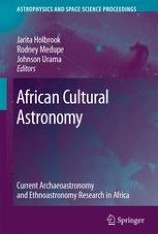
African Cultural Astronomy : Current Archaeoastronomy and Ethnoastronomy research in Africa
Astronomy is the science of studying the sky using telescopes and light collectors such as photographic plates or CCD detectors. However, people have always studied the sky and continue to study the sky without the aid of instruments this is the realm of cultural astronomy. This is the first scholarly collection of articles focused on the cultural astronomy of Africans. It weaves together astronomy, anthropology, and Africa. The volume includes African myths and legends about the sky, alignments to celestial bodies found at archaeological sites and at places of worship, rock art with celestial imagery, and scientific thinking revealed in local astronomy traditions including ethnomathematics and the creation of calendars. Authors include astronomers Kim Malville, Johnson Urama, and Thebe Medupe; archaeologist Felix Chami, and geographer Michael Bonine, and many new authors.
