



Page 1
Page 1

New Perspectives in the Study of Mesoamerican Primates : Distribution, Ecology, Behavior, and Conservation
The purpose of this volume is to present a comprehensive overview of recent advances in primate field research, ecology, and conservation biology in Mesoamerica. The overall goal of each contribution is to integrate newly collected field data with theoretical perspectives drawn from evolutionary biology, socioecology, biological anthropology, and conservation to identify how our current knowledge of primate behavior and ecology has moved beyond more traditional approaches. A corollary to this, and an important goal of the volume is to identify geographical regions and species for which we continue to lack sufficient information, to develop action plans for future research, and to identify areas for immediate conservation action. Despite many decades of primate research in Mesoamerica, much is still unknown concerning the basic ecology and behavior of these species, demography, current distribution, and conservation status of local populations, and the effectiveness of conservation policies on primate survivorship. Four major areas of research are the focus of the volume: Evolutionary Biology and Biogeography; Population Demography and Ecology; Behavior; and Conservation and Management Policies.

Migration of organisms : Climate. geography. ecology
The editor presents a suitable collection of topics, to achieve the goal of this book, which is explaining the migration of organisms through many examples of different groups of marine and non-marine organisms, ranging from micro-invertebrates to large vertebrates (mammals), and focusing on several aspects that are not collected together.

Insect Conservation and Islands
A series of original papers and reviews dealing with the peculiarities of island insects and their conservation in many parts of the world. Contributions to this special issue of Journal of Insect Conservation range from biogeographical analyses andecological features of island insects and their evolution to the variety of concerns for their wellbeing, and practical conservation through a variety of, sometimes novel, approaches. They provide a valuable and up-to-date resource for entomologists and conservation practitioners.

High mountain conservation in a changing world
This book aims to provide case studies and a general view of the main processes involved in the ecosystem shifts occurring in the high mountains, and to analyse the implications for nature conservation. Although case studies from the Pyrenees are preponderant, conclusions are aimed at any mountain range surrounded by highly populated lowland areas. The chapters give emphasis to approaches from environmental geography, functional ecology, biogeography, and paleoenvironmental reconstructions. The introductory and closing chapters summarize the main challenges that nature conservation may face in mountain areas under the environmental shifting conditions.

Foundations of Systematics and Biogeography
the book highlights three principal messages: biological classifications and their explanatory mechanisms are separate notions; most, if not all, homology concepts pre-date the works of Darwin; and that the foundation of all comparative biology is the concept of relationship - neither 'similarity' nor 'genealogical hypotheses of descent' are sufficient. Foundations of Systematics and Biogeography is an ideal volume for students, academics, researchers and professionals in the fields of systematics, biogeography, evolutionary biology and palaeontology.

Etymological Dictionary of Grasses
The dictionary provides explanations of the meaning and origins of generic and specific names of grasses, one of the largest and economically most important plant families. Most of the names published during the past 250 years are included.

Environmental and Microbial Relationships
After the publication of Volume IV in 1997, the introduction of molecular methods into ecology led to significant new findings. Emphasizing these advances, the chapters for the second edition have been completely updated and revised. This volume provides insight into current research on fungal populations and communities. It focuses on fungal responses to the physical environment, interactions with other fungi, microorganisms and invertebrates, the role of fungi in ecosystem processes such as decomposition and nutrient cycling, and aspects of biogeography and conservation. Several chapters deal with various applications in, e.g. biological pest control, natural products discovery, and the degradation of toxic organic compounds. This is an invaluable source of information both for scientists who wish to update their knowledge of current progress and for graduate students interested in obtaining a first overview of this field of research.

Encyclopedia of South American Aquatic Insects : Odonata - Anisoptera : Illustrated Keys to Known Families, Genera, and Species in South America
To help readers understand naming conventions, a brief introductory biological review of the group includes illustrations of the main morphological features as well as explanations of alternative systems for naming the wing veins and other structures.

Culture history and convergent evolution : Can we detect populations in prehistory?
This volume brings together diverse contributions from leading archaeologists and paleoanthropologists, covering various spatial and temporal periods to distinguish convergent evolution from cultural transmission in order to see if we can discover ancient human populations. With a focus on lithic technology, analyzes ancient materials and cultures to systematically explore the theoretical and physical aspects of culture, convergence, and populations in human evolution and prehistory. will be of interest to academics, students and researchers in archaeology, paleoanthropology, genetics, and paleontology.
Links between geological processes, microbial activities & evolution of life : Microbes and geology
Microbial activities influence water-rock interaction processes and chemical transport between the major geochemical reservoirs and the formation/transformation of minerals and rocks, whereas geological processes and geochemical controls influence the microbial ecology in extreme environments. How biological activity influences geological processes and what role these processes played in the geological evolution of the Earth are fundamental questions.
Bird species : How they arise, modify and vanish
The average person can name more bird species than they think, but do we really know what a bird “species” is? This open access book takes up several fascinating aspects of bird life to elucidate this basic concept in biology. From genetic and physiological basics to the phenomena of bird song and bird migration, it analyzes various interactions of birds – with their environment and other birds. Lastly, it shows imminent threats to birds in the Anthropocene, the era of global human impact.This book brings together various disciplines involved in observing bird species come into existence, modify, and vanish. It is a rich resource for bird enthusiasts who want to understand various processes at the cutting edge of current research in more detail. At the same time it offers students the opportunity to see primarily unconnected, but booming big-data approaches such as genomics and biogeography meet in a topic of broad interest. Lastly, the book enables conservationists to better understand the uncertainties surrounding “species” as entities of protection.
Biological Invasions in South Africa
This book presents a comprehensive account of all aspects of biological invasions in South Africa, where research has been conducted over more than three decades, and where bold initiatives have been implemented in attempts to control invasions and to reduce their ecological, economic and social effects.
Biogeography, Time, and Place : Distributions, Barriers, and Islands
Biogeography considers the distribution of biological units over a wide range of scales. The units range from genotypes, populations and species to families and higher taxa. Processes can be local, such as the isolation on islands due to sea-level fluctuations, or large-scale tectonic processes that separates continents and creates oceans. In all processes time is an important factor and by combining data on recent patterns with paleontological data the understanding of the distribution of extant taxa can be improved. This volume focuses on speciation due to isolation in island-like settings, and the evolution of large-scale diversity as the result of origination, maintenance and extinction.
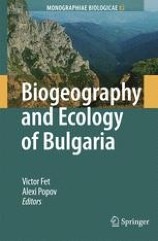
Biogeography and Ecology of Bulgaria
The book includes 22 chapters by 28 authors united by the single theme: biogeography and ecology of Bulgaria. From the single-celled organisms in the Black Sea sand to the endemic cave crustaceans, from the mountain glacial relict insects to the most diverse bird fauna in Europe, the unique fauna of Bulgaria has been a subject of study of mostly Bulgarian zoologists for more than a century. This is the first monograph in English broadly addressing all vertebrate and many key invertebrate groups of Bulgaria, their faunistics, origin, geographical and ecological distribution, and conservation issues are addressed by the experts on each group.
Biodiversity Conservation and Phylogenetic Systematics : Preserving our evolutionary heritage in an extinction crisis
This book brings an updated state of the art of phylogenetic diversity in conservation biology. Nineteen chapters written by scientists from research institutions of fourteen countries demonstrate that approaches for preserving the evolutionary heritage are now very tuned into human impacts and sustainability issues. The questions, methods and applications around which it is organized show the importance of phylogenetic diversity in avoiding biodiversity losses in the present extinction crisis. They touch important points such as the way we value phylogenetic diversity, the importance of thinking at a much wider sample of the Tree of Life, the choice of adequate measures. In methods section, new solutions, such as dealing with abundances, sampling effort, or with information coming from conflicting phylogenetic trees are provided. Application section includes study cases of different groups of organi
Aquatic Biodiversity II : The Diversity of Aquatic Ecosystems
The present book comprises a unique collection of primary research papers spanning a wide range of topics in aquatic biodiversity studies, and including a first global assessment of specific diversity of freshwater animals. The book also presents a section on the interaction between scientists and science policy managers
African Biodiversity : molecules, organisms, ecosystems
BIOTA is an interdisciplinary research project focusing on sustainable use and conservation of biodiversity in Africa (http://www.biote-africa.de). Session titles were Biogeography and Speciation Processes, Phylogenetic Patterns and Systematics, Diversity Declines and Conservation, and Applied Biodiversity Informatics
