



Page 7
Page 7

Magnesium Injection Molding
Injection molding of metallic alloys is a modern and environment-friendly technology with universal features, capable of implementing many conventional and novel processing methods based on semisolid and liquid routes. After its application to magnesium and recent commercialization, it is used to manufacture millions of light-weight, fully-recyclable components for various markets, including consumer electronics housings, automotive parts, sporting goods, household devices and office equipment.

Lead-free Soldering
The push toward lead-free soldering in computers, cell phones and other electronic and electrical devices has taken on a greater urgency as laws have been passed or are pending in the United States, the European Union and Asia which ban lead-bearing solder. These new restrictions on hazardous substances are changing the way electronic devices are assembled, and specifically affect process engineering, manufacturing and quality assurance. Lead-Free Soldering offers in a single volume a broad collection of practical techniques for lead-free soldering design and manufacture, which up to now have been scattered in difficult-to-find scholarly sources. The book includes the latest information on proposed changes to lead-free standards, and up-to-date analysis of government and legislative activities and regulations in North America, Europe and Asia.
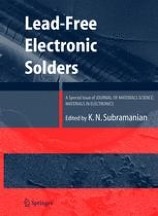
Lead-Free Electronic Solders : A Special Issue of the Journal of Materials Science : Materials in Electronics
In the last few decades the effect of lead contamination on human health has received significant attention. Based on such concerns, elimination of lead from ceramic glaze, paint, plumbing etc. has been legislated and implemented. However, until recently, solders used in electronics, based on suitability and knowledge-base developed over a long period of time, remained lead-based. Successive rapid advances in microelectronic devices in recent decades make them obsolete within a very short period after their introduction resulting in significant quantities of electronic wastes in landfills. Leaching of toxic lead from such electronic wastes can result in contamination of the human food chain causing serious health hazards. As a consequence, several European and Pacific Rim countries have passed legislations warranting elimination of lead from electronic solders by fast approaching deadlines. Global economic pressures brought on by such legislations have resulted in a flurry of research activities to find suitable lead-free substitutes for the traditional leaded electronic solders.

Laser Fabrication and Machining of Materials
Laser Fabrication and Machining of Materials introduces readers to the fundamental properties and physical phenomena of laser machining and its applications on the macro, micro, and nano scales. Examples of existing, emerging, and potential techniques are discussed, giving students and practicing engineers alike the opportunity to expand their use of lasers in such disciplines as mechanical processes, electronics, materials, and manufacturing.

Computational and Ambient Intelligence ; 9th International Work-Conference on Artificial Neural Networks, IWANN 2007, San Sebastián, Spain, June 20-22, 2007, Proceedings
This biennial meeting focuses on the foundations, theory, models and applications of systems inspired by nature (neural networks, fuzzy logic and evo- tionary systems).These new computational techniques are used in applications that try to bring a new situation of well-being to the user. The conjunction of a more and more miniaturized hardware together with the growing computational intelligence embodied in this hardware leads us towards fully integrated embedded systems-on- chip and opens the door for truly ubiquitous electronics.
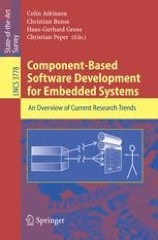
Component-Based Software Development for Embedded Systems : An Overview of Current Research Trends
Embedded systems are ubiquitous. They appear in cell phones, microwave ovens, refrigerators, consumer electronics, cars, and jets. Some of these embedded s- tems are safety- or security-critical such as in medical equipment, nuclear plants, and X-by-wire control systems in naval, ground and aerospace transportation - hicles. With the continuing shift from hardware to software, embedded systems are increasingly dominated by embedded software. Embedded software is complex. Its engineering inherently involves a mul- disciplinary interplay with the physics of the embedding system or environment. Embedded software also comes in ever larger quantity and diversity. The next generation of premium automobiles will carry around one gigabyte of binary code. The proposed US DDX submarine is e?ectively a ?oating embedded so- ware system, comprising 30 billion lines of code written in over 100 programming languages. Embedded software is expensive. Cost estimates are quoted at around US$15– 30 per line (from commencement to shipping). In the defense realm, costs can range up to $100, while for highly critical applications, such as the Space Shuttle, the cost per line approximates $1,000. In view of the exponential increase in complexity, the projected costs of future embedded software are staggering.

Complex-valued neural networks
This book is the first monograph ever on complex-valued neural networks, which lends itself to graduate and undergraduate courses in electrical engineering, informatics, control engineering, mechanics, robotics, bioengineering, and other relevant fields. It is useful for those beginning their studies, for instance, adaptive signal processing for highly functional sensing and imaging, control in unknown and changing environment, brainlike information processing, robotics inspired by human neural systems, and interdisciplinary studies to realize comfortable society. It is also helpful to those who carry out research and development regarding new products and services at companies.

Climate Change and Energy Pathways for the Mediterranean : Workshop Proceedings, Cyprus
This the workshop proceedings present an overview of the implications of climate change for the eastern Mediterranean and the impact of climate change response on regional economic activity, particularly in the hydrocarbon industry.
Challenges and Solutions for Sustainable Smart City Development
Discusses advances in smart and sustainable development of smart environments. The authors discuss the challenges faced in developing sustainable smart applications and provide potential solutions. The solutions are aimed at improving reliability and security with the goal of affordability, safety, and durability. Topics include health care applications, sustainable smart transportation systems, intelligent sustainable wearable electronics, and sustainable smart building and alert systems. Authors are from both industry and academia and present research from around the world. Addresses problems and solutions for sustainable development of smart cities; Includes applications such as healthcare, transportation, wearables, security, and more ; Relevant for scientist and researchers working on real time smart city development.

CFN Lectures on Functional Nanostructures : Vol.1
This book contains a selection of lectures from the first Summer School organized by the Center for Functional Nanostructures (CFN) at the University of Karlsruhe. The mission of the CFN is to carry out research in the following areas: nanophotonics, nanoelectronics, molecular nanostructures and nanostructured materials. The aim of the summer schools is mainly to exchange new ideas and illustrate emerging research methodologies through a series of lectures. This is reflected by both the selection of topics addressed in the present volume as well as the tutorial aspect of the contributions.

Carbon Nanotubes : Advanced Topics in the Synthesis, Structure, Properties and Applications
The carbon nanotubes field has evolved substantially since the publication of the bestseller "Carbon Nanotubes: Synthesis, Structure, Properties and Applications". The present volume builds on the generic aspects of the aforementioned book, which emphasizes the fundamentals, with the new volume emphasizing areas that have grown rapidly since the first volume, guiding future directions where research is needed and highlighting applications. The volume also includes an emphasis on areas like graphene, other carbon-like and other tube-like materials because these fields are likely to affect and influence developments in nanotubes in the next 5 years.
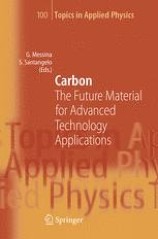
Carbon : The future material for advanced technology applications
Carbon-based materials and their applications constitute a burgeoning topic of scientific research among scientists and engineers attracted from diverse areas such as applied physics, materials science, biology, mechanics, electronics and engineering. Further development of current materials, advances in their applications, and discovery of new forms of carbon are the themes addressed by the frontier research in these fields. This book covers all the fundamental topics concerned with amorphous and crystalline C-based materials, such as diamond, diamond-like carbon, carbon alloys, carbon nanotubes. The goal is, by coherently progressing from growth - and characterisation techniques to technological applications for each class of material, to fashion the first comprehensive state-of-the-art review of this fast evolving field of research in carbon materials.

Broadband Opto-Electrical Receivers in Standard CMOS
Broadband Opto-Electrical Receivers in Standard CMOS starts from the basic fundamentals, necessary for the design of opto-electronic interface circuits. The book continues with an in-depth analysis of the photodiode, transimpedance amplifier (TIA) and limiting amplifier (LA). To thoroughly understand the light detection mechanisms in silicon, first a one-dimensional and second a two-dimensional model is developed. Analytical design equations are derived to guide the design of the amplifying circuits. For the TIA, the focus lies on the sensitivity-speed trade-off. For the LA, a high gain-bandwidth is pursued. Several practical design examples reveal the subtleties and challenges encountered during the design of high-performance analog circuits.

Brilliant light in life and material sciences
This book aim to create a synchrotron radiation facility, CANDLE, as an international laboratory for advanced research in life and material sciences. About 50 researchers from NATO, partner countries and Armenia gathered at Yerevan to discuss modern trends in developments of advanced light sources with high spectral brilliance and applications in basic and applied research in a wide range of fields. Research with high brilliant photon beams are used, for example for practical applications in pharmacy, electronics and nanotechnology. Such practical relevance promoted the design and construction of now more than 50 such facilities worldwide. Overview and specialized talks on the status and highlights of newly constructed light sources (ALBA, SPEAR3, European XFEL Facility, Siberian Synchrotron Radiation Center, CANDLE), on instrumentation and development of experimental techniques, and frontier research in life and material sciences using synchrotron radiation have been presented.
Bonding in Microsystem Technology
Bonding in Microsystem Technology starts with descriptions of terminology, kinds of microsystems and market analysis. Followed by the presentation of mechanisms of wet etching, set of process parameters, description of micromachining methods, examples of procedures, process flow-charts and applications of basic micromechanical structures in microsystems are shown. Next, high-temperature, low temperature and room-temperature bonding and their applications in microsystem technology are presented. The following part of the book contains the detailed description of anodic bonding, starting from analysis of properties of glasses suitable for anodic bonding, and discussion of the nature of the process. Next all types of anodic bonding and sealing procedures used in microsystem technology are presented.

Bionanotechnology : Proteins to Nanodevices
Bionanotechnology is the key integrative technology of the 21st century and aims to use the knowledge, gathered from the natural construction of cellular systems, for the advancement of science and engineering. Investigating the topology and communication processes of cell parts can lead to invention of novel biological devices with exciting applications. Though microscale to nanoscale research offers an excellent space for the development of futuristic technologies, a number of challenges must be overcome. Due to paucity of a dedicated literature on the protein based nanodevices we bring you this monograph that combines collective research works of scientists probing into this fascinating universe of bionanotechnology. The monograph has been written with an aim of surveying engineering design principles of biomolecular nanodevices, prototype nanodevices based on redox proteins, bacteriorhodopsins and natural fibers, and touching upon the future developments in the field.
Big data-enabled internet of things
Covers analytical techniques for handling the huge amount of data generated by the Internet of Things, from architectures and platforms to security and privacy issues, applications, and challenges as well as future directions. The fields of Big Data and the Internet of Things (IoT) have seen tremendous advances, developments, and growth in recent years. The IoT is the inter-networking of connected smart devices, buildings, vehicles and other items which are embedded with electronics, software, sensors and actuators, and network connectivity that enable these objects to collect and exchange data. The IoT produces a lot of data. Big data describes very large and complex data sets that traditional data processing application software is inadequate to deal with, and the use of analytical methods to extract value from data. This edited book covers analytical techniques for handling the huge amount of data generated by the Internet of Things, from architectures and platforms to security and privacy issues, applications, and challenges as well as future directions.

Axial flux permanent magnet brushless machines
This book deals with the analysis, construction, design, control and applications of AFPM machines. The authors present their own research results, as well as significant research contributions made by others.

Artificial immune systems ; 6th International Conference, ICARIS 2007, Santos, Brazil, August 26-29, 2007, Proceedings
This book contains sections on search and optimization, classification and clustering, anomaly detection and negative selection, robotics, control and electronics. Modeling papers, conceptual papers, and technical papers and general applications are also included.
Applied Physics of Carbon Nanotubes : Fundamentals of Theory, Optics and Transport Devices
The book describes the state-of-the-art in fundamental, applied and device physics of nanotubes, including fabrication, manipulation and characterization for device applications; optics of nanotubes; transport and electromechanical devices and fundamentals of theory for applications. This information is critical to the field of nanoscience since nanotubes have the potential to become a very significant electronic material for decades to come. The book will benefit all all readers interested in the application of nanotubes, either in their theoretical foundations or in newly developed characterization tools that may enable practical device fabrication.
