



Page 66
Page 66

Blockchains For Network Security : Principles, technologies and applications
Blockchain technology is a powerful, cost-effective method for network security. Essentially, it is a decentralized ledger for storing all committed transactions in trustless environments by integrating several core technologies such as cryptographic hash, digital signature and distributed consensus mechanisms. Over the past few years, blockchain technology has been used in a variety of network interaction systems such as smart contracts, public services, Internet of Things (IoT), social networks, reputation systems and security and financial services. With its widespread adoption, there has been increased focus on utilizing blockchain technologies to address network security concerns and vulnerabilities as well as understanding real-world security implications.
Blockchain : Empowering Secure Data Sharing
The book explains the security architecture model and the practice of building data sharing from the blockchain infrastructure, allowing readers to understand the importance of data sharing security based on the blockchain framework, as well as the threats to security and privacy. Further, by presenting specific data sharing case studies, it offers insights into solving data security sharing problems in more practical fields. The book is intended for readers with a basic understanding of the blockchain infrastructure, consensus mechanisms, smart contracts, secure multiparty computing, homomorphic encryption and image retrieval technologies.
Biomimetics for architecture & design : Nature - analogies - technology
Provides the readers with a timely guide to the application of biomimetic principles in architecture and engineering design. As a result of a combined effort by two internationally recognized authorities, the biologist Werner Nachtigall and the architect Göran Pohl, the book describes the principles which can be used to compare nature and technology, and at the same time it presents detailed explanations and examples showing how biology can be used as a source of inspiration and “translated” in building and architectural solutions (biomimicry). Even though nature cannot be directly copied, the living world can provide architects and engineers with a wealth of analogues and inspirations for their own creative designs. But how can analysis of natural entities give rise to advanced and sustainable design? By reporting on the latest bionic design methods and using extensive artwork, the book guides readers through the field of nature-inspired architecture, offering an extraordinary resource for professional architects, engineers, designers and urban planners, as well as for university teachers, researchers and students.
Bio-Materials & Prototyping Applications in Medicine
Bio-Materials and Prototyping Applications in Medicine focuses on bio-materials and prototyping applications in medical environments. The applications that ardiscussed integrate bio-materials, CAD, and physical prototyping techniques.
Biologically Inspired Approaches to Advanced Information Technology ; 2nd International Workshop, BioADIT 2006, Osaka, Japan 26-27, 2006, Proceedings
This book contains 30 articles and three abstracts of invited talks presented at The Second International Workshop on Biologically Inspired Approaches for Advanced Information Technology,The workshop is intended to provide an e?ective forum for original research results in the ?eld of bio-inspired approaches to advanced information technologies. It also serves to foster the connection between biological paradigms and solutions to building the next-generation information systems.
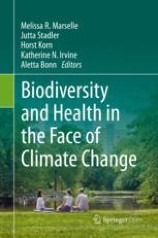
Biodiversity and health in the face of climate change
This book identifies and discusses biodiversity’s contribution to physical, mental and spiritual health and wellbeing. Furthermore, the book identifies the implications of this relationship for nature conservation, public health, landscape architecture and urban planning – and considers the opportunities of nature-based solutions for climate change adaptation. This transdisciplinary book will attract a wide audience interested in biodiversity, ecology, resource management, public health, psychology, urban planning, and landscape architecture. The emphasis is on multiple human health benefits from biodiversity - in particular with respect to the increasing challenge of climate change.
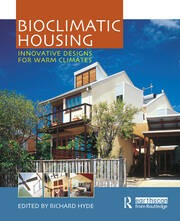
Bioclimatic housing : Innovative designs for warm climates
In the search for sustainable architecture, there is growing interest in the relationship between nature and design. In this context, Bioclimatic Housing covers creative, vernacular architecture to present both the theory and practice of innovative, low-energy architecture.The book interweaves the themes of social progress, technological fixes and industry transformation within a discussion of global and country trends, climate types, solutions and technologies. this is a truly international and authoritative work, providing an essential primer for building designers, builders, developers and advanced students in architecture and engineering.
Bio-based Building Skin
This book provides a compendium of material properties, demonstrates several successful examples of bio-based materials’ application in building facades, and offers ideas for new designs and novel solutions. It features a state-of-the-art review, addresses the latest trends in material selection, assembling systems, and innovative functions of facades in detail. Selected case studies on buildings from diverse locations are subsequently presented to demonstrate the successful implementation of various biomaterial solutions, which defines unique architectural styles and building functions. The structures, morphologies and aesthetic impressions related to bio-based building facades are discussed from the perspective of art and innovation; essential factors influencing the performance of materials with respect to functionality and safety are also presented. Special emphasis is placed on assessing the performance of a given facade throughout the service life of a building, and after its end.
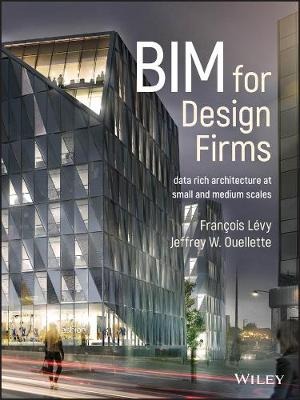
BIM for design firms : Data rich architecture at small and medium scales
Expands on Building Information Modeling, showing its applicability to a range of design-oriented projects. It emphasizes the full impact that a data modeling tool has on design processes, systems, and the high level of collaboration required across the design team. It also explains the quantitative analysis opportunities that BIM affords for sustainable design and for balancing competing design agendas, while highlighting the benefits BIM offers to designing in 3D for construction. The book concludes with a deep look at the possible future of BIM and digitally-enhanced design.
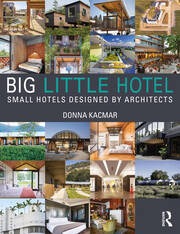
Big little hotel : Small hotels designed by architects
This book showcases small hotels, all located in the United States, designed by architects who use light and materials in interesting and intentional ways. The designs also deliberately connect to their local history, context, or land – in many cases all three. Both the architecture and the operations harmonize with the place, whether that is a bustling city, small town, or natural area. Many are new buildings but some are adaptive reuse projects or renovations of historic properties, extending the connectivity of the place into the future.
Big data-enabled internet of things
Covers analytical techniques for handling the huge amount of data generated by the Internet of Things, from architectures and platforms to security and privacy issues, applications, and challenges as well as future directions. The fields of Big Data and the Internet of Things (IoT) have seen tremendous advances, developments, and growth in recent years. The IoT is the inter-networking of connected smart devices, buildings, vehicles and other items which are embedded with electronics, software, sensors and actuators, and network connectivity that enable these objects to collect and exchange data. The IoT produces a lot of data. Big data describes very large and complex data sets that traditional data processing application software is inadequate to deal with, and the use of analytical methods to extract value from data. This edited book covers analytical techniques for handling the huge amount of data generated by the Internet of Things, from architectures and platforms to security and privacy issues, applications, and challenges as well as future directions.
Big Data Recommender Systems ; Vol.1 : Algorithms, Architectures, Big Data, Security and Trust
Combines experimental and theoretical research on big data recommender systems to help computer scientists develop new concepts and methodologies for complex applications. It includes original scientific contributions in the form of theoretical foundations, comparative analysis, surveys, case studies, techniques and tools.

Big Data – BigData 2020; 9th International Conference, Held as Part of the Services Conference Federation, SCF 2020, Honolulu, HI, USA, September 18-20, 2020, Proceedings
Constitutes the proceedings of the 9th International Conference on Big Data, BigData 2020, held as part of SCF 2020, during September 18-20, 2020. The conference was planned to take place in Honolulu, HI, USA and was changed to a virtual format due to the COVID-19 pandemic. The 16 full and 3 short papers presented were carefully reviewed and selected from 52 submissions. The topics covered are Big Data Architecture, Big Data Modeling, Big Data As A Service, Big Data for Vertical Industries (Government, Healthcare, etc.), Big Data Analytics, Big Data Toolkits, Big Data Open Platforms, Economic Analysis, Big Data for Enterprise Transformation, Big Data in Business Performance Management, Big Data for Business Model Innovations and Analytics, Big Data in Enterprise Management Models and Practices, Big Data in Government Management Models and Practices, and Big Data in Smart Planet Solutions.
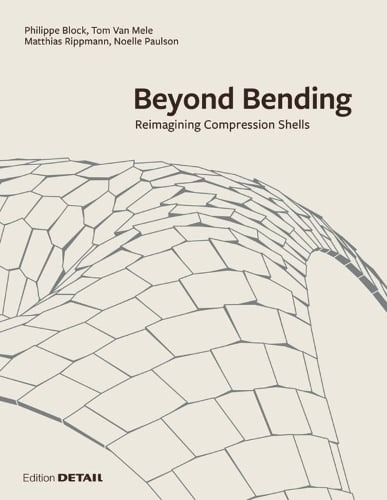
Beyond bending : Reimagining compression shells
The examination of old construction principles in combination with the development of new digital graphic construction methods leads to unusual ways in the design of self-supporting structures. Based on its Armadillo Vault, which was awarded at the Venice Biennale 2016, the Block Research Group of ETH Zurich describes development processes and visions of resource-saving, refined load-bearing structures without steel. The intensive examination of principles is fundamental.

Best of detail : Holz / wood
Brings together highlights from DETAIL about wood as a material. Besides a theoretical basis, the publication also offers a comprehensive section on projects, ranging from experiments to elaborate details, which provides abundant inspiration and examples of successful architectural design using wood.
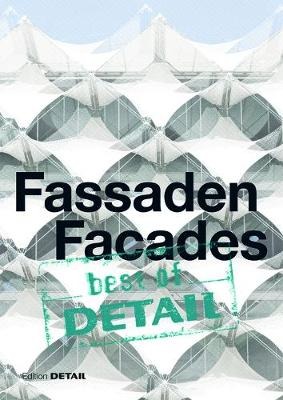
Best of Detail : Fassaden / Facades : Architectural highlights from DETAIL on the topic 'Facades' - best of DETAIL
The facade serves as the building's public face, allowing rapid assessment of its architecture. 'Best of Detail: Facades' explores this topic with theoretical discussions and an in-depth look at a range of selected projects, which, besides showcasing suitable materials and designs, give the reader a detailed look behind the scenes. It turns out that quality architecture can only result from a coherency between the facade, structure, internal organisation and building services design elements that interact directly with each other. This presents the architect with enormous challenges, particularly as the unity between the exterior and interior is no longer a given, as today's range of materials and design possibilities offer nearly limitless creativity.

Best of Detail : Beton / Concrete - Best of DETAIL
Presents highlights from the magazine published in recent years about concrete, a powerful medium for architectural expression. In additional to compelling specialist articles, this book contains a special section with a wide range of examples to inspire your own architectural practice, from train stations and churches to single-family homes
Beginning Database-Driven Application Development in Java EE : Using GlassFish™
The book explains in detail how you can organize your Java EE solution into a multilayer architecture, placing most emphasis on how to implement the persistence and database tiers of an application. Through many examples, this book shows how you can efficiently use the Java Persistence features available in the Java EE platform. Find out how you can greatly simplify the task of building the persistence layer of your Java EE application by moving some application logic into the underlying database, utilizing database views, stored programs, and triggers. The book also explains how to deploy Java EE applications to GlassFish, a free, open source Java EE 5–compliant application server.
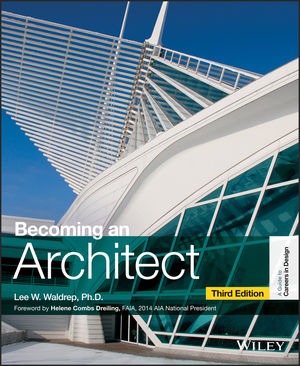
Becoming an Architect
Covers recent changes to the Intern Development Program (IDP) Provides advice on obtaining professional experience while studying to be an architect Considers career paths in a myriad of work environments, such as government agencies, education, and research Includes helpful appendixes with resources for further information, such as career-related associations, websites, and recommended reading
Bauhaus effects in art, architecture, and design
Bringing together an international team of scholars, this book offers new perspectives on the impact that the Bauhaus and its teaching had on a wide range of artistic practices.
