



Page 6
Page 6

Computational Intelligence in Multimedia Processing : Recent Advances
This book presents a large number of interesting applications to intelligent multimedia processing of various Computational Intelligence techniques, such as rough sets, Neural Networks; Fuzzy Logic; Evolutionary Computing; Artificial Immune Systems; Swarm Intelligence; Reinforcement Learning and evolutionary computation.

Computational intelligence in biomedicine and bioinformatics : Current trends and applications
The purpose of this book is to provide an overview of powerful state-of-the-art methodologies that are currently utilized for biomedicine and/ or bioinformatics-oriented applications, so that researchers working in those fields could learn of new methods to help them tackle their problems.

Computational intelligence for remote sensing
This book is a composition of different points of view regarding the application of Computational Intelligence techniques and methods to Remote Sensing data and applications. The book covers a broad range of topics, starting from the hardware design of hyperspectral sensors, and data handling problems, namely data compression and watermarking issues, as well as autonomous web services.

Computational intelligence ; Vol. 174 : Engineering of hybrid systems
Hybrid Intelligent Systems has become an important research topic in computer science and a key application field in science and engineering. This book offers a gentle introduction to the engineering aspects of hybrid intelligent systems, also emphasizing the interrelation with the main intelligent technologies such as genetic algorithms? evolutionary computation, neural networks, fuzzy systems, evolvable hardware, DNA computing, artificial immune systems. A unitary whole of theory and application, the book provides readers with the fundamentals, background information, and practical methods.
Linkage in Evolutionary Computation
The whole volume consisting of 19 chapters is divided into 3 parts: Models and Theories; Operators and Frameworks; Applications. This edited volume will serve as a useful guide and reference for researchers who are currently working in the area of linkage. For postgraduate research students, this volume will serve as a good source of reference. It is also suitable as a text for a graduate level course focusing on linkage issues.
Linear Genetic Programming
Linear Genetic Programming examines the evolution of imperative computer programs written as linear sequences of instructions. In contrast to functional expressions or syntax trees used in traditional Genetic Programming (GP), Linear Genetic Programming (LGP) employs a linear program structure as genetic material whose primary characteristics are exploited to achieve acceleration of both execution time and evolutionary progress.

Large-Scale Knowledge Resources. Construction and Application ; 3rd International Conference on Large-Scale Knowledge Resources, LKR 2008, Tokyo, Japan, March 3-5, 2008. Proceedings
At the start of the 21st century,we are now well on the way to wards aknowled- intensive society, in which knowledge plays ever more important roles. Thus, research interest should inevitably shift from information to knowledge, with the problems of building, organizing, maintaining and utilizing knowledge - coming centralissues in a wide varietyof felds. The 21stCentury COE program “Framework for Systematization and Application of Large-scale Knowledge - sources (COE-LKR)” conducted by the Tokyo Institute of Technology is one of several early attempts worldwide to address these important issues. Inspired by this project, LKR2008 aimed at bringing together diverse contributions in cognitive science, computer science, education and linguistics to explore design, construction, extension, maintenance, validation and application of knowledge.
Knowledge-Driven Computing : Knowledge Engineering and Intelligent Computations
Knowledge-Driven Computing constitutes an emerging area of intensive research located at the intersection of Computational Intelligence and Knowledge Engineering with strong mathematical foundations. It embraces methods and approaches coming from diverse computational paradigms, such as evolutionary computation and nature-inspired algorithms, logic programming and constraint programming, rule-based systems, fuzzy sets and many others. The use of various knowledge representation formalisms and knowledge processing and computing paradigms is oriented towards the efficient resolution of computationally complex and difficult problems.

Job Scheduling Strategies for Parallel Processing ; Vol. 3834 : 11th International Workshop, JSSPP 2005, Cambridge, MA, USA, June 19, 2005, Revised Selected Papers
Constitutes the refereed postproceedings of the 11th International Workshop on Job Scheduling Strategies for Parallel Processing, 2005, held in conjunction with the 19th ACM International Conference on Supercomputing. This book covers a range of parallel architectures, from distributed grids, through clusters, to massively-parallel supercomputers.

Computational and Ambient Intelligence ; 9th International Work-Conference on Artificial Neural Networks, IWANN 2007, San Sebastián, Spain, June 20-22, 2007, Proceedings
This biennial meeting focuses on the foundations, theory, models and applications of systems inspired by nature (neural networks, fuzzy logic and evo- tionary systems).These new computational techniques are used in applications that try to bring a new situation of well-being to the user. The conjunction of a more and more miniaturized hardware together with the growing computational intelligence embodied in this hardware leads us towards fully integrated embedded systems-on- chip and opens the door for truly ubiquitous electronics.
Complex Scheduling
This book deals with such complex scheduling problems and methods to solve them. It consists of three parts: The ?rst part (Chapters 1 and 2) contains a description of basic scheduling models with applications and an introduction into discrete optimization (covering complexity, shortest path algorithms, linear programming, network ?ow algorithms and general optimization methods). In the second part (Chapter 3) resource-constrained project scheduling problems are considered. Especially, methods like constraint propagation, branch-a- bound algorithms and heuristic procedures are described. Furthermore, lower bounds and general objective functions are discussed.
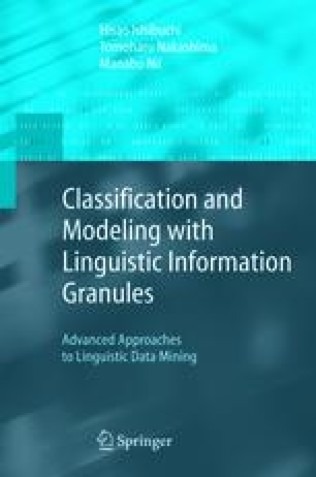
Classification and Modeling with Linguistic Information Granules : Advanced Approaches to Linguistic Data Mining
Many approaches have already been proposed for classification and modeling in the literature. These approaches are usually based on mathematical mod els. Computer systems can easily handle mathematical models even when they are complicated and nonlinear (e.g., neural networks). On the other hand, it is not always easy for human users to intuitively understand mathe matical models even when they are simple and linear. This is because human information processing is based mainly on linguistic knowledge while com puter systems are designed to handle symbolic and numerical information. A large part of our daily communication is based on words. We learn from various media such as books, newspapers, magazines, TV, and the Inter net through words. We also communicate with others through words. While words play a central role in human information processing, linguistic models are not often used in the fields of classification and modeling. If there is no goal other than the maximization of accuracy in classification and modeling, mathematical models may always be preferred to linguistic models. On the other hand, linguistic models may be chosen if emphasis is placed on interpretability.

Classification and Learning Using Genetic Algorithms : Applications in Bioinformatics and Web Intelligence
This book provides a unified framework that describes how genetic learning can be used to design pattern recognition and learning systems. The book is unique in the sense of describing how a search technique, the genetic algorithm, can be used for pattern classification mainly through approximating decision boundaries, and it demonstrates the effectiveness of the genetic classifiers vis-à-vis several widely used classifiers, including neural networks. It provides a balanced mixture of theories, algorithms and applications, and in particular results from the bioinformatics and Web intelligence domains.

Cellular Genetic Algorithms
CELLULAR GENETIC ALGORITHMS defines a new class of optimization algorithms based on the concepts of structured populations and Genetic Algorithms (GAs). The authors explain and demonstrate the validity of these cellular genetic algorithms throughout the book. This class of genetic algorithms is shown to produce impressive results on a whole range of domains, including complex problems that are epistatic, multi-modal, deceptive, discrete, continuous, multi-objective, and random in nature. The focus of this book is twofold. On the one hand, the authors present new algorithmic models and extensions to the basic class of Cellular GAs in order to tackle complex problems more efficiently. On the other hand, practical real world tasks are successfully faced by applying Cellular GA methodologies to produce workable solutions of real-world applications.
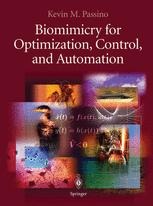
Biomimicry for Optimization, Control, and Automation
In this book, we focus onhowtousebiomimicryof the functionaloperationofthe “hardwareandso- ware” of biological systems for the development of optimization algorithms and feedbackcontrolsystemsthatextendourcapabilitiestoimplementsophisticated levels of automation. The primary focus is not on the modeling, emulation, or analysis of some biological system. The focus is on using “bio-inspiration” to inject new ideas, techniques, and perspective into the engineering of complex automation systems. There are many biological processes that, at some level of abstraction, can berepresentedasoptimizationprocesses,manyofwhichhaveasa basicpurpose automatic control, decision making, or automation.

Biologically Inspired Approaches to Advanced Information Technology ; 2nd International Workshop, BioADIT 2006, Osaka, Japan 26-27, 2006, Proceedings
This book contains 30 articles and three abstracts of invited talks presented at The Second International Workshop on Biologically Inspired Approaches for Advanced Information Technology,The workshop is intended to provide an e?ective forum for original research results in the ?eld of bio-inspired approaches to advanced information technologies. It also serves to foster the connection between biological paradigms and solutions to building the next-generation information systems.
Biologically Inspired Algorithms for Financial Modelling
Then Part I provides a thorough guide to the various bioinspired methodologies – neural networks, evolutionary computing (particularly genetic algorithms and grammatical evolution), particle swarm and ant colony optimization, and immune systems. Part II brings the reader through the development of market trading systems. Finally, Part III examines real-world case studies where BIA methodologies are employed to construct trading systems in equity and foreign exchange markets, and for the prediction of corporate bond ratings and corporate failures.
Bioinspired optimization methods and their applications ; 9th International conference, BIOMA 2020, Brussels, Belgium, November 19–20, 2020, Proceedings
This book constitutes the refereed proceedings of the 9th International Conference on Bioinspired Optimization Methods and Their Applications, BIOMA 2020, held in Brussels, Belgium, in November 2020. The 24 full papers presented in this book were carefully reviewed and selected from 68 submissions. The papers in this BIOMA proceedings specialized in bioinspired algorithms as a means for solving the optimization problems and came in two categories: theoretical studies and methodology advancements on the one hand, and algorithm adjustments and their applications on the other.

Bio-inspired modeling of cognitive tasks ; 2nd International Work-conference on the interplay between natural and artificial computation, IWINAC 2007, La Manga del Mar Menor, Spain, June 18-21, 2007, Proceedings, Part I
This volume includes all the contributions mainly related with theoretical, conceptual and methodological aspects linking AI and knowledge engineering with neurophysiology, clinics and cognition.
Autonomous Robots and Agents
This book deals with the theoretical and methodological aspects of incorporating intelligence in Autonomous Robots and Agents. Challenges faced in the real world to accomplish complex tasks, which require collaborative efforts, and methods to overcome them, are detailed. Several informative articles deal with navigation, localization and mapping of mobile robots, a problem that engineers and researchers are grappling with all the time.This edited volume is targeted to present the latest state-of-the-art methodologies in Robotics. It is a compilation of the extended versions of the very best papers selected from the many that were presented at the 3rd International Conference on Autonomous Robots and Agents (ICARA 2006) which was held at Palmerston North, New Zealand from 11-14 December, 2006. Scientists and engineers who work with mobile robots will find this book very useful and stimulating.
