



Page 6
Page 6

Mathematics and Democracy : Recent Advances in Voting Systems and Collective Choice
In this book, different quantitative approaches to the study of electoral systems have been developed: game-theoretic, decision-theoretic, statistical, probabilistic, combinatorial, geometric, and optimization ones. All the authors are prominent scholars from these disciplines. Quantitative approaches offer a powerful tool to detect inconsistencies or poor performance in actual systems. Applications to concrete settings such as EU, American Congress, regional, and committee voting are discussed.

Irreversible Decisions under Uncertainty : Optimal Stopping Made Easy
In real life, as well as in economic models, individuals often make decisions in an uncertain environment. In many cases, a problem which an optimizing agent faces can be formulated or reformulated as a problem of optimal timing of a certain irreversible or partially reversible action or optimal stopping problem. In this book, the authors present an alternative approach to optimal stopping problems. The basic ideas and techniques of the approach can be explained much simpler than the standard methods in the literature on optimal stopping problems. The monograph will teach the reader to apply the technique to many problems in economics and finance, including new ones. From the technical point of view, the method can be characterized as option pricing via the Wiener-Hopf factorization.

Iron metabolism : Methods and protocols
Explores classical and cutting-edge methods optimized and validated to analyze various aspects of iron metabolism, from in vitro to multi-organ level. Opening with a section on basic iron metabolism methods, the book continues with methods applicable to a variety of systems, ranging from bacteria to cultured mammalian cells and tissues, with a focus on cellular heme and iron-sulfur cluster species, as well as mitochondrial iron and its derivatives. Written for the highly successful Methods in Molecular Biology series, chapters include introductions to their respective topics, lists of the necessary materials and reagents, step-by-step and readily reproducible laboratory protocols, and tips on troubleshooting and avoiding known pitfalls.

IP Network-based Multi-agent Systems for Industrial Automation : Information Management, Condition Monitoring and Control of Power Systems
IP Network-based Multi-agent Systems for Industrial Automation is the first book to present an introduction to the use of the Internet protocol suite and multi-agent systems for the information management, online monitoring and control of distributed power system substations. An open architecture is proposed, in which mobile agents are applied to the retrieval and analysis of substation data, and to remote operator intervention. A prototype implementation of this architecture is also described, which has been demonstrated and evaluated using a substation simulator.

Investigative Electrocardiography in Epidemiological Studies and Clinical Trials
It reviews the prevalence and incidence and emphasizes the prognostic implications of common ECG abnormalities in contrasting populations. It provides a comprehensive, penetrating and critical analysis of topics such as QT prolongation in clinical drug trials, left ventricular hypertrophy, myocardial ischemia/infarction and epidemiological consideration of relative risks associated with ECG abnormalities. As such it is an essential tool in epidemiological or clinical research using ECGs and in investigations of possible adverse responses of new pharmacological agents.

Intuitive Human Interfaces for Organizing and Accessing Intellectual Assets ; International Workshop, Dagstuhl Castle, Germany, March 1-5, 2004, Revised Selected Papers
This book constitutes the thoroughly refereed post-proceedings of the 2004 International Workshop on Intuitive Human Interfaces for Organizing and Accessing Intellectual Assets, held in Dagstuhl Castle, Germany in March 2004. The 17 revised full papers presented together with an introductory overview have gone through two rounds of reviewing and revision. The papers are organized in topical sections on man-machine interface for intuitive knowledge access, intelligent pad and meme media, visualization and design of information access spaces, and semantics and narrative organization and access of knowledge.

Introduction to toxicology
Charts the evolution of the field of toxicology, from the use of natural toxins by ancient tribes through the developments established by Paracelsus, and progresses through to the current topics in the public interest. For centuries, the study of toxicology has fascinated students. The book begins with basic toxicological principles, including an historical summary, dose-response relationships (NEW chapter), exposure-response relationships (NEW chapter), disposition, and metabolism of xenobiotic toxic substances. Other important new chapters include target organ toxicity, toxicity of carcinogenic agents and new and updated concepts in toxicity testing, and antidotes and treatment of poisonings. In all, nine new or expanded chapters from the third edition are advanced. Current concerns about the effects of therapeutic drugs, carcinogens, industrial toxins, pesticides, and herbicides on human health, animal welfare, and the stability and maintenance of the ecosystem continue to highlight toxicology as an important and growing scientific discipline.

Introduction to basics of pharmacology and toxicology ; Vol.2 : Essentials of systemic pharmacology : From principles to practice
Describes the pharmacology of drugs acting on different systems in the human body Analyses various human diseases and the pharmacological agents governing them Provides a valuable reference resource for academicians, researchers, and clinical practitioners Offers a comprehensive overview of the pharmacology concerning the autonomic, central, and peripheral nervous systems. Presenting up-to-date information on chemical mediators and their significance, it highlights the therapeutic aspects of several diseases affecting the cardiovascular, renal, respiratory, gastrointestinal, endocrinal, and hematopoietic systems. The book also includes drug therapy for microbial and neoplastic diseases. It also comprises sections on immunopharmacology, dermatological, and ocular pharmacology providing valuable insights into these emerging and recent topics.

Internet and Network Economics ; Vol. 3828 : 1st International Workshop, WINE 2005, Hong Kong, China, December 15-17, 2005, Proceedings
Consists of the main program of 31 papers, of which the submitter email accounts are: 10 from edu (USA) accounts, 3 from hk (Hong Kong), 2 each from il (Isreal), cn (China), ch (Switzerland), de (Germany), jp (Japan), gr (Greece), 1 each from hp. com, sohu. com, pl (Poland), fr (France), ca (Canada), and in (India). In addition, 77 papers from 20 countries or regions and 6 dot. coms were selected for 16 special focus tracks in the areas of Internet and Algorithmic Economics; E-Commerce Protocols; Security; Collaboration, Reputation and Social Networks; Algorithmic Mechanism; Financial Computing; Auction Algorithms; Online Algorithms; Collective Rationality; Pricing Policies; Web Mining Strategies; Network Economics; Coalition Strategies; Internet Protocols; Price Sequence; Equilibrium.
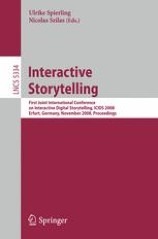
Interactive storytelling ; 1st Joint International Conference on interactive digital storytelling, ICIDS 2008 Erfurt, Germany, November 26-29, 2008 Proceedings
This book constitutes the refereed proceedings of the First Joint International Conference on Interactive Digital Storytelling, ICIDS 2008, held in Erfurt, Germany, in November 2008.The 19 revised full papers, 5 revised short papers, and 5 poster papers presented together with 3 invited lectures and 8 demo papers were carefully reviewed and selected from 62 submission. The papers are organized in topical sections on future perspectives on interactive digital storytelling, interactive storytelling applications, virtual characters and agents, user experience and dramatic immersion, architectures for story generation, models for drama management and interacting with stories, as well as authoring and creation of interactive narrative.

Intelligent Virtual Agents ; Vol.4133 ; 6th International Conference, IVA 2006, Marina Del Rey, CA; USA, August 21-23, 2006, Proceedings
This volume contains the proceedings of the 6th International Conference on Intelligent Virtual Agents, IVA 2006, held in Marina del Rey, California, USA from August 21–23.For the second year in a row,IVA also hosted the Gathering of Animated Lifelike Agents (GALA 2006), an annual festival to showcase the latest animated lifelike agents created by university students and academic or industrial research groups. IVA 2006 received 73 submissions from Europe, the AmericasandAsia.Thepaperspublishedherearethe24fullpapersand11short papers presented at the conference, as well as one-page descriptions of posters and the featured invited talks by Brian Parkinson of Oxford University, Rod Humble of Electronic Arts, and Michael Mateas of the University of California, Santa Cruz and Andrew Stern of Procedural Arts.

Intelligent Virtual Agents ; Vol.3661 : 5th International Working Conference, IVA 2005, Kos, Greece, September 12-14, 2005, Proceedings
The origin of the Intelligent Virtual Agents conference dates from a successful workshop on Intelligent Virtual Environments held in Brighton at the 13th European Conference on Artificial Intelligence (ECAI'98). This workshop was followed by a second one held in Salford in Manchester in 1999. Subsequent events took place in Madrid, Spain in 2001 and Irsee, Germany in 2003 and attracted participants from both sides of the Atlantic as well as Asia. th This volume contains the proceedings of the 5 International Working Conference on Intelligent Virtual Agents, IVA 2005, held on Kos Island, Greece, September 12–14, 2005, which highlighted once again the importance and vigor of the research field. A half-day workshop under the title “Socially Competent IVA’s: We are not alone in this (virtual) world!” also took place as part of this event. IVA 2005 received 69 submissions from Europe, North and South America, Africa and Asia. The papers published here are the 26 full papers and 14 short papers presented at the conference, as well as one-page descriptions of the 15 posters and the descriptions of the featured invited talks by Prof. Justine Cassell, of Northwestern University and Prof. Kerstin Dautenhahn, of the University of Hertfordshire. We would like to thank a number of people that have contributed to the success of this conference. First of all, we thank the authors for their high-quality work and their willingness to share their ideas.

Intelligent Virtual Agents ; 8th International Conference, IVA 2008, Tokyo, Japan, September 1-3, 2008. Proceedings
This book constitutes the refereed proceedings of the 8th International Workshop on Intelligent Virtual Agents, IVA 2008, held in Tokyo, Japan, in September 2008.The 18 revised full papers and 28 revised short papers presented together 42 poster papers were carefully reviewed and selected from 99 submissions. The papers are organized in topical sections on motion and empathy; narrative and augmented reality; conversation and negotiation; nonverbal behavior; models of culture and personality; markup and representation languages; architectures for robotic agents; cognitive architectures; agents for healthcare and training; and agents in games, museums and virtual worlds.

Intelligent Virtual Agents ; 7th International Working Conference, IVA 2007, Paris, France, September 17-19, 2007, Proceedings
The 19 revised full papers and 12 revised short papers presented together with five invited talks and the abstracts of 32 poster papers are organized in topical sections on rendering and analysis, culture and identity, behavior models, feedback models, dialogues, applications, evaluation, gaze models and emotions.

Intelligent Media Technology for Communicative Intelligence ; 2nd International Workshop, IMTCI 2004, Warsaw, Poland, September 13-14, 2004. Revised Selected Papers
The 2nd Workshop on Intelligent Media Technology for Communicative Intelligence commemorating the 10th anniversary of the Polish-Japanese Institute of Information Technology in Warsaw aimed to explore the current research topics in the ?eld of int- ligent media technologies for communicative intelligence. Communicative intelligence represents a new challenge towards building a sup- intelligence on the ubiquitous global network by accumulating a huge amount of - man andknowledgeresources.The term "communicativeintelligence"re?ects the view that communication is at the very core of intelligence and its creation. Communication permits novel ideas to emerge from intimate interactions by multiple agents, ranging from collaboration to competition. The recent advance of information and commu- cation technologies has established an information infrastructure that allows humans and artifacts to communicate with each other beyond space and time. It enables us to advance a step further to realize a communicative intelligence with many fruitful applications. Intelligentmediatechnologiesattempttocaptureandaugmentpeople’scommuni- tive activities by embedding computers into the environment to enhance interactions in an unobtrusive manner. The introduction of embodied conversational agents that might mediate conversations among people in a social context is the next step in the p- cess. The scope of intelligent media technologies includes design and development of intelligent supports for content production, distribution, and utilization, since rich c- tent is crucial for communication in many applications. The promising applications of intelligence media technologies include e-learning, knowledge management systems, e-democracy, and other communication-intensivesubject domains.

Intelligent information processingg II ; IFIP TC12/WG12.3 International Conference on Intelligent Information Processing (IIP2004) October 21-23, 2004, Beijing, China
This book is based on IIP2004, which provides a forum for engineers and scientists in academia, university and industry to present their latest research findings in any aspect of intelligent information processing. Papers on intelligence science, intelligent agents, machine learning, and autonomic computing, as well as papers that highlight bioinformatics, e-commerce, and business intelligence were presented. IIP2004 meets the needs of a large and diverse community.

Intelligent information processing III ; IFIP TC12 International Conference on Intelligent Information Processing (IIP 2006), September 20-23, Adelaide, Australia
The IFIP series publishes state-of-the-art results in the sciences and technologies of information and communication. The principal aim of the IFIP series is to encourage education and the dissemination and exchange of information about all aspects of computing.

Intelligent Distributed Computing, Systems and Applications ; Proceedings of the 2nd International Symposium on Intelligent Distributed Computing – IDC 2008, Catania, Italy, 2008
Addresses many topics related to intelligent and distributed computing, systems and applications, including: adaptivity and learning; agents and multi-agent systems; argumentation; auctions; case-based reasoning; collaborative systems; data structures; distributed algorithms; formal modeling and verification; genetic and immune algorithms; grid computing; information extraction, annotation and integration; network and security protocols; mobile and ubiquitous computing; ontologies and metadata; P2P computing; planning; recommender systems; rules; semantic Web; services and processes; trust and social computing; virtual organizations; wireless networks; XML technologies.

Intelligent decision-making support systems : Foundations, applications and challenges
The book brings together up-to-date information on the theory and application of i-DMSS. Readers will learn about the foundations, architectures, methods and strategies for successfully designing, developing, implementing, and evaluating intelligent Decision-making Support Systems. Intelligent Decision-making Support Systems: Foundations, Applications and Challenges will be of value to researchers in AI and management studies interested in the latest thinking in decision-making, as well practising managers and consultants who are involved with putting advanced information technologies into practice in organisations. The Decision Engineering series focuses on the foundations and applications of tools and techniques related to decision engineering, and identifies their relevance in ‘engineering’ decisions. The series provides an aid to practising professionals and applied researchers in the development of tools for informed operational and business decision making, within industry, by utilising distributed organisational knowledge.

Intelligent data engineering and automated Learning - IDEAL 2008 ; 9th International Conference Daejeon, South Korea, November 2-5, 2008 Proceedings
This book constitutes the refereed proceedings of the 9th International Conference on Intelligent Data Engineering and Automated Learning, IDEAL 2008, held in Daejeon, Korea, in November 2008.The 56 revised full papers presented together with 10 invited papers were carefully reviewed and selected from numerous submissions for inclusion in the book. The papers are organized in topical sections on learning and information processing, data mining and information management, bioinformatics and neuroinformatics, agents and distributed systems, as well as financial engineering and modeling.
