



Page 5
Page 5

Integration of Fuzzy Logic and Chaos Theory
Attempts to present some current research progress and results on the interplay of fuzzy logic and chaos theory. More specifically, this book includes a collection of some state-of-theart surveys, tutorials, and application examples written by some experts working in the interdisciplinary fields overlapping fuzzy logic and chaos theory.

Innovations in Machine Learning : Theory and Applications
Machine learning is currently one of the most rapidly growing areas of research in computer science. In compiling this volume we have brought together contributions from some of the most prestigious researchers in this field. This book covers the three main learning systems; symbolic learning, neural networks and genetic algorithms as well as providing a tutorial on learning casual influences. Each of the nine chapters is self-contained. Both theoreticians and application scientists/engineers in the broad area of artificial intelligence will find this volume valuable. It also provides a useful sourcebook for Postgraduate since it shows the direction of current research.

Innovations in Hybrid Intelligent Systems
Hybrid Artificial Intelligence Systems (HAIS) combines symbolic and sub-symbolic techniques to construct more robust and reliable problem solving models. This volume focused on "Hybrid Artificial Intelligence Systems" contains a collection of papers that were presented at the 2nd International Workshop on Hybrid Artificial Intelligence Systems, held in 12 - 13 November, 2007, Salamanca, Spain. This carefully edited book provides a comprehensive overview of the recent advances in the hybrid intelligent systems and covers a wide range of application areas, including data analysis and data mining, intelligent control, pattern recognition, robotics, optimization, etc. The book is aimed at researchers, practitioners and postgraduate students who are engaged in developing and applying advanced intelligent systems principles to solving real-world problems.

Innovations and Advanced Techniques in Computer and Information Sciences and Engineering
Innovations and Advanced Techniques in Computer and Information Sciences and Engineering is a collection of world class paper articles addressing the following topics: Signal and Image Processing: Content Based Video Retrieval, Character Recognition, Incremental Learning for Speech Recognition, Signal Processing Theory and Methods, and Vision-based Monitoring Systems. Software and Systems: Activity-Based Software Estimation, Algorithms, Genetic Algorithms, Information Systems Security, Programming Languages, Software Protection Techniques, Software Protection Techniques, and User Interfaces. Distributed Processing: Asynchronous Message Passing System, Heterogeneous Software Environments, Mobile Ad Hoc Networks, Resource Allocation, and Sensor Networks. Advanced and innovative techniques in computing: e-Science and Virtual Instrumentation, Fault-Tolerant Scheduling, Grid Computing, Microcracking in Cortical Bones, Service-oriented Architectures, and Virtualization in Data Warehouses.

Information Retrieval Technology ; Vol. 4182 ; 3rd Asia Information Retrieval Symposium, AIRS 2006, Singapore, October 16-18, 2006, Proceedings
Asia Information Retrieval Symposium (AIRS) 2006 was the third AIRS conf- ence in the series established in 2004.The ?rst AIRS washeld in Beijing, China, and the 2nd AIRS was held in Cheju, Korea. The AIRS conference series traces its roots to the successful Information Retrieval with Asian Languages (IRAL) workshop series which started in 1996. The AIRS series aims to bring together international researchers and dev- opers to exchange new ideas and the latest results in information retrieval. The scope of the conference encompassed the theory and practice of all aspects of information retrieval in text, audio, image, video, and multimedia data. Wearehappyto reportthatAIRS2006received148submissions,thehighest number since the conference series started in 2004. Submissions came from Asia and Australasia, Europe, and North America. We accepted 34 submissions as regular papers (23%) and 24 as poster papers (16%). We would like to thank all the authors who submitted papers to the conf- ence, the seven area chairs, who worked tirelessly to recruit the program c- mittee members and oversaw the review process, and the program committee members and their secondary reviewers who reviewed all the submissions.

Independent Component Analysis and Blind Signal Separation ; 6th International Conference, ICA 2006, Charleston, SC, USA, March 5-8, 2006, Proceedings
This book constitutes the refereed proceedings of the 6th International Conference on Independent Component Analysis and Blind Source Separation, ICA 2006, held in Charleston, SC, USA, in March 2006. The 120 revised papers presented were carefully reviewed and selected from 183 submissions. The papers are organized in topical sections on algorithms and architectures, applications, medical applications, speech and signal processing, theory, and visual and sensory processing.
Hybrid metaheuristics ; Vol. 4030 ; 3rd International Workshop, HM 2006, Gran Canaria, Spain, October 13-14, 2006, Proceedings
The selection of papers for HM 2006 consolidated some of the mainstream issues that have emerged from the past editions. Firstly, there are prominent examples of e?ective hybrid techniques whose design and implementation were motivated by challenging real-world applications. We believe this is particularly important for two reasons: on the one hand, researchers are conscious that the primary goal of developing algorithms is to solve relevant real-life problems; on the other hand, the path towarde?cient solving methods for practical problems is a source of new outstanding ideas and theories. A second important issue is that the research community on metaheur- tics has become increasingly interested in and open to techniques and methods known from arti?cial intelligence (AI) and operations research (OR). So far, the most representative examples of such integration have been the use of AI/OR techniques as subordinates of metaheuristic methods. As a historical and - ymological note, this is in perfect accordance with the original meaning of a metaheuristic as a “general strategy controlling a subordinate heuristic. ” The awareness of the need for a sound experimental methodology is a third keypoint.

Hybrid metaheuristics ; Vol. 3636 ; 2nd International Workshop, HM 2005, Barcelona, Spain, August 29-30, 2005. Proceedings
Constitutes the refereed proceedings of the Second International Workshop on Hybrid Metaheuristics, HM 2005, held in Barcelona, Spain, in August 2005. In this book, the papers addresses topics such as: low-level hybridization, high-level hybridization, portfolio techniques, expert systems, co-operative search, taxonomy, terminology, and more.

Hybrid metaheuristics ; 4th International Workshop,HM 2007, Dortmund, Germany, October 8-9, 2007, Proceedings
This book constitutes the refereed proceedings of the 4th International Workshop on Hybrid Metaheuristics, HM 2007, held in Dortmund, Germany. The 14 revised full papers discuss specific aspects of hybridization of metaheuristics, hybrid metaheuristics design, development and testing.

Hybrid Intelligent Systems for Pattern Recognition Using Soft Computing : An Evolutionary Approach for Neural Networks and Fuzzy Systems
This monograph describes new methods for intelligent pattern recognition using soft computing techniques including neural networks, fuzzy logic, and genetic algorithms. Hybrid intelligent systems that combine several soft computing techniques are needed due to the complexity of pattern recognition problems.

Hybrid Intelligent Systems : Analysis and Design
The objective of this edited volume is to offer a general view at the recent conceptual developments of Soft Computing (SC) regarded as a general methodology supporting the design of hybrid systems along with their diversified applications to modeling, simulation and control of non-linear dynamical systems. As of now, SC methodologies embrace neural networks, fuzzy logic, genetic algorithms and chaos theory. Each of these methodologies exhibits well delineated advantages and disadvantages. Interestingly, they have been found useful in solving a broad range of problems. However, many real-world complex problems require a prudent, carefully orchestrated integration of several of these methodologies to fully achieve the required efficiency, accuracy, and interpretability of the solutions. In this edited volume, an overview of SC methodologies, and their applications to modeling, simulation and control, will be given in an introductory paper by the Editors. Then, detailed methods for integrating the different SC methodologies in solving real-world problems will be given in the papers by the other authors in the book. The edited volume will cover a wide spectrum of applications including areas such as: robotic dynamic systems, non-linear plants, manufacturing systems, and time series prediction.
Hybrid Evolutionary Algorithms
Hybridization of evolutionary algorithms is getting popular due to their capabilities in handling several real world problems involving complexity, noisy environment, imprecision, uncertainty and vagueness. This edited volume is targeted to present the latest state-of-the-art methodologies in ’Hybrid Evolutionary Algorithms’. This book deals with the theoretical and methodological aspects, as well as various applications to many real world problems from science, technology, business or commerce. This volume comprises of 14 chapters including an introductory chapter giving the fundamental definitions and some important research challenges. Chapters were selected on the basis of fundamental ideas/concepts rather than the thoroughness of techniques deployed.
High performance computing ; 4th International Symposium, ISHPC 2002, Kansai Science City, Japan, May 15-17, 2002. Proceedings
The objective of this symposium is to exchange the latest research results in software, architecture, and applications in HPC in a more informal and friendly atmosphere. I am delighted that the symposium is, like past successful ISHPCs, comprised of excellent invited talks, panels, workshops, as well as high-quality technical papers on various aspects of HPC. We hope that the symposium will provide an excellent opportunity for lively exchange and discussion about - rections in HPC technologies and all the participants will enjoy not only the symposium but also their stay in Kansai Science City.

Hierarchical Bayesian Optimization Algorithm : Toward a New Generation of Evolutionary Algorithms
This book provides a framework for the design of competent optimization techniques by combining advanced evolutionary algorithms with state-of-the-art machine learning techniques. The book focuses on two algorithms that replace traditional variation operators of evolutionary algorithms by learning and sampling Bayesian networks: the Bayesian optimization algorithm (BOA) and the hierarchical BOA (hBOA). BOA and hBOA are theoretically and empirically shown to provide robust and scalable solution for broad classes of nearly decomposable and hierarchical problems. A theoretical model is developed that estimates the scalability and adequate parameter settings for BOA and hBOA. The performance of BOA and hBOA is analyzed on a number of artificial problems of bounded difficulty designed to test BOA and hBOA on the boundary of their design envelope.

Hardware and software : Verification and testing ; 1st International Haifa Verification Conference, Haifa, Israel, November 13-16, 2005, Revised Selected Papers
The First Haifa Verification Conference was held at the IBM Haifa Research Lab and at the Haifa University in Israel from November 13 to16, 2005. The conference incorporated three different workshops that took place separately in previous years. The IBM Verification Workshop is now its sixth year, the IBM Software Testing Workshop is now in its fourth year, and the PADTAD Workshop on testing and debugging multi-threaded and parallel software was held for the third time. The Verification Conference was a three-day, single-track conference followed by a one-day tutorial on the testing and review of multi-threaded code. The conference presented a unique combination of fields that brought together the hardware and software testing communities. Merging the different communities under a single roof gave the conference a distinctive flavor and provided the participants with added benefits. While the applications in these separate fields are different, the techniques used are often very similar. By offering lectures in these disparate but related disciplines, the conference engendered an environment of collaboration and discovery.

Genetic Systems Programming : Theory and Experiences
This book is devoted to reporting innovative and significant progress about the contribution of genetic programming in systems programming. The contributions of this book clearly demonstrate that genetic programming is very effective in solving hard and yet-open problems in systems programming. Followed by an introductory chapter, in the remaining contributed chapters, the reader can easily learn about systems where genetic programming can be applied successfully. These include but are not limited to, information security systems, compilers, data mining systems, stock market prediction systems, robots and automatic programming.

Genetic rogramming ; Vol. 3447 : 8th European conference, EuroGP 2005, Lausanne, Switzerland, March 30-April 1, 2005, Proceedings
In this volume we present the contributions for the 18th European Conference on Genetic Programming (EuroGP 2005). The conference took place from 30 March to 1 April in Lausanne, Switzerland. EuroGP is a well-established conf- ence and the only one exclusively devoted to genetic programming. All previous proceedings were published by Springer in the LNCS series. From the outset, EuroGP has been co-located with the EvoWorkshops focusing on applications of evolutionary computation. Since 2004, EvoCOP, the conference on evolutionary combinatorial optimization, has also been co-located with EuroGP, making this year’s combined events one of the largest dedicated to evolutionary computation in Europe. Genetic programming (GP) is evolutionary computation that solves complex problems or tasks by evolving and adapting a population of computer programs, using Darwinian evolution and Mendelian genetics as its sources of inspiration. Some of the 34 papers included in these proceedings address foundational and theoretical issues and there is also a wide variety of papers dealing with di?erent application areas, such as computer science, engineering, language processing, biology and computational design, demonstrating that GP is a powerful and practical problem-solving paradigm.
Genetic Programming Theory and Practice IV
Genetic Programming Theory and Practice IV was developed from the fourth workshop at the University of Michigan’s Center for the Study of Complex Systems to facilitate the exchange of ideas and information related to the rapidly advancing field of Genetic Programming (GP). Contributions from the foremost international researchers and practitioners in the GP arena examine the similarities and differences between theoretical and empirical results on real-world problems.
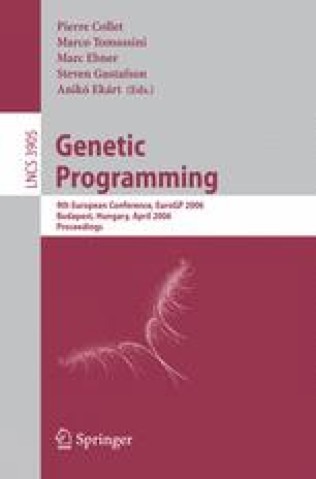
Genetic Programming ; Vol. 3905 ; 9th European Conference, EuroGP 2006, Budapest, Hungary, April 10-12, 2006. Proceedings
This book constitutes the refereed proceedings of the 9th European Conference on Genetic Programming, EuroGP 2006, held in Budapest, Hungary, in April 2006, colocated with EvoCOP 2006. The 21 revised plenary papers and 11 revised poster papers were carefully reviewed and selected from 59 submissions. The papers address fundamental and theoretical issues, along with a wide variety of papers dealing with different application areas, such as computer science, engineering, machine learning, Kolmogorov complexity, biology and computational design.

Genetic algorithms: theory, design and programming
We present a series of scientific contributions that delve into the intricate theoretical foundations and practical nuances of genetic algorithms (GAs). Beyond the academic realm, GAs have demonstrated profound applications in societal decision-making and engineering optimization, showcased through real-world examples and case studies. A dedicated section on programming principles offers a thorough guide for implementing GAs across diverse languages. This edition, tailored for researchers and academics, serves as a testament to the scientific advancements within the field, inviting readers to explore the nuanced journey from theoretical constructs to pragmatic applications in the dynamic landscape of GAs.
