



Page 44
Page 44
Alpha-1 antitrypsin : Methods and protocols
Provides a collection of protocols that will allow researchers to further explore the multiple, fascinating activities of Alpha-1 Antitrypsin (AAT) isoforms in innate immunity, and gene therapy. Written in the highly successful Methods in Molecular Biology series format, chapters include introductions to their respective topics, lists of the necessary materials and reagents, step-by-step, readily reproducible laboratory protocols, and tips on troubleshooting and avoiding known pitfalls.
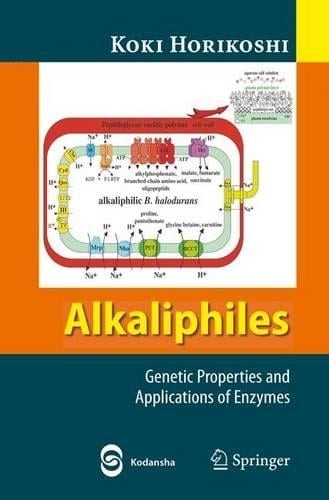
Alkaliphiles : Genetic properties and applications of enzymes
The pioneering work of Dr. Koki Horikoshi on the discovery, research and applications of alkaliphilic bacteria are described here in their entirety. The isolation, distribution and taxonomy of alkaliphilic microorganisms as well as their cell structure and physiology are discussed for a basic understanding of these entities. The molecular biology and genome sequencing of some alkaliphilic bacterial strains are also presented. Part II of the volume focuses on enzymes of alkaliphiles and their applications. These include alkaline proteases, starch-degrading enzymes and numerous others. Some of these enzymes are currently in wide commercial use as laundry detergent additives and in wastewater treatment. Alkaliphiles are a relatively recent field of research that will no doubt provide avenues to a wide range of further discoveries and applications for a new generation of workers in bioscience and technology.

Algorithms in Bioinformatics ; Vol. 3692 ; 5th international workshop, WABI 2005, Mallorca, Spain, October 3-6, 2005, Proceedings
this book present the proceedings of the 5th Workshop on Algorithmsin Bioinformatics (WABI 2005) which took place in Spain, 2005. The Workshop on Algorithms in Bioinformatics highlights research workspecifically developed to address algorithmic problems in biosequence analysis. The emphasis is therefore on statistical and probabilistic algorithms that addressimportant problems in the field of molecular and structural biology. the workshop aims to present recent research results, includingsignificant work in progress, and to identify and explore directions of futureresearch.Original research papers (including significant work in progress) or state-of-the-art surveys were solicited on all aspects of algorithms in bioinformatics,including, but not limited to: exact and approximate algorithms for genomics,genetics, sequence analysis, gene and signal recognition, alignment, molecularevolution, phylogenetics, structure determination or prediction, gene expressionand gene networks, proteomics, functional genomics, and drug design.
Algorithms in Bioinformatics ; 8th International Workshop, WABI 2008, Karlsruhe, Germany, September 15-19, 2008. Proceedings
This book constitutes the refereed proceedings of the 8th International Workshop on Algorithms in Bioinformatics, WABI 2008, held in Karlsruhe, Germany, in September 2008 as part of the ALGO 2008 meeting.
Algorithms in Bioinformatics : Theory and Implementation
Explores a comprehensive and insightful treatment of the practical application of bioinformatic algorithms in a variety of fields. Delivers a fulsome treatment of some of the main algorithms used to explain biological functions and relationships. It introduces readers to the art of algorithms in a practical manner which is linked with biological theory and interpretation. The book covers many key areas of bioinformatics, including global and local sequence alignment, forced alignment, detection of motifs, Sequence logos, Markov chains or information entropy. Other novel approaches are also described, such as Self-Sequence alignment, Objective Digital Stains (ODSs) or Spectral Forecast and the Discrete Probability Detector (DPD) algorithm. Readers will also benefit from the inclusion of: A detailed presentation of new methods, such as Self-sequence alignment, Objective Digital Stains and Spectral Forecast ; A treatment of sequence alignment, including local sequence alignment, global sequence alignment and forced sequence alignment with full implementations ; Discussions of position-specific weight matrices, including the count, weight, relative frequencies, and log-likelihoods matrices ; A detailed presentation of the methods related to Markov Chains as well as a description of their implementation in Bioinformatics and adjacent fields ; An examination of information and entropy, including sequence logos and explanations related to their meaning ; A chapter on philosophical transactions that allows the reader a broader view of the prediction process ; Extensive worked examples with detailed case studies that point out the meaning of different results

Algorithms and computation ; Vol. 4288: 17th International symposium, ISAAC 2006, Kolkata, India, December 18-20, 2006, Proceedings
This book constitutes the refereed proceedings of the 17th International Symposium on Algorithms and Computation, ISAAC 2006, held in Kolkata, India in December 2006. The 73 revised full papers presented were carefully reviewed and selected from 255 submissions. The papers are organized in topical sections on algorithms and data structures, online algorithms, approximation algorithm, graphs, computational geometry, computational complexity, network, optimization and biology, combinatorial optimization and quantum computing, as well as distributed computing and cryptography.

Algorithms and computation ; Vol. 3827 ; 16th International symposium, ISAAC 2005, Sanya, Hainan, China, December 19-21, 2005, Proceedings
This book constitutes the refereed proceedings of the 16th International Symposium on Algorithms and Computation, ISAAC 2005, held in China in 2005. The 112 revised full papers presented were carefully reviewed and selected from 549 submissions. The papers are organized in topical sections on computational geometry, computational optimization, graph drawing and graph algorithms, computational complexity, approximation algorithms, internet algorithms, quantum computing and cryptography, data structure, computational biology, experimental algorithm mehodologies and online algorithms, randomized algorithms, parallel and distributed algorithms, graph drawing and graph algorithms, computational complexity, combinatorial optimization, computational biology, computational complexity, computational optimization, computational geometry, approximation algorithms, graph drawing and graph algorithms, computational geometry, approximation algorithms, graph drawing and graph algorithms, and data structure.

Algorithms and computation ; 18th International symposium, ISAAC 2007, Sendai, Japan, December 17-19, 2007, Proceedings
This book presented algorithms and data structures, online algorithms, approximation algorithm, graphs, computational geometry, computational complexity, network, optimization and biology, combinatorial optimization and quantum computing, as well as distributed computing and cryptography.

Algorithms and Complexity ; 6th Italian Conference, CIAC 2006, Rome, Italy, May 29-31, 2006, Proceedings
Here are the refereed proceedings of the 6th Italian Conference on Algorithms and Computation, CIAC 2006. The 33 revised full papers presented together with 3 invited papers address such topics as sequential, parallel and distributed algorithms, data structures, approximation algorithms, randomized algorithms, on-line algorithms, graph algorithms, analysis of algorithms, algorithm engineering, algorithmic game theory, computational biology, computational complexity, communication networks, computational geometry, cryptography, discrete optimization, graph drawing, mathematical programming, and quantum algorithms.
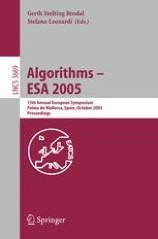
Algorithms – ESA 2005 ; 13th Annual European Symposium, Palma de Mallorca, Spain, October 3-6, 2005, Proceedings
This volume contains the 75 contributed papers and the abstracts of the threeinvited lectures presented at the 13th Annual European Symposium on Algo-rithms (ESA 2005), held in Spain, 2005. respectively.Papers were solicited in all areas of algorithmic research, including but notlimited to algorithmic aspects of networks, approximation and on-line algo-rithms, computational biology, computational geometry, computational financeand algorithmic game theory, data structures, database and information re-trieval, external memory algorithms, graph algorithms, graph drawing, machinelearning, mobile computing, pattern matching and data compression, quantumcomputing, and randomized algorithms. The algorithms could be sequential,distributed, or parallel. Submissions were especially encouraged in the area ofmathematical programming and operations research, including combinatorialoptimization, integer programming, polyhedral combinatorics, and semidefiniteprogramming.Each extended abstract was submitted to one of the two tracks.

Algorithmic Foundation of Robotics VII : Selected Contributions of the 7th International Workshop on the Algorithmic Foundations of Robotics
This book contains the proceedings from the 2006 Workshop on the Algorithmic Foundations of Robotics. The 32 papers in this book span a wide variety of topics: from fundamental motion planning algorithms to applications in medicine and biology, but they have in common a foundation in the algorithmic problems of robotic systems.
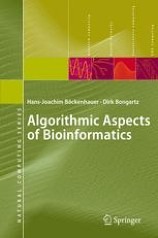
Algorithmic Aspects of Bioinformatics
Advances in bioinformatics and systems biology require improved computational methods for analyzing data, while progress in molecular biology is in turn influencing the development of computer science methods. This book introduces some key problems in bioinformatics, discusses the models used to formally describe these problems, and analyzes the algorithmic approaches used to solve them. After introducing the basics of molecular biology and algorithmics, Part I explains string algorithms and alignments; Part II details the field of physical mapping and DNA sequencing; and Part III examines the application of algorithmics to the analysis of biological data. Exciting application examples include predicting the spatial structure of proteins, and computing haplotypes from genotype data. This book describes topics in detail and presents formal models in a mathematically precise, yet intuitive manner, with many figures and chapter summaries, detailed derivations, and examples. It is well suited as an introduction into the field of bioinformatics, and will benefit students and lecturers in bioinformatics and algorithmics, while also offering practitioners an update on current research topics.
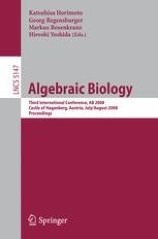
Algebraic Biology ; 3rd International Conference, AB 2008, Castle of Hagenberg, Austria, July 31-August 2, 2008 Proceedings
This book constitutes the refereed proceedings of the Third International Conference on Algebraic Biology, AB 2008, held at the Castle of Hagenberg, Austria in July 2008 as part of the RISC Summer 2008, organized by the Research Institute for Symbolic Computation.
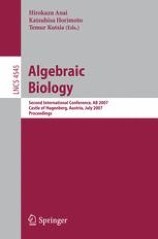
Algebraic Biology ; 2nd International Conference, AB 2007, Castle of Hagenberg, Austria, July 2-4, 2007, Proceedings
This volume constitutes the refereed proceedings of the Second International Conference on Algebraic Biology. The conference served as an interdisciplinary forum for the presentation of research on all aspects of the application of symbolic computation in biology, including computer algebra, computational logic, and related methods.

Algal Toxins : Nature, Occurrence, Effect and Detection
This volume contains the lectures and seminars given at the NATO Advanced Study Institute on “Sensor Systems for Biological Threads: The Algal Toxins Case”, held in Pisa, Italy in October, 2007. Algae can form heavy growths in ponds, lakes, reservoirs and sl- moving rivers throughout the world; algae can house toxins which are - ually released into water when the cells rupture or die. Hundreds of toxins have been identified so far. Detection methods, including rapid screening, have been developed to help us learning more about them, especially to find out which toxins are a real threat for people and what conditions encourage their production and accumulation. Early detection of algal toxins is an - portant aspect for public safety and natural environment, and significant efforts are underway to develop effective and reliable tools that can be used for this purpose.
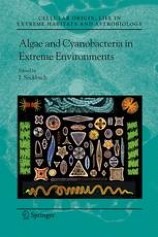
Algae and Cyanobacteria in Extreme Environments
ALGAE AND CYANOBACTRIA IN EXTREME ENVIRONMENTS is a unique collection of essays, contributed by leading scientists from around the world, devoted to algae – and some related microbes – observed in unexpected harsh habits, which it seems are an oasis or Garden of Eden for these organisms. This timely book on Extremophilic alga, including its especially impressive micrographs, may provide clues about the edges of life on Earth and possibly elsewhere in the universe. This volume is a must for students of the field of biodiversity, as well as those in Phycology, ecology and general biological research.

Alcohol problems in adolescents and young adults : Epidemiology. neurobiology. prevention. and treatment
Alcohol continues to be the substance of choice for today’s youth, leading to serious physical, psychological, and social consequences. Alcohol Problems in Adolescents and Young Adults ably addresses this growing trend. The latest entry in the Recent Developments in Alcoholism series, it comprehensively presents a wide-ranging clinical picture of teen drinking - epidemiology, neurobiology, behavioral phenomena, diagnostic and assessment issues, prevention and treatment data - in a developmental context. Fifty expert contributors display the scientific rigor, practical wisdom, and nuanced analysis that readers have come to expect from previous volumes.

AIDS-Associated Viral Oncogenesis
AIDS-associated viral oncology is a significant healthcare problem. Since the identification of human immunodeficiency virus (HIV)-associated acquired immune disease syndrome (AIDS), the role of viruses in human cancers has become acutely apparent over the past twenty years. The understanding and treatment of AIDS-associated cancers has become a major concern among healthcare organizations. Human cancers that were once rare in the population have now become common within the HIV infected population.
Agrobacterium : From Biology to Biotechnology
Agrobacterium’ is a comprehensive book on Agrobacterium research, including its history, application, basic biology discoveries, and effects on human society. Although the book largely focuses on providing a detailed review of virtually all molecular events of the genetic transformation process, it also provides coverage of ethical and legal issues relevant to the use of Agrobacterium as a "genetic transformation machine". The result is an all-inclusive text which readers—including scientists and students involved in plant genetic engineering—will find useful as a reference source for all major aspects of the Agrobacterium-mediated genetic transformation of plant and non-plant organisms.

Aging and Senescence
Aging is characterized by a progressive loss of physiological integrity, leading to impaired function and increased vulnerability to death. This deterioration is the primary risk factor for major human pathologies, including cancer, diabetes, cardiovascular disorders, and neurodegenerative diseases. Aging research has experienced an unprecedented advance over recent years, particularly with the discovery that the rate of aging is controlled, at least to some extent, by genetic pathways and biochemical processes conserved in evolution. Although recent developments in molecular biology are far from understanding the biological basis of aging, research suggests that targeting the aging process itself could ameliorate many age-related pathologies.
